
Donald Trump's inauguration happened slap bang in the middle of last year’s World Economic Forum, his return to the White House both exciting US chief executives and worrying European leaders in equal measure.
Addressing Davos invitees by videolink, the US President gave a flavour of what was to come: every global company should invest in America or face tariffs, NATO countries should spend 5% of GDP on defence, Ukraine was ready to do a peace deal, the EU had been ripping off the United States for years thanks to its trade surplus.
The bitterest gripe about the EU was that it had thwarted the building of a fence at his golf links in Doonbeg, Co Clare (not true).
Twelve months on, that teaser has not done justice to the wrecking ball Mr Trump has taken to global trade, to respect for territorial integrity and to presidential and legal norms.
If Davos is the kumbaya citadel of global trade and togetherness, then it should represent everything MAGA hates: yet, Mr Trump is coming, with the biggest ever US delegation, including Secretary of State Marco Rubio and special envoy Steve Witkoff.
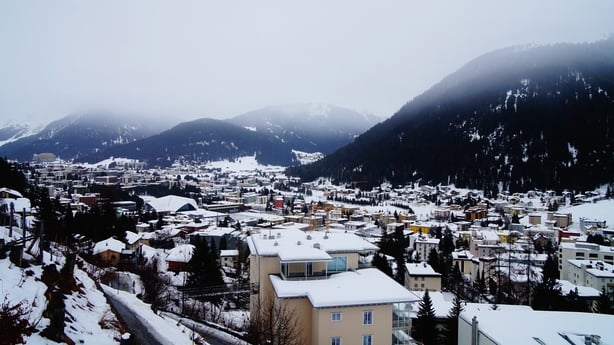
Indeed, the World Economic Forum (WEF) looks like it is having a bumper year like no other, as if the collapse of normal trading relations and a rampant increase in threats to geopolitical stability have forced a displacement to the Swiss Alps out of sheer desperation.
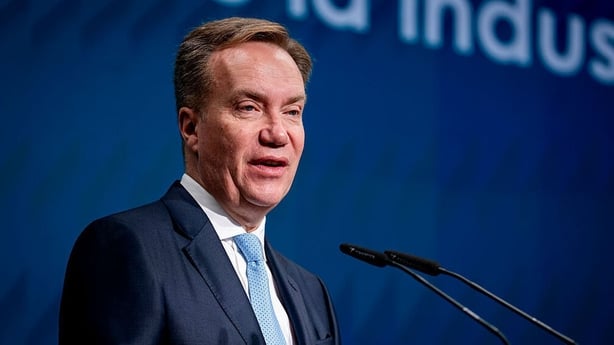
"There is historic record participation," says WEF Chief Executive Børge Brende.
The truth may be more to do with changes at the top of the WEF hierarchy.
For decades, the organisation’s founder Klaus Schwab was the ultimate grandee of the Davos set, cajoling the global elite to make the pilgrimage, and conducting interviews on stage in his gravely and heavily accented voice.
Mr Schwab resigned in April last year, following an investigation into WEF’s workplace culture (he was later cleared by the board) and was replaced by Larry Fink, the chair and CEO of the US investment giant BlackRock.
Mr Fink has turned out to be the ultimate powerbroker, reportedly singlehandedly convincing President Trump to return to Davos for the first time since 2019. He has managed to invite Jensen Huang, CEO and founder of the leading AI chip manufacturer NVIDIA (market capitalisation $5 trillion) who will make his first appearance.
Mr Fink will also personally interview JPMorgan boss Jamie Dimon and Microsoft CEO Satya Nadella on stage.
Choppering and limo-ing their way to the ski resort will be more than 3,000 participants from 130 countries, including 64 heads of state or government (including six of the G7 leaders, and Taoiseach Micheál Martin), 1,700 business people, including 850 chief executives and chairs of leading companies.
"We will have a hard look at Iran, Gaza, Ukraine, and also Latin America, and what we're seeing in Venezuela."
There will be 60 ministers of finance, 30 trade ministers, more than 30 foreign ministers, and 15 EU commissioners, including Ireland’s Michael McGrath. The biggest ever delegations from the Gulf, China, Asia and Africa will also be descending on Davos.
There will be 150 academics and heads of think-tanks, and 10 Nobel Prize winners.
Yet, that sense of can-do collaboration to tackle global problems appears entirely at odds with the zeitgeist.
The WEF’s annual global risks survey, published this week, noted that "geoeconomic confrontation" had moved to the top of the list of chief executive concerns, up eight places from last year, with just under a fifth saying economic rivalries were most likely to trigger a crisis this year.
Armed conflict between states was ranked as the second-biggest threat (the survey was done before the United States attacked Venezuela, abducting President Maduro, and before Mr Trump declared he would take Greenland "the hard way" if need be).
Undeterred, the WEF organisers believe the forum is needed more than ever, even when confronting the most acute crises. "We will have a hard look at Iran, Gaza, Ukraine, and also Latin America, and what we're seeing in Venezuela," Mr Brende told a pre-Davos briefing.
While critics of the snowy love-in - with its weird cocktail of thought leaders, spiritual gurus, tech utopians, corporate billionaires, climate activists, trade union leaders and anti-poverty campaigners - question the merits (or even morality) of Davos, its defenders say it offers an unrivalled way of taking big-picture challenges and then throwing power, money and expertise at them.
"At the core of the annual meeting programme is the notion that we operate in a new economic reality where geopolitics, exponential innovation, the concepts of economic, societal, environmental resilience are deeply intertwined, and they're also interacting with each other at a rapid clip," says WEF Managing Director Mirek Dušek.
"We need to figure out how we are going to trade with each other in the future."
Challenges broken down into themes
This year’s challenges have been broken down into five themes: how to revive growth, geopolitical threats, AI innovation, how to invest in people and how to build resilience in the sphere of nature, water and climate.
The schedule does not shy away from the harsh new realities of Trump world. Under the heading "How can we cooperate in a more contested world?" there are plenty of panel discussions on the threats to global trade, not least when tariffs are weaponised to boost domestic production and as a bargaining chip in great power geopolitics.
Oil corporations are now being used as a blunt force weapon by the Trump administration in Venezuela, while sectors such as car-manufacturing, semi-conductors and pharmaceuticals are being more intimately tied to national, or even European Union sovereignty.
"The heyday of globalisation is not coming back," The Economist notes in its Davos preview. "The future is likely to hold yet more state involvement. The allure of commercial riches motivated Mr Trump’s toppling of Nicolás Maduro in Venezuela and is guiding his efforts to secure a truce between Russia and Ukraine."
Senior WEF figures are nothing if not optimistic (the forum’s slogan remains "Committed to Improving the State of the World", and this year’s theme is "A Spirit of Dialogue").
"We need to figure out how we are going to trade with each other in the future," says Mr Brende. "And we have seen that trade has been pretty resilient. Trade is like water. It finds its way. We collaborate differently than in the past. Is more bespoke, is more plurilateral, all this we will try to figure out in Davos."
How or whether that fits in with Donald Trump’s current thinking is hard to say. For him, bespoke means divide and conquer, attempting to peel off the odd EU member state here or there with inducements, threatening other countries with eye-watering tariffs for reasons that have more to do with personal grudges than economic statecraft.
His speech in Congress Hall on Wednesday afternoon will be closely watched. Having once again insulted Ukraine’s President Volodymyr Zelensky as being the "obstacle" to peace, there is still the chance that he will meet him in Davos (Kyiv has suggested both leaders could finalise a peace plan there).
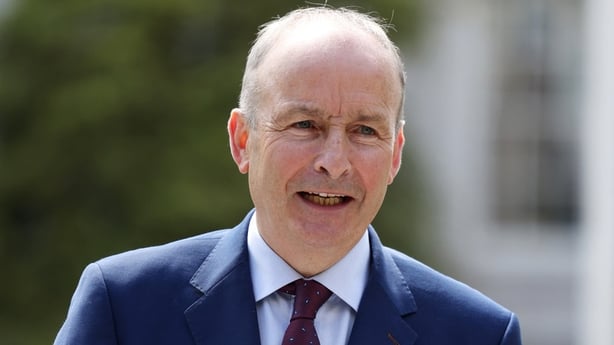
The Taoiseach is expected to hold bilateral meetings with senior political figures, including the Palestinian Prime Minister Mohammad Mustafa, as well as US tech chief executives.
Nailing down his precise agenda is proving trickier than usual given the fear among corporate leaders about publicly consorting with non-US leaders in case they incur the wrath of President Trump.
Despite that, IDA Ireland says they're expecting between 65 and 70 corporate leaders to attend their annual dinner in the Grischa Hotel on Wednesday evening with Micheál Martin.
Last year the guest list tapered off to around 50 once it emerged that the Taoiseach was grounded in Dublin in order to form the new government. Sources suggest that this year there will be a healthy smattering of big names at the dinner, which will also be attended by Michael McGrath and Peter Burke, Minister for Enterprise, Tourism and Employment.
WEF organisers, indeed, argue that the start of 2026 finds the global economy in a more resilient shape than had been predicted a year ago. Despite that, global debt and low growth remain stubborn concerns, while geopolitical fragmentation and asset bubbles continue to pose risks.
As usual, there will be plenty of speakers cheerleading the potential for AI to boost growth and productivity, while also accelerating progress in scientific and health research, as well as green technology.
"We’re hearing from business leaders that when it comes to the opportunity side of things, this goes well beyond artificial intelligence," says Saadia Zahidi, senior managing director of WEF.
"There is opportunity when it comes to medical and healthcare services, particularly with changing demographics. There’s opportunity when it comes to advanced manufacturing, especially when that starts blending with Artificial Intelligence."
But the big geopolitical crises of our time will be front and centre.
European leaders will include Germany’s Friedrich Merz, French President Emmanuel Macron, Spain’s Pedro Sánchez, Finland’s Alexander Stubb, Polish President Karol Nawrocki and NATO Secretary General Mark Rutte.
They are likely to impress upon President Trump the need to rethink his designs on Greenland and instead restore his focus to ending the war in Ukraine.
Whether or not he will listen is another matter. Either way, Davos 2026 promises to be the most keenly watched gathering ever.