
Just two months ago, Ireland was cited as a model for successfully tackling unemployment. However, since then, the Covid-19 virus has wreaked havoc on the labour force at huge financial, personal and emotional cost.
After peaking at almost 16% in February 2012, by the end of February this year the Government had driven that unemployment rate down to around 4.8%, below the EU average.
But thanks to the virus, it's all gone horribly wrong and yesterday's latest unemployment figures tell the story.
There are 598,000 people receiving the €350 Covid-19 Pandemic Unemployment Payment (PUP), an increase of 7,000 on the previous week, and an extraordinary figure considering the payment was only launched on 16 March.
That's on top of around 205,000 recipients of 'normal' or 'non-Covid' Jobseeker's Benefit worth €203 per week.
In total, around 800,000 former employees are now totally dependent on the State for their financial survival.
But that's not all, 427,000 workers are having at least part of their wages subsidised by the Government through the Temporary Wage Subsidy Scheme (TWSS).
Add them all together, and 1.23 million people, all private sector workers, are now fully or partially reliant on the State for their income.
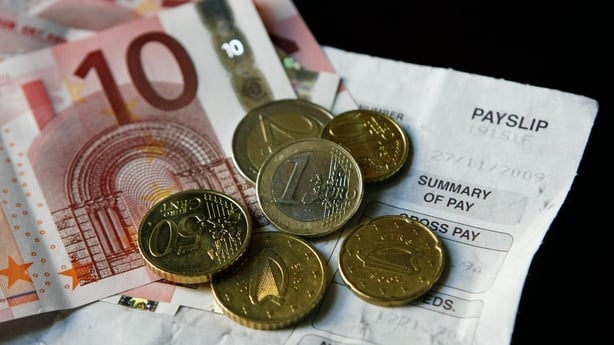
Behind every one of those statistics is a person, possibly with a dependent family, facing financial loss, insecurity and anxiety, with no idea of when the end might be in sight.
The sectors with the highest numbers of PUP recipients are accommodation and food service activities (128,500), wholesale and retail trade (90,300) and construction (79,300).
Meanwhile, a new report titled "The Initial Impacts of the Covid-19 Pandemic on Ireland's Labour Market", prepared by the Department of Employment Affairs and Social Protection (DEASP) and the Central Bank, reveals that those who have lost their jobs or been temporarily laid off are more likely to be "young, low-skilled, female and part-time than the population average".
Workers aged under 35 account for over 43% of all PUP recipients.
On a county-by-county basis, Dublin tops the league for Pandemic Unemployment Payment with 171,700 claims. Cork is in second place with 61,200, with Galway coming in third with 32,000 claims. Leitrim has the fewest claims with 4,100 applications.
The PUP and TWSS schemes were set up at extraordinary speed with the aim of delivering cash where it was most needed as soon as possible, amid a deluge of unemployment claims.
With a highly stressed population facing an unprecedented lockdown to combat a potentially fatal virus, it was vital to eliminate as much financial anxiety as possible, and provide a financial safety net.
Arguably the Government has delivered on that, though critics have highlighted some shortcomings, particularly in the PUP scheme.
Unlike for Jobseekerss' Benefit, PUP claimants do not have to provide documentary proof that an employer has laid them off.
This gave rise to claims from the Convenience Stores and Newsagents Association that workers, particularly part-time ones, had quit because they were better off receiving the flat rate €350 Covid payment.
However, DEASP insists that it does carry out other checks and that confidential facilities are available for the public to report cases of suspected "mis-claiming".
The DEASP/Central Bank report also stresses the importance of minimising disincentives to work in the welfare system.
Read:
Latest coronavirus stories
It notes that for lower-paid workers, the PUP replaces up to 76% of earnings, adding that international research suggests that where the so-called "replacement rate" rises above 70%, "it would be prudent to pay particular attention".
But as the unemployment statistics approach a plateau, attention is now turning to the post-pandemic period when policymakers will have to decide how to support firms in re-establishing employer-employee relationships, and helping the unemployed to rejoin the workforce.
The report cautions that what it calls transitional measures may be required, particularly for smaller firms, to restore the labour market as quickly and effectively as possible.
A key factor in all of this is cost.
Pandemic Unemployment Payments for this week alone will cost €209.3m. It would be even more, but 73,000 claimants subsequently closed their applications, in many cases because they have been re-hired by employers availing of the TWSS.
As for the TWSS, the State has already issued payments totalling €712m.
Both schemes were initially set up for a 12-week period expiring in June and the Government itself acknowledges that this level of financial support cannot continue indefinitely.
According to the Government's road map for recovery, by 18 May construction and other outdoor workers could be back on the payroll.

That would take over 79,000 off the PUP, reducing the financial burden of the claims bill somewhat.
However, Minister for Employment Affairs and Social Protection Regina Doherty has acknowledged that other sectors such as tourism, leisure and retail will take far longer to re-open, never mind recover, and will require further supports in the longer term.
Speaking on RTÉ's Morning Ireland, she said her department will continue to support workers until they go back to work, but the current payments are not sustainable in the long term.
But how can they be unwound? After 12 weeks, will the €350 Covid-19 payment go down to the €203 level of Jobseeker's Benefit? How will claimants react?
Will people on Jobseeker's Benefit demand to be brought up to the PUP rate as the new social security 'floor'?
How long will the State continue to subsidise wages and what will be the criteria for reducing the subsidies?
Minister Doherty cited measures announced to assist businesses and said some unemployed workers may need to retrain for alternative work in emerging sectors.
But as efforts to form a new government continue at a snail's pace, whichever ruling combination emerges faces the unenviable task of unwinding these crisis supports, when a tiny invisible virus could reignite at any time, disrupting the best laid plans for recovery.