Were you ever drawn to the slot machines?
If so, it is likely you will be familiar with the feeling.
The dwindling pile of coins. The despairing hope that maybe your luck is about to change. The pull of the lever; the spin of the icons before they settle. And then silence.
Followed by the knowledge that the last of your money is gone.
Last Tuesday morning, immediately after what was a Bank Holiday Monday in Northern Ireland, the DUP called a news conference.
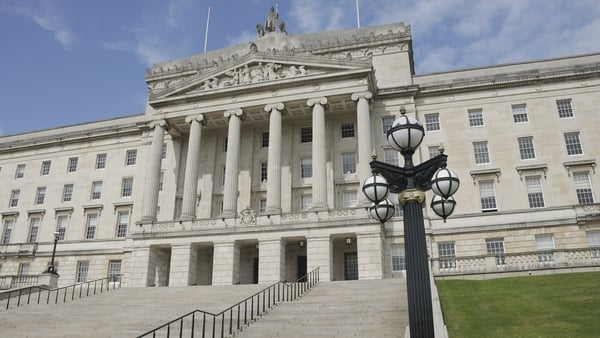
Shortly after the pre-arranged meeting time, Arlene Foster led a delegation of party members down the Stormont steps and they assembled before the camera crews, photographers and reporters.
Nigel Dodds, Jeffrey Donaldson and Gregory Campbell were among some of the party's ten Westminster MPs present.
Some but not all of the 28 DUP Assembly members turned up - Simon Hamilton was one of the notable absentees.
A few held up A4 size posters saying 'The DUP is here. Where's Sinn Fein?' A newly commissioned banner was unfurled. It features the message 'Sinn Féin (written in green and spelt correctly) End Your Boycott Now.'
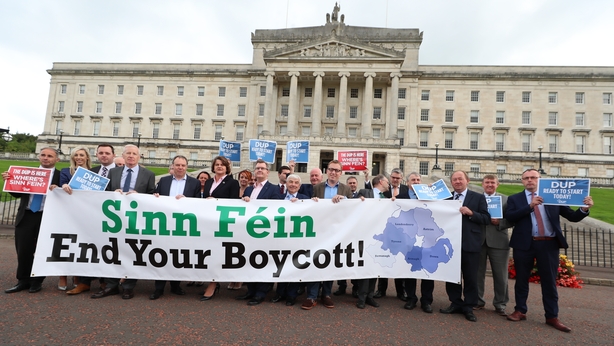
The post has an image with five of the counties in various shades of blue, one of them being 'Londonderry', but with Fermanagh, the home of party leader, Arlene Foster, for some not obvious reason, in white.
During what was a very brief news conference, Arlene Foster called on Sinn Féin to immediately engage with all the other Stormont parties so that a government could be formed.
She said the DUP was prepared to do so immediately and parallel negotiations could be held about the issues that had brought down the administration in January 2017.
She was asked why was the DUP the only Northern Ireland party to not accept an invitation to the Dublin Castle function for the Pope.
Her reply was she had received the invite but was tied up with family commitments for the weekend.
When asked why she had not asked a colleague to attend, she quickly stated the invitation was sent to her.
When efforts were made to ask deputy leader, Nigel Dodds, if he would have deputised in Dublin, Arlene Foster intervened and said the decision was hers.
There was an attempt to get an update on the party's examination of the issues around the North Antrim MP, Ian Paisley, but that too got a curt response.
As the damp squib news conference drew to a close, DUP backroom staff began carefully folding the new banner. It was a mild, sunny day in the distance, an expected pattern was beginning to form.
Smoke was rising from Belfast city centre, five miles away. It would soon emerge that the most popular store in Belfast's commercial heart, Primark, the star attraction that draws in thousands upon thousands of shoppers, was on fire and would soon be destroyed.
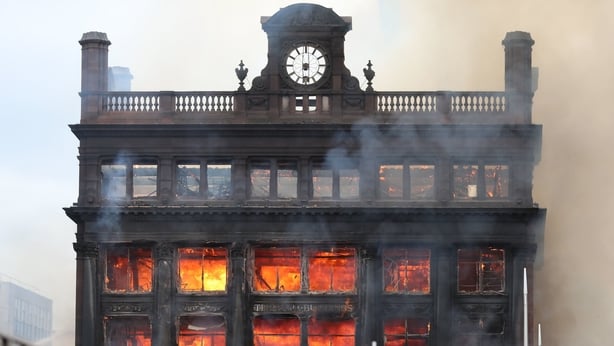
Just like slot machines the wheels of the bad news business were continuing to turn. Northern Ireland's run of misfortune continues.
The "you couldn't make it up" saga goes on.
And watch this space because there will be more.
The cash for ash affair
Arlene Foster, in her first minister role, was on a British government-led trade mission to China, when the earthquake and aftershocks around the Renewable Heat Incentive scheme erupted in late 2016.
Her partner in government, Martin McGuinness, pulled out of the trip at the last minute for health reasons.
The British government’s representative, leading the delegation, was the then Minister for Sport and Culture, Karen Bradley.
A game-changing factor in the affair was a BBC Northern Ireland Spotlight programme, assembling many of the strands and rumours after the ‘cash for ash’ scheme, including the principle, the bigger your wood pellet boiler and the more you burn, the more profit you make on state subsidies.
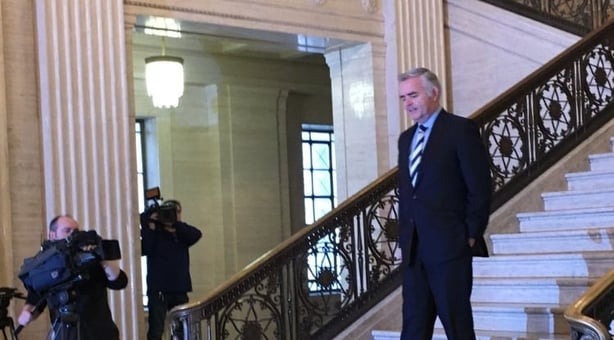
A key contributor to the unbelievable tale that spilled out was Jonathan Bell, a DUP Assembly member.
A qualified social worker, he was a junior minister in the Robinson-McGuinness administration and was given the enterprise portfolio in May 2015 when Arlene Foster became minister for finance.
He found himself holding the RHI toxic file when the music stopped. His interviews with the BBC’s Stephen Nolan, when the wood pellets hit the fan, created the momentum that led to the collapse of the administration and the establishment of a public inquiry.
In the coming week, Jonathan Bell, now retired from politics after an unsuccessful run as an independent in last year's Assembly elections, will begin giving his evidence to the RHI Inquiry.
It is being chaired by Sir Patrick Coughlin, a former Northern Ireland Court of Appeal judge.
He will be 73 in November and the manner in which he has applied himself to his role in the inquiry reflects the forensic approach of a Cambridge graduate who has acquired and fine-tuned his skills set during a career of almost 50 years.
The Bell evidence will kick-start the decisive phase of the evidence gathering.
Arlene Foster will be back before the inquiry towards the end of September when some of the Bell material may be revisited.
Northern Ireland’s most senior civil servants and a number of special advisers are also scheduled to feature.
The evidence and the performances of the witnesses over the next few weeks are likely to heavily influence the conclusions Sir Patrick Coughlin and his inquiry members will provide in their final report.
The proceedings are in public and can be watched online.
So much has happened since the ‘cash for ash’ controversy emerged in the closing weeks of 2016.
But it is important to remember this is the issue that started the slide. Much of it has its origins within the DUP circle.
It has exposed fault-lines within what was normally, in public at the very least, the coherent, forceful power-bloc that rivalled and sometimes outmanoeuvred Sinn Féin.
September’s evidence will decide where the wood chips will fall and if heads will follow.
The North Antrim Westminster seat
The heavy sanction imposed on the DUP’s North Antrim MP, Ian Paisley, automatically triggered a process that could lead to a Westminster by-election in North Antrim.
It is the first time that new regulations, created after the controversy over MP’s expenses, have come into play. If 10% of a constituency electorate sign forms, seeking the resignation of their MP, then the by-election will follow.
Northern Ireland’s Electoral Office had scope to establish between one and ten locations, where those wishing to participate in the 10% option could register their views.
Three were set up, in Ballymena, Ballycastle and Ballymoney. They are open weekdays, from 9am to 5pm, and the provision is in place from 8 August to 19 September.
At some stage on 20 September, when the petitions are counted and re-checked in the Belfast headquarters of the Electoral Office, the speaker of the house in Westminster will be told about the numbers and the result will be made public.
That’s the process that will decide the next chapter in the career of Ian Paisley.
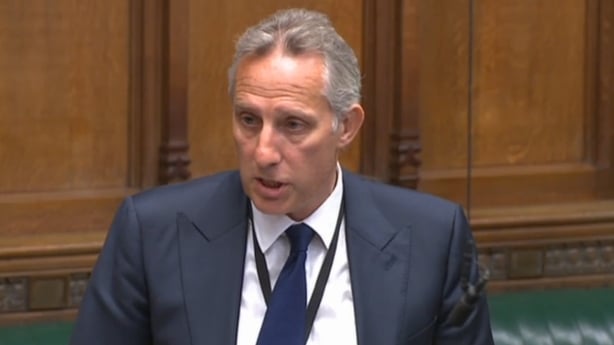
It’s not widely known but Tuesday next is an important staging post in this untravelled journey.
A ballot box behind a curtain guarantees anonymity on polling day, regardless of what emblems and onlookers are gathered outside a polling station.
But the intentions of those making their way to the three designated centres in the current North Antrim process are 100% obvious.
They are exercising their right to push for the resignation of the local MP.
They have one other option which should provide the secrecy, normally associated with an election process.
They can apply for a postal petition form.
The deadline for receipt of such postal applications is Tuesday 4 September, 15 days before the process ends.
Any request that arrives in relation to the postal option from Wednesday morning onwards will not be entertained.
North Antrim is Paisley heartland, built on the popularity and the service provided by Ian Paisley and his late father in what is an overwhelmingly unionist constituency.
He romped home in the first past the post system Westminster election last year, receiving 28,521 votes, 58.9% of the total when the turnout was 64.1%.
His nearest challenger in a six candidate contest was Sinn Féin’s Cara McShane who received 7,878 votes - Ian Paisley was more than 20,000 votes ahead of her.
The total electorate in North Antrim is around 75,000 and the 10% figure required to trigger a by-election is not based on the turnout in recent elections (64.1 Westminster 2017: 65% 2016 Brexit Referendum) but on the total electorate figure.
So around 7,500 verified petitions will be needed to trigger a by-election. From the non-unionist side of the house, in last year’s Westminster elections, the relevant figures were Sinn Féin 7,878, SDLP 2,574, Alliance 2,723 - a total of 13,175.
There will have to be a very significant anti-Ian Paisley backlash within the constituency, if the circumstances for a by-election are to be created.
The cause of the controversy are in the public domain. Ian Paisley availed of two family visits to Sri Lanka, financed by its government, didn’t declare them, and breached the rules for paid advocacy by writing to then prime minister David Cameron in 2014 to lobby against a United Nations resolution on human rights abuses in Sri Lanka.
The DUP hasn’t taken a public position on the situation while it carries out an internal investigation.
Of the other parties, Sinn Féin is making the running in the push for a contest.
The 'Chuckle Brothers' relationship between the now deceased Ian Paisley senior and Martin McGuinness is one of the ‘tickle me’ images from the opening days of the DUP-Sinn Féin partnership.
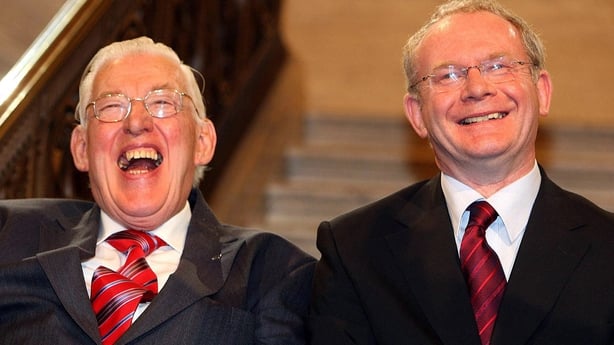
Indeed Ian Paisley junior, then a junior minister in the Stormont administration, accompanied them on that US trip when they were like movie stars.
But this is raw, black and white politics. In the constituency where Sinn Féin ditched one of its Assembly members, Daithi McKay, when he crossed lines in the NAMA inquiry, they are going for Paisley blood.
Will the 10% petitions threshold be reached? How will the DUP react to the situation that is causing it some internal as well as external disquiet?
Will there be any discussion about the holiday cost and making some form of recompense?
Even if a by-election is triggered, would the Paisley brand, track record and constituency loyalty see the imcumbent returned?
Would the DUP consider running a different candidate in a by-election? 20 September will tell a tale and Tuesday next, the closure date for postal applications, will influence the result.
Is the SDLP doomed?
David Cameron’s unintended contribution to Irish history in 2016 was, by calling the Brexit Referendum, when he thought he had the golden touch, he undermined the Good Friday Agreement.
One of Theresa May’s achievements through the snap 2017 Westminster election she called after her walking holiday in Wales was she dealt a severe and possibly a mortal blow to the SDLP.
One able and fair-minded observer in Westminster told how there was no sadder sight than seeing three former leaders of the SDLP, Mark Durkan, Margaret Richie and Alasdair McDonnell clear out their offices and lockers after they had lost their seats.
Their absence in the chamber, the contributions they could make, the respect they would command, are an on-going political tragedy.
Sinn Féin will not change from its policy of not formally taking its Westminster seats and it has a mandate from its voters to hold that line.
A practical consequence of the SDLP Westminster wipe out is the disappearance of financial supports that played a crucial role in the party infrastructure.
Policy advisor Eoin Bradley, a bright spark with a great future somewhere, and press officer Tanya McCampbill, left earlier this year.
The flow of funds has dried up. It’s a dramatic change from the days when several parties from south of the border sent personnel to campaign for the SDLP at election time and when the SDLP leader’s party conference address was carried live on RTÉ television.
A cruel irony for the party is the demise happens at a time when it has a new layer of representatives with genuine promise.Colum Eastwood, the party leader, is just 35 and was Derry’s youngest mayor at the age of 27.
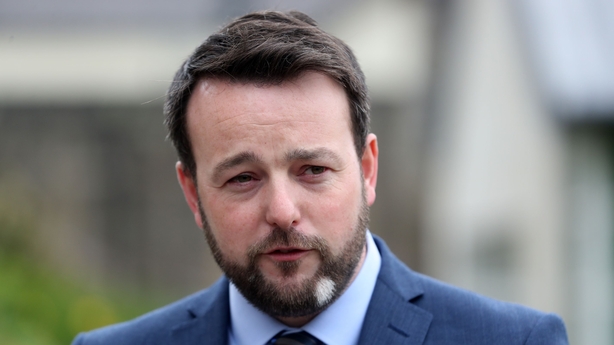
Nicola Mallon from North Belfast and Clare Hannah of South Belfast were two of the most impressive performers in the Assembly before it closed.
Daniel McCrossan, aged 29 and from West Tyrone, is another able dealer.
Former Antrim footballer, Justin McNulty, was identified and nurtured by Seamus Mallon.
But without an Assembly pitch to play on and deprived of a Westminster role, the SDLP is withering.
Even the gestures that might give a temporary bounce are not coming the party’s way: there was, for instance, no push to have SDLP types find a berth in Seanad Eireann. It’s against that backdrop of drift and disappointment that the move is on for some form of SDLP/Fianna Fail ‘arrangement’.
In keeping with modern times, it may not be a formal marriage but some form of ‘partnership’.
The advantages are obvious because it could re-energise the SDLP and satisfy the long-standing ambition of many Fianna Fáilers to come north. But there are potential downsides too.
John Hume’s decision in the early 90s to engage with Sinn Fein’s Gerry Adams was a decisive move that led to the end of the killing.
But Sinn Féin didn’t just enter the political tent, it became so at home inside it, it pushed the SDLP and took competent ownership of that party's policies, strategies and crucially, significant pockets of its support base.
South of the border, the Sinn Féin brand grows.
Democratic Left is no more, Labour has been bypassed and the next target, the ultimate tussle for ‘top dog of nationalist Ireland title’ is with the Soldiers of Destiny, Fianna Fáil.
Micheál Martin knows what happens to junior coalition partners - the Greens, the FDP and even the Social Democrats after the SDP, CDU grand coalition in Germany.
The Lib Dems in Britain, the Progressive Democrats, the Labour Party, the Green Party in Ireland. Maybe that’s why he saw the option of a coalition with Fine Gael as a lethal honey trap and let it pass.
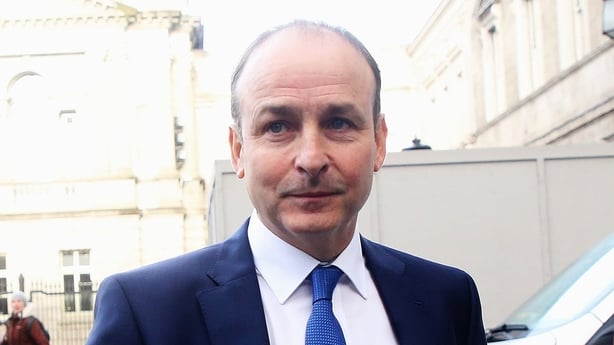
If he exercises the partnership option with the SDLP, he will be moving into Northern Ireland territory where Sinn Féin will waste no time in reminding him ‘on this turf we are in charge and you are the minnows’.
He may well decide the initiative is morally as well as politically justified.
The pragmatist in him knows the bare-knuckle battle with Sinn Féin is coming - south of the border in the next general election.
The outcome of Fianna Fáil discussions with the SDLP will be known in weeks.
Sinn Féin's Presidential Election candidate
Why is Sinn Féin running a Presidential Election candidate?
That’s like the question the frog asked the scorpion after it received a lethal sting.
The answer is the obvious one - that’s what political parties do.
Sinn Féin contests elections. It avails of every practical opportunity to exercise its political machine.
It has first-hand knowledge of the dangers of having a machine (hardware and personnel) under-used in Stormont.
And with Fine Gael, Fianna Fáil and Labour vacating the stage in favour of Michael D Higgins, Sinn Féin couldn’t resist the opportunity of having a run under the post Adams leadership of Mary Lou McDonald.
Seven years ago when Michael D Higgins received 701,101 first preference votes (39.6% of the turnout), Independent Seán Gallagher came second with 504,964 (28.5%) and Sinn Féin’s Martin McGuinness third of the six candidates with 243,030 (13.7%).
McGuinness was eliminated (with Fine Gael’s Gay Mitchell) after the third count, by which stage he had received 12,585 transfers.
It was a sobering result for Sinn Féin. McGuinness was widely considered more congenial than Gerry Adams.
Had the party allowed him to attend the Dublin Castle event for Queen Elizabeth and Mary McAleese six months before, might he have attracted more votes?
He was bruised by the public encounter on the campaign trail with family members of Private Patrick Kelly, who was shot dead when the Don Tidey IRA kidnap gang was confronted in Ballinamore in 1983.
He was beaten into third place by Independent, Seán Gallagher.
The 2018 Presidential contest will allow Sinn Féin an opportunity to benchmark.
Anything less than the 243,000 votes Martin McGuinness received seven years ago would be a setback.
Especially so with the other main parties standing aside. John Finucane got 19,000 votes in the North Belfast constituency Westminster elections.
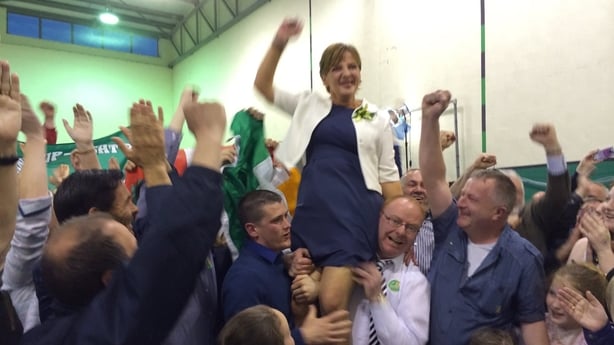
He closed the gap on the DUP’s Nigel Dodds to 2,000 votes but failed to oust him. Liadh Ní Riada received 125,309 votes in the 2014 European elections, southern constituency contest - 19% of the total vote.
They are two of the names linked to the Sinn Féin candidate role.
The well-known artist, Bobby Ballagh, is another who was mentioned in some quarters.
The date for the election is set for 26 October. Sinn Féin will name its standard-bearer in days.
The person will be a ‘non gunsmoke, Mary-Lou endorsed’ selection and will provide telling evidence about the state of the Sinn Féin machine and whether the party really is getting increased traction, and voter transferability, with the Irish electorate.
Might Brexit provide the magic?
The road ahead is indeed a rocky one and around one of the many blind corners, the European Union October summit looms and the March 2019 date when the UK is officially due to leave the EU.
One of the bizarre images of recent days was Theresa May dancing her way around Kenya, Nigeria and South Africa as the UK seeks the money trees to finance its post-Brexit surge of affluence and prosperity.
There has been nothing to suggest that a formula is emerging to resolve the conundrum where the island of Ireland is the most problematic and vulnerable component.
Ultimately, the fudge, the resolution or the inadequate sticking plaster will be decided during negotiations in Brussels. Leo Varadkar and his Government have decided to put their trust in their identity as one of the 27. In that context, the president of the European Commission, Jean-Claude Juncker, will emerge as a key player.
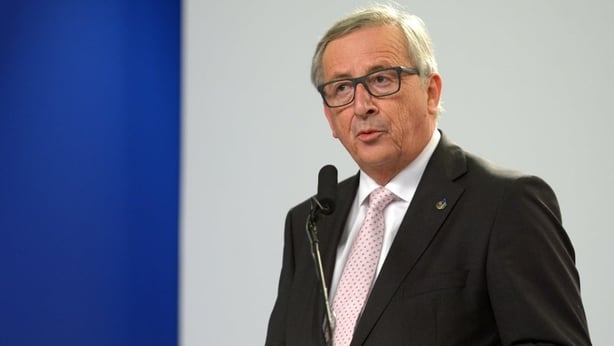
In a past life (1989-2001) I had dealings with him in my role as RTÉ’s Europe Editor. If Ireland was small then, Luxembourg was even smaller.
In his role as Luxembourg’s finance minister (and then prime minister after Jacques Santer became European Commission president), Juncker was always empathetic towards Ireland. He never refused a request for an interview, even at short notice.
He had a good relationship with Bertie Ahern. Helmut Kohl, the chancellor in neighbouring Germany and a hugely influential figure, admired and encouraged Juncker.
Because he came from a country of half a million residents, surrounded by more powerful countries, he readily identified with Ireland’s challenge to constantly punch above its weight.
Even then, 20 years ago and more, some of Juncker’s fingers were brown from cigarette smoke.
Some of the UK redtops often suggest he likes a drink or two but the smoking may be the more wearing influence on his health.
He has been in the Commission presidency role since 2014. For the previous decade, Portugal’s Jose Manuel Barosso had the job - ‘the vanity and after-shave years‘ when the EU, befuddled by post-Cold War triumphalism, its single currency and its enlarged membership, slid into recession and lost contact with its soul.
Juncker may well be past his best. But he will know that Brexit has the potential to cause collateral damage to the project that has dominated his career and life. He’s not the kind of person who will easily acquiesce to failure.
And when the deal is being done in the small hours, in October, November, or at some later date, the Luxembourger is unlikely to willingly allow for the mangling of a small state with the EU's best example of unfinished reconciliation.