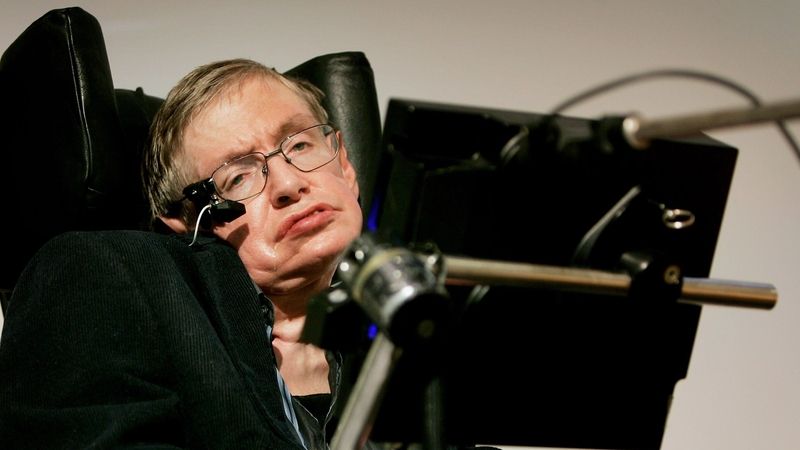

Last week one of the brightest stars of science stopped twinkling.
An extraordinary man, whose personal story was almost as compelling as that of the cosmos about which he was so obsessed.
But how do you sum up the legacy of arguably one of the greatest scientists of modern times?
That was the conundrum facing journalists, scientists, politicians and other commentators last week following the sad news that Professor Stephen Hawking had passed away, aged 76.
For his contribution to so many aspects of life was, quite simply, immeasurable - unique and brilliant in a multitude of ways.
A scientific genius, his theories opened up a new intellectual front on our conventional understanding of the universe.
From the singularity theories he published with Roger Penrose in 1970, through to his landmark 1974 proposal that black holes emit radiation, and his later 1982 thesis that quantum fluctuations could cause galaxies to spread in the universe, Hawking’s contributions turned aspects of traditional thinking about physics on their head.
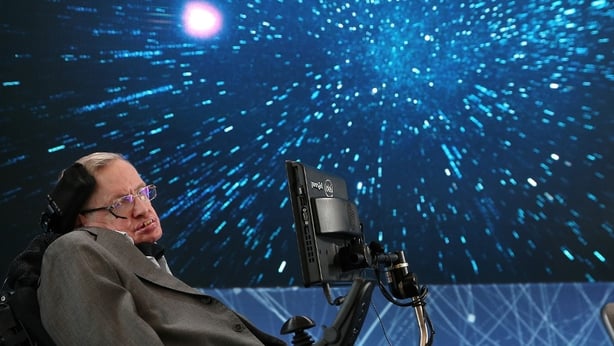
But like all great scientists, he wasn’t always wedded to his views nor was he afraid to admit when he was incorrect.
His thoughts and his theories expanded and developed with time, just like the universe he so closely studied.
In Dublin in 2004, for example, he famously proclaimed that he had done a U-turn on his theory of the parallel universe, in the process conceding a long-standing bet to fellow theoretical physicists Kip Thorne and John Preskill.
Although he won the bulk of the prizes and accolades that anyone in his area could, he was never awarded a Nobel Prize.
That was down to the fact that his theories had not (yet at least) been proven in experimental form - something which may in the not too distant future be rectified through progress being made in gravitational wave detection and experimentation.
Sadly though, Professor Hawking will not be around to see such a breakthrough, or to claim the prize that many believe he undoubtedly deserved.
But nonetheless, there is also little doubt that his extraordinary achievements in his branch of science will be the focal point of study and of debate for decades, even centuries to come.
"There are many good theoretical physicists who make a big contribution, but there aren’t that many greats," said Professor Brian Cox in the wake of Prof Hawking’s death.
"And by that I mean that I think there are physicists in a thousand year’s time, they will still be talking about Hawking radiation, they will be using his fundamental results on black holes."
But it wasn’t just the Cambridge professor’s theoretical physics work that made him so special.
His gift in the area of science communication was a rich one.
He drew in and engaged millions of people around the world who might not otherwise have had an interest in science.
A Brief History of Time may be the book that ultimately made Hawking into a global household name.
But it wasn’t the only one he wrote.
In fact he penned more than a dozen books, a number of which were aimed at children and co-authored by his daughter Lucy.
We will never know how many of those young readers he inspired enough to make them pursue their own career in STEM, but undoubtedly there were many.
His efforts to communicate science were helped by his sense of humour.
By all accounts he had a legendary wit, never afraid to poke fun at himself or indeed others.
Plenty of stories circulated last week to illustrate this.
Like the time when, as he waited for a TV interview, a producer unplugged a lead for a light.
The professor slumped forward in his wheelchair, as though something important had been disconnected.
The panicked producer allegedly ran out of the room to get help, only to return to a chuckling Hawking!
He also brought that humor, sense of fun and adventure across from science into entertainment and popular culture.
Among the many well-known TV shows he played cameo roles in were the Simpsons, the Big Bang Theory and Star Trek - introducing his brand and his science to a whole new audience in the process.
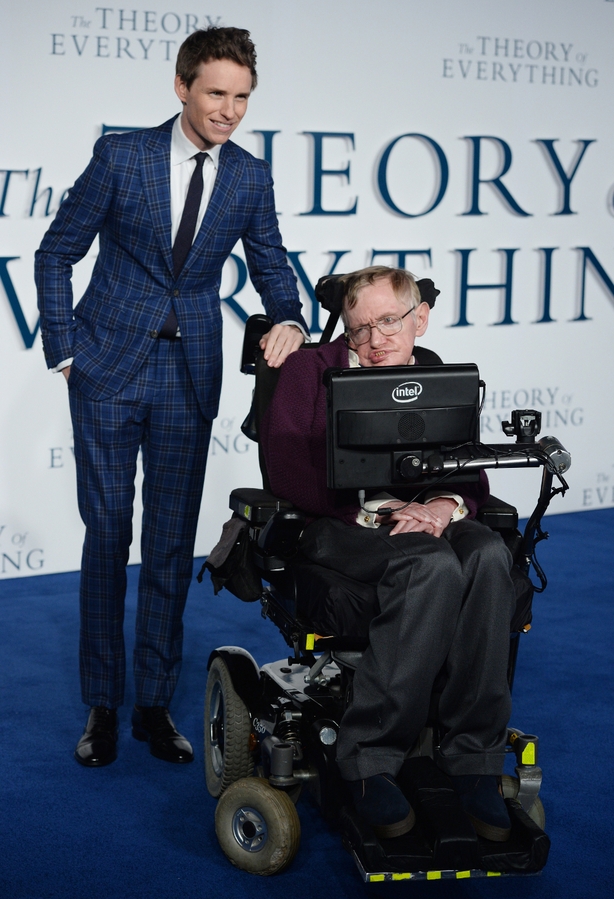
He achieved all this in spite of his crippling disability, which he bore with courage and determination for more than half a century following his diagnosis at the age of 21.
A beautiful mind trapped inside a slowly failing body, Prof Hawking maintained a publicly positive outlook on his illness.
"My advice to other disabled people would be, concentrate on things your disability doesn’t prevent you doing well, and don’t regret the things it interferes with. Don’t be disabled in spirit, as well as physically," he told the New York Times seven years ago.
This is clearly how he lived his life, choosing to use his Amyotrophic Lateral Sclerosis as an enabler rather than a disabler.
It forced him, and by extension the rest of us, to look beyond the physical disability of a paralysed shell, to the unbridled brilliant potential of the human mind, the inspiration and the reason inside it.
His computer generated voice, so iconic and so unique, may have served as his only means of communication and connection to the world.
But it also served as an effective tool to make people listen more attentively to him.
Most impressive though was that despite being a stellar scientist, who commanded huge audiences and attention, hung out with world leaders and stars of stage and screen, he remained grounded to his inherent humanity.
Many words of tribute and anecdotes have been written and spoken about Stephen Hawking over the past week.
But none were more revealing of the man than those recounted by his children Lucy, Robert and Tim who recalled how their father once said: "It would not be much of a universe if it wasn’t home to the people you love."
A bright light may have gone out, but the science, the inspiration and the humanity of Professor Stephen Hawking shines on.
Comments welcome via Twitter to @willgoodbody