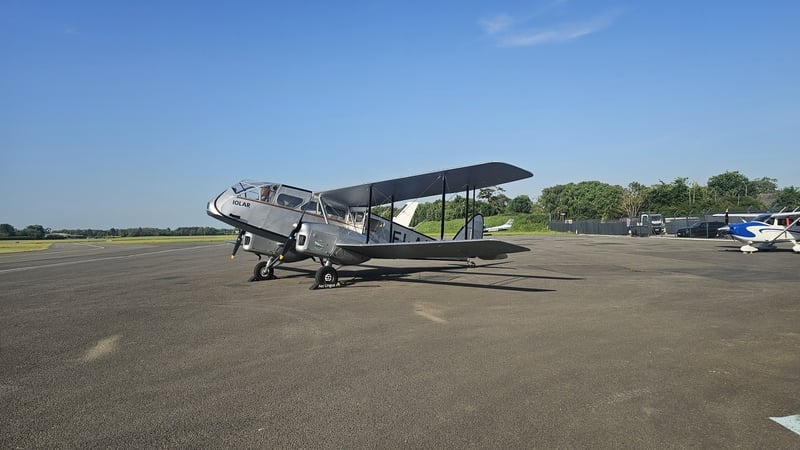

A restored 1936 Aer Lingus aircraft has taken off from Weston Airport in Dublin on its way to Bristol, recreating the first flight for the airline, which took off on the same route on this day in 1936.
The 1936 de Havilland Dragon is following the original Dublin–Bristol route to mark 90 years of flying with Aer Lingus.
The Iolar aircraft, named after the Irish word for eagle, took off at 10.16am, piloted by Captain Brendan Bruton, an Aer Lingus pilot who usually flies transatlantic routes, and Captain Mark Dolan.
Cpt Bruton said is looking forward to this more traditional experience, and all being well the flight time is expected to be around 2 hours and 40 minutes, flying at around 170km/h.
However, unlike his more normal mode of transportation, the de Havilland Dragon comes with its own challenges in the current hot spell, with the tiny cockpit feeling like a greenhouse, he said.
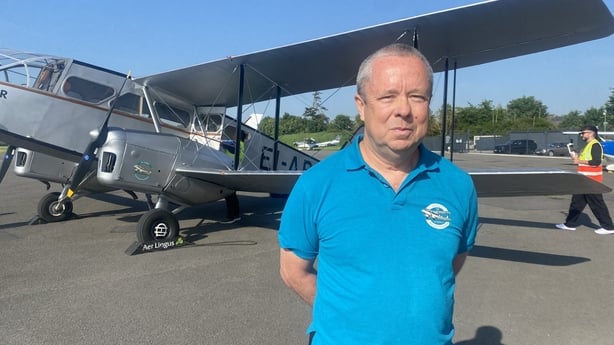
Asked what the aircraft is like to fly, Cpt Bruton said: "It would be quite typical of an aircraft of its day. So, again, you wouldn't be flying on clouds, you're navigating just from point to point visual references, little bit slower than more modern aircraft, but the view is a lot better, particularly on days like today.
"Conditions are very pleasant. We'll head out towards Dublin Port, from there down towards Fishguard in Wales, up along the Bristol Channel, so passing Swansea, Cardiff, and then into Bristol. So, forecast is good, maybe some showers later in the day, but we hope to be in Bristol long before that," he added.
With the high pressure conditions, there is a possibility of sea fog, he said.
Oliver Murphy headed up the engineering team which restored the aircraft in Abbeyshrule in Co Longford, and is also on board the flight to Bristol.
"We flew the aircraft originally from Dublin Airport to Abbeyshrule in Longford, in early January. Since then we've done a lot of recovering of the wings or rebuilding of the wings.
"We've done top overhauls on both engines, and we've gone through the entire airframe to check to see if there's any work that needs to be done to keep it or bring it back to back to life as such," Mr Murphy said.
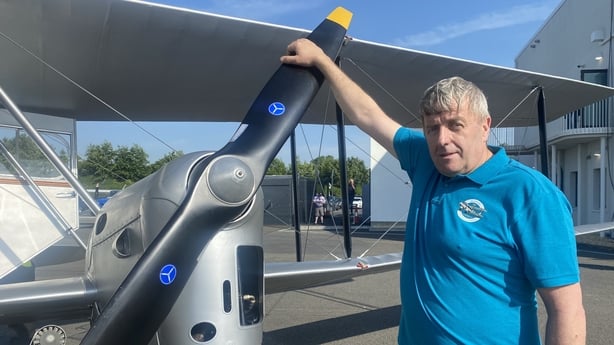
Aviator Geoffrey de Havilland was the aircraft's designer and it was built in 1936 in Hatfield in the UK.
"Geoffrey actually flew this aircraft on its first test flight after manufacture. It carries up to 80% of its own weight, so I think if you check out what eagles can do these days, it's probably something quite similar," Mr Murphy said.
"There aren't too many wooden aircraft left in the world, actually. There’s a number of privately owned, mostly biplanes, but yeah, it was a bit difficult to get carpenters who are competent in the trade."
Aer Lingus CEO Lynne Embleton said: "It started 90 years ago to the day.
"One aircraft, six seats, five passengers flying Dublin to Bristol, and here we are, able to replicate that again.
"And it's a moment in our history that we're very proud of, we've been flying and connecting Ireland to the UK and the US for decades, and this is where it all started."
Speaking about the original flight, she said: "It took off on a runway of grass. They weighed the passengers, not just the bags. So, there's a lot has changed since then, but this is this is really the beginning of our DNA."
Chief Corporate Affairs Officer for Aer Lingus Donal Moriarty said the plane was bought in the 1960s and restored for the 50th anniversary in 1986.
He said as the structure of the aircraft is mainly of wood, carpentry expertise was needed to restore it to flight airworthiness.
"It's very hard to find aircraft carpenters... but we have one and his name is Brendan Donoghue and he assisted in the restoration of the aircraft along with many others, so we're very proud of all the work that they did."
Mr Moriarty said that the aircraft is "absolutely" safe and "is fully certified".
Speaking on RTÉ's Morning Ireland, he added that the flight "represents the very beginning, literally the very beginning of Aer Lingus in terms of its first flight.
"And it's a powerful reminder of that history and indeed of how far we've come both as an airline and how much the world has changed in that 90-year period."