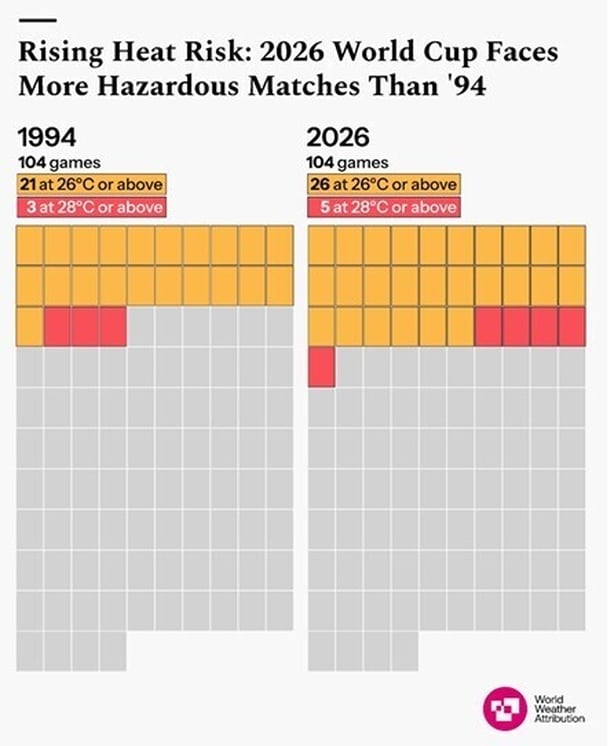

A study by World Weather Attribution has found that 25% of the matches at the World Cup are likely to be played in conditions exceeding 26C.
Scientists said this poses significant risks to players and fans during the tournament, which is taking place in North America across the US, Canada and Mexico during June and July.
The Wet Bulb Globe Temperature (WBGT) is an index used to assess physical heat stress on the body.
A WBGT of around 28C is widely considered a threshold at which heat stress becomes a significant concern for elite athletes.
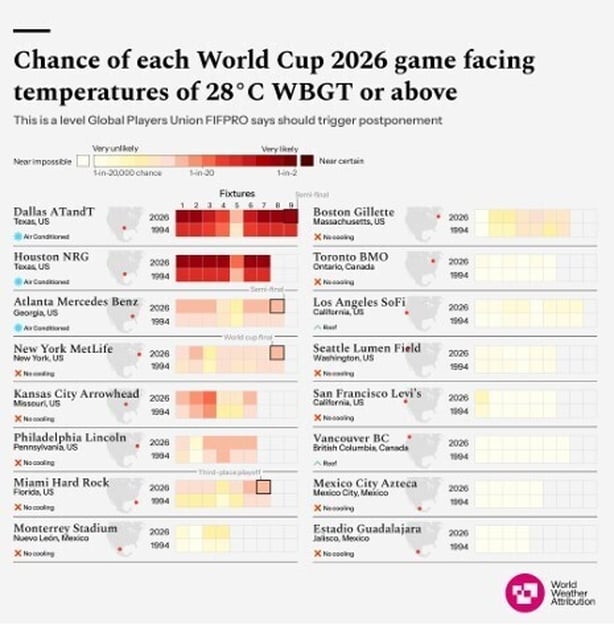
World Weather Attribution said about five games are expected to occur above 28C. High-risk venues include Miami, Kansas City, New York and New Jersey.
In Dallas and Houston, while stadiums are cooled, fans face a one in three chance of enduring temperatures above 28C WBGT outside the arena for most matches.
With all 16 host cities staging open-air fan festivals, hundreds of thousands of supporters could be impacted.
"Above 28C, the risk of serious heat illness becomes more concerning - not only for players, but also for the hundreds of thousands of fans in stadiums and outdoor fan festivals. Heat stroke, the most severe form of heat illness, is life-threatening, and older people and those with pre-existing medical conditions are particularly vulnerable", said Honorary Clinical Senior Lecturer at Imperial College London, Dr Chris Mullington.
Around 25% of all World Cup games are likely to be played when conditions exceed 26C Wet Bulb Globe Temperature.
The venue for the final - the New York New Jersey Stadium - has seen its risk of heat-related disruption increase by around 50% since the 1994 World Cup, which was held in the US.

These estimations justify the need for - and implementation of - a series of mitigation strategies with a view to better protecting players' health and performance when they are exposed to hot conditions, said FIFPRO Medical Director Dr Vincent Gouttebarge.
The analysis also shows that climate change has made these conditions significantly more likely.
"Our research shows that climate change is having a real and measurable impact on the viability of holding World Cups during the northern hemisphere summer. The 1994 World Cup may not feel particularly distant to many adults today, yet half of human-induced climate change has happened since then." said Dr Gouttebarge.
FIFA officials said they will be monitoring weather conditions throughout the tournament and will activate extreme heat plans if the temperatures become too hot.