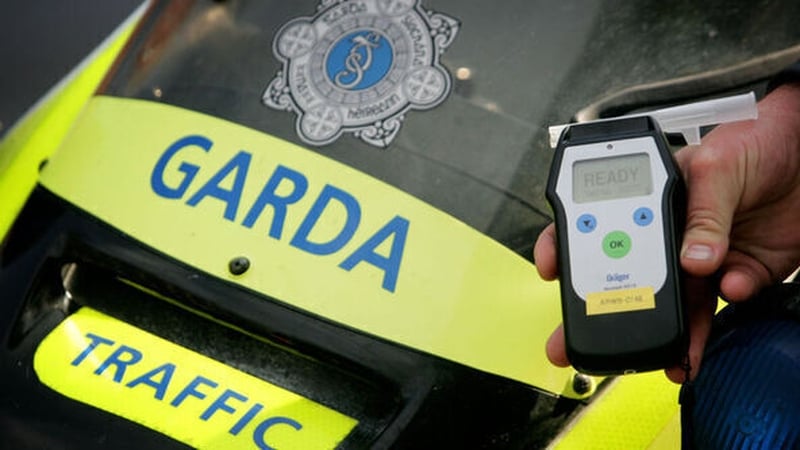

The number of breath tests that are being carried out nationwide is decreasing despite a rise in the number of drivers on Irish roads.
Alcohol Action Ireland has said there needs to be "prioritisation" of the enforcement of the law, as the group warns that alcohol is involved in over a third of driver deaths.
While breath testing is one of the measures used to tackle this problem, campaigners say that the number of tests being carried out has been "plummeting" for over a decade.
In 2010, more than half a million tests were carried out which resulted in more than 10,000 arrests for drink driving. In 2025, just under 190,000 breath tests were conducted, with almost 4,900 arrests for drink driving.
The concerns were raised at the Joint Oireachtas Committee on Transport, where Dr Sheila Gilheany described how Ireland has the lowest level of roadside breath testing in the EU.
She also referred to a survey that found 12% of drivers admitted to drink driving.
"That is over 424,000 people or to put it in another way, over 1,100 a day are taking a lethal weapon onto our roads," she said.
The same RSA survey found that 75% of drivers think it is unlikely they will be breathalysed.
It led to questions from TDs around a lack of garda visibility on our roads and around the attitudes among some members of An Garda Síochána towards breath testing.
Green Party leader Roderic O'Gorman said there is a shared view of the need for more gardaí. However, he said when he read the Crowe Report specifically on road policing, he found some of the attitudes "quite alarming", and while it was not all gardaí, he questioned the impact of their attitude.
Dr Gilheany replied that "we are just factual, we just publish the evidence" as she referred back to the need to have "targets" around breath tests.
She said that if they do not have the right garda numbers on the streets, there wont be the level of visibility and testing that is needed.
Dr Gilheany said their evidence points to a lack of resources, but also referred to a general acceptance in Ireland around alcohol and the issues this causes.
"Alcohol and binge drinking is normalised and everyone in the medical field knows what an ED is like on a Saturday evening."
She said it is not surprising that follows through into all areas of enforcement.
Speaking to RTÉ's News at One, Dr Gilheaney said even after an arrest for drink-driving, about 37% of cases that come to court are dismissed.
She said there needs to be an investigation to look at the loopholes.
Particularly where someone has been injured and taken to hospital after a collision, she said.
"In order to take a blood sample, gardaí have to direct a doctor to do that. In Australia, any doctor in a hospital can take that and store it in particular conditions," she said.
She also said there is a three-hour time limit to take those samples, which is three hours from when the driver last had control of the vehicle, which she said is a "tight window".
"We are saying, we need to extend that window," she said.
Fine Gael TD Emer Currie said the figures from Alcohol Action Ireland are shocking and truly appalling.
She also described how stretched policing has become, adding "we are seeing that playing out in your statistics...in terms of bad behaviour on our roads".
Concerns were also raised over the low level of convictions in relation to arrests for drink driving.
"The status quo is not acceptable. 37% of court cases don't result in convictions," she said.
Watch: 'Over 1,100 a day are taking a lethal weapon onto our roads,' committee told
Consultant in Emergency Medicine in Cork University Hospital Dr Eoin Fogarty said drivers are handed back the keys to their cars, and added that once the perpetrator has sobered up, they are handed back the keys of "the lethal weapon".
"It is mind-boggling, but that is what happens in Ireland," Dr Fogarty said.
In response to the figures, gardaí said there was a 14% increase in drug driving-related detections and a 5% increase in drink driving-related detections in 2025 compared to 2024.
Gardaí added that they arrested over 8,000 people for driving under the Influence of drugs or alcohol last year, 61% of arrests were alcohol related and 39% were drug-related.
We need your consent to load this rte-player contentWe use rte-player to manage extra content that can set cookies on your device and collect data about your activity. Please review their details and accept them to load the content.Manage Preferences