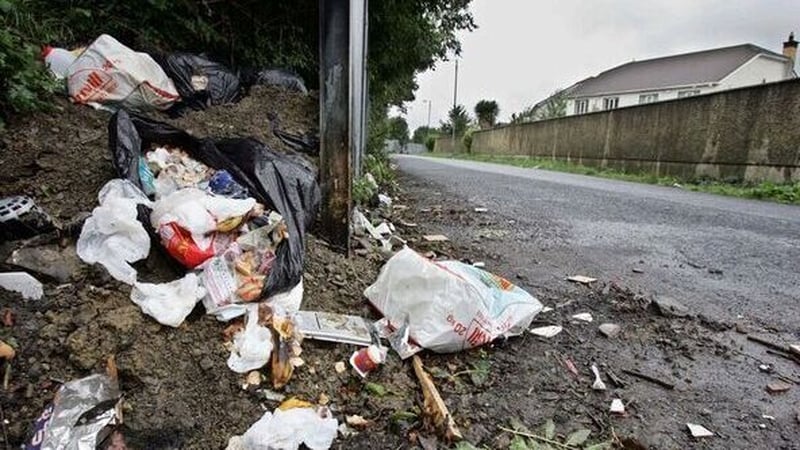

Fines for littering and dog fouling will be increased by €100 from the beginning of September.
Minister of State for the Circular Economy Alan Dillon will announce that these on-the-spot fines will rise from €150 to €250.
The move is aimed at deterring littering and illegal dumping, and the minister will encourage local authorities to improve enforcement.
Mr Dillon will also announce a €3 million investment in anti-dumping initiatives across all councils.
More than 200 projects will receive funding this year.
This will fund local authorities to use CCTV monitoring along with supporting clean up operations and raising public awareness.
Since 2017, this work has led to the removal of more than 26,000 tonnes of waste nationwide.
Last year, Vision Ireland said that 48 dog fouling fines were issued by local authorities in 2024.
It found Cork County Council issued the most fines with 11, while most local authorities issued just one or two fines that year.
The data showed that almost half of local authorities, 14, issued no fines for dog fouling in 2024.
Head of Policy, Partnerships and External Affairs at Vision Ireland, Kevin Kelly, said dog fouling is quite an issue for those who are blind or visually impaired.
"Vision Ireland, for a number of years, have been raising this matter on an annual basis," he said, speaking on RTÉ's Drivetime.
Mr Kelly said it presents a slipping hazard and a serious public safety and health risk to people who cannot see.
He said some visually impaired people use a white cane. The roller tip of this can get caught up in the dog waste.
"Often the person is unaware that this has happened, they then fold the white stick up, the dog waste then gets on their hands and perhaps into their bag.
"It is very, very unpleasant for people who are blind or vision impaired, and for anyone … whether they be a wheelchair user or someone pushing a buggy," he said.
Mr Kelly said the problem is getting worse and said there needs to be an increase in the number of fines issued.
He said it was difficult to see the increased cost of a fine having any impact unless it comes with greater enforcement.
Difficult for councils to identify dog owners
Environmental Enforcement Warden for Dún Laoghaire-Rathdown, Alan Hand, said it is difficult for councils to identify the dog owner with regard to dog fouling.
Speaking on RTÉ's Drivetime, Mr Hand said: "Dog fouling falls within the Litter Pollution Act. So, it comes under the same category of offences as illegal dumping."
"With illegal dumping it is easier to secure fines and prosecutions because evidence in a lot of cases can be readily available," he said.
This includes the use of CCTV and finding a car owner’s details through their registration plate, if a car was used during the dumping incident.
He said the challenge with dog fouling is trying to identify the offender. "People generally don’t have an audience when they do it," he said.
Mr Hand said the council has gone down the route of awareness and rolled out programmes in schools.
"We are trying to futureproof and encourage responsible dog ownership," he said.
He said bins are also part of the solution, with additional barrel-style bins being rolled out during the summer months.
On his local authority, Dún Laoghaire-Rathdown, which issued no fines during the period of the survey, Mr Hand said they are fully cognisant of the fact.
He said additional staff have been hired and dog licence checks have been carried out.