
The Government has renewed its call on the European Commission to set up a pharmaceutical taskforce in light of ongoing threats by the Trump administration to impose fresh tariffs on the sector.
Dublin is lobbying the commission to create a "strategic dialogue" between the pharmaceutical industry, the European Commission and member states due to "ongoing challenges in the international trading environment".
Last month US President Donald Trump announced 100% tariffs on a range of pharmaceuticals under a so-called Section 232 investigation on the basis that imports to the US "threaten to impair… national security".
Those tariffs could take effect within 120 days of the announcement, which was made by the White House on 2 April. Smaller drug manufacturers were granted a 180 day delay.
Most EU pharmaceutical products remain subject to a 15% tariff rate with some companies attracting a zero rate if they enter pricing agreements and on-shoring investment commitments with the United States.
In a letter to the European Commission, seen by RTÉ News, the Government has called on Brussels to "revisit the idea of a working group or strategic dialogue between the sector, the Commission and those Member States most impacted".
The communication points out that Mr Harris had written to the commission last year "highlighting these issues and supporting the idea of the setting up of a pharmaceutical taskforce".
It states: "While we are very open as to the exact vehicle and forum for a discussion on these matters, we believe that a substantive dialogue on these issues would be very helpful, notably in light of the US Administration's recent announcements on tariffs on pharmaceuticals, with the EU as well as with other partners, and the ongoing section 232 investigation into the medical devices sector."
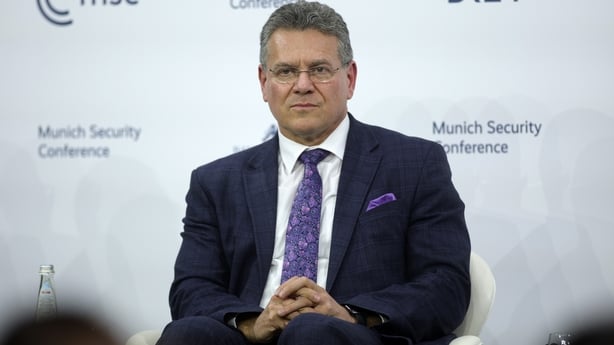
The letter was addressed to the EU trade commissioner Maroš Šefčovič and health commissioner Olivér Várhelyi.
The letter suggests that European pharma and medical devices companies, as well as US and international companies located in Europe, "are at the cutting-edge of research and development, contributing to improving the health of people around the world.
"These sectors also provide well paid jobs, tax revenues and support enterprise development and job creation in ancillary industries in areas where they are based, with enormous growth potential in the years ahead."
It adds: "The current challenges and instability in the global trading and investment environment require us to be proactive in safeguarding and supporting this strategic, future orientated sector.
"Ireland would be keen to contribute positively to a dialogue, alongside other Member States and the life sciences sector. We would welcome the opportunity to discuss this with you both to help take this initiative forward in the period ahead."
The letter makes it clear that Ireland intends to highlight the role of the pharmaceuticals and medtech sectors to the European economy during its upcoming presidency of the EU.
The Government added that the sector is in tune with the EU's drive to simplify regulation and boost the competitiveness of the single market.
"In this context, we welcome the Commission's proposal for a European Biotech Act and the proposed changes to modernise and simplify the EU’s legislative framework for medical devices," the letter states.
"These are all areas, which we intend to actively take forward during our Presidency.
"At the same time, we believe that fostering an open dialogue with the sector can ensure that our efforts are most effectively focussed and can best contribute to our economic competitiveness and to the long term well- being of European citizens."
The European Commission has been contacted for a response.
EU ready for 'every scenario' after US car tariff threat
EU chief Ursula von der Leyen has said that the bloc is "prepared for every scenario" after Mr Trump threatened to hike levies on European cars.
Mr Trump vowed Friday to raise tariffs on EU cars and trucks from 15% to 25%, accusing the bloc of reneging on a trade accord struck last year - a charge Ms von der Leyen rejected.
"A deal is a deal, and we have a deal," the European Commission president told reporters in Yerevan, adding: "We are both implementing this deal while respecting the different democratic procedures we have on both sides."
The European Parliament has given conditional approval to the EU-US trade pact, but under the bloc's procedures a final version still needs to be negotiated with member states.
"On the European Union side, we are now in the final stages of implementing the remaining tariff commitments," said Ms von der Leyen, whose commission leads trade policy for the 27-nation EU.
"At the same time, the US has the commitment - for example where alignment with the agreed ceiling is still outstanding," Ms von der Leyen said.
"So we want from this work mutual gain, cooperation and reliability - and we are prepared for every scenario," she said.
The EU-US trade deal last year capped US tariffs at 15% on most European goods, including cars - lower than the 25% Mr Trump imposed on vehicles from many other trading partners.
The EU's trade chief Maros Sefcovic is to hold talks with his US counterpart, Trade Representative Jamieson Greer, on the margins of a G7 ministerial meeting in Paris today.
Mr Greer told CNBC Monday that approval process on the EU side had been "very slow" and had introduced amendments that would "limit the deal".
"After discussing this with our European colleagues over many, many months, the president decided that if the Europeans aren't implementing the deal right now, then we don't have to implement all of it either at this time," Mr Greer added.
The European Commission has insisted it remains committed to the accord.
"Since day one, we are implementing the joint statement, and we're fully committed to delivering on our shared commitments," EU spokesman Thomas Regnier said yesterday.
The EU has warned it is keeping its options open, but Mr Regnier refused to speculate on how the EU would act if the new tariffs kick in.
Additional reporting AFP