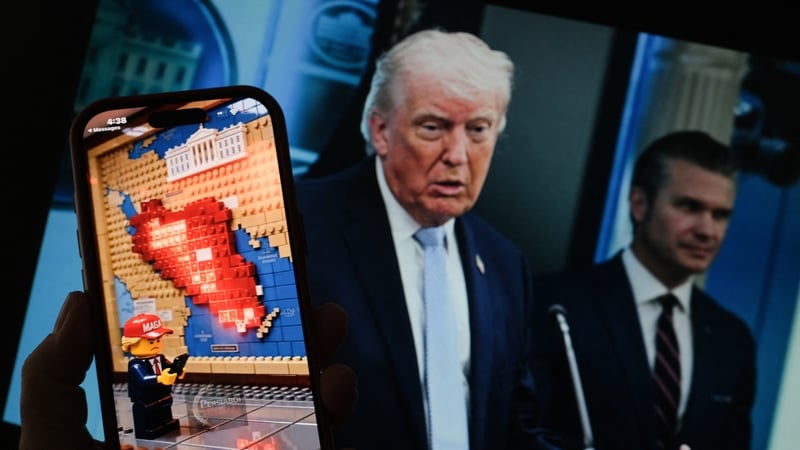

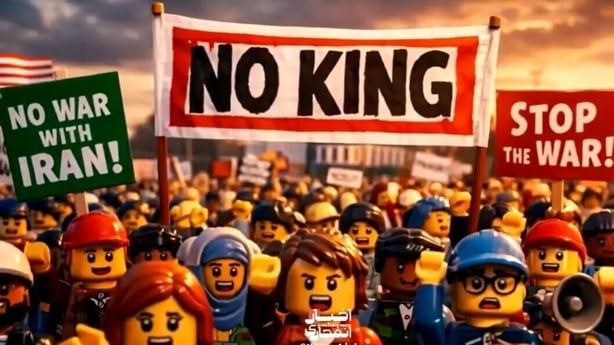
A Lego figure wearing a king's crown and unmistakable Trump hairdo stands in the middle of a chessboard surrounded by soldiers.
"Send them to the slaughter, you're the only one to blame," rap the lyrics over a catchy beat.
The video cuts to an angry Lego Benjamin Netanyahu, thumping his fists and we hear, "bleeding for your puppet while you shaking in your suite".
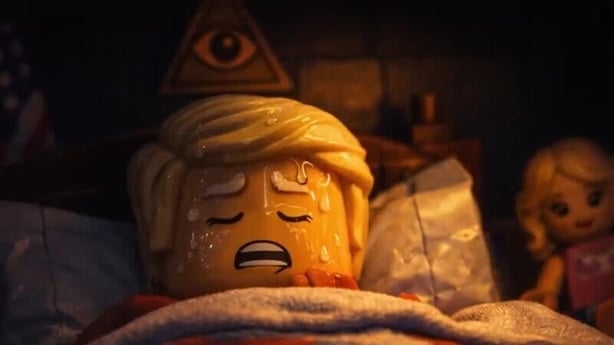
Lego Trump is covered in beads of sweat.
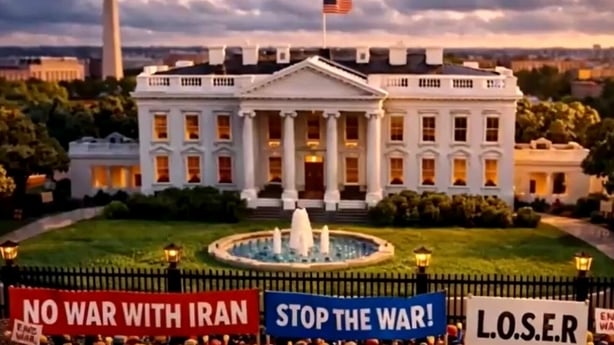
Then "L.O.S.E.R," is spelt out as the word rises from smoking ash.
In another meme, shared by Iran’s embassy in South Africa, an AI-generated Trump, in a garish multicoloured jacket and 1980s Europop bouffant, twiddles the nobs on an electric keyboard, while crooning about a blockade of the Strait of Hormuz.
These are just two examples in a giant wave of content, apparently produced in Iran, that has taken the world by storm, racking up millions of views across Western social media platforms.
Young Americans are lapping it up.
"I gotta admit getting my news from Lego videos wasn’t something I expected this year," wrote one on TikTok.
This unforeseen development in the long-running enmity between Iran and the United States injected humour into the deadly serious business of the US/Israel-Iran war.
But it has also exposed how easily US-made tech and popular culture can be weaponised against its country of origin.
Welcome to the age of 'slopaganda' - otherwise known as 'memetic warfare'.
Observers, used to the tired and predictable "death to America" and "death to Israel" slogan-slinging from Iran’s ageing theocratic rulers, have been taken by surprise.
This internet-savvy, youth-led production, which draws on the US's deepest fears (e.g. tiny Lego coffins draped in the Stars and Stripes) and ploughs the US's deepest internal divisions (e.g. the Epstein Files), has its finger firmly on the pulse.
Of course, some of it plays fast and loose with the facts. But that too is very much on point in the post-truth age.
AI enabling rapid-response content
What has made it all possible? Artificial Intelligence.
"[It’s] the sort of content that just a few short years ago, would have taken a minimum of weeks to produce," Professor Darren Linvill, co-director of the media forensics hub at Clemson University, South Carolina, told RTÉ News
"Now, using AI, you can put that content out very quickly in response to real events on the ground in real time," he said.
He added that the real magic of what Iran had managed to do was create content that genuinely connected with audiences.
The unpopularity of the war in the US - and abroad - meant the videos landed on fertile ground and spread organically across the internet worldwide.
All this is especially striking given that the primary target of the viral memes is a man who rose to power, in no small part, thanks to his own mastery of social-media messaging.
Iran seems to have out-trolled the "troller-in-chief," the Atlantic magazine concluded.
In contrast, some of the posts emerging from the White House these days seem to miss the mark.
An AI-generated image of President Trump dressed in robes, golden light beaming from his hands, at the bedside of a sick patient caused outrage among many Americans, including in his Christian base.
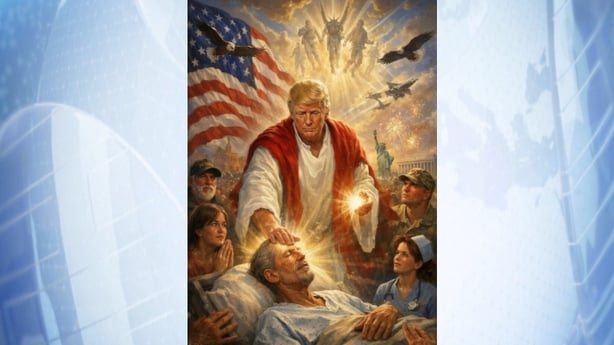
Amid the backlash, Mr Trump said it wasn’t him as Jesus Christ, it was him as a doctor, creating fodder for the US's late-night comedians.
Previously, about a week into the US and Israeli attack on Iran, the White House released a video entitled "Justice the American Way," followed, on X, with a US flag and a fire emoji.
It depicted real military strikes spliced together with clips from well-known Hollywood movies, including Braveheart, Top Gun and Superman to create what looked a lot like a video game.
Critics found it abhorrent.
Actor Ben Stiller demanded the White House remove the clip of his 2008 film Tropic Thunder, declaring: "War is not a movie."
But the Trump administration is not trying to win over its critics, analysts told RTÉ News.
Trump's own base is the target of their memes, and successfully so.
While some Americans may cringe, there are plenty of others who clap along.
With content that "glorifies the violence and the military, it appeals to the same US-based demographic that they've been appealing to for years," Mr Linvill said.
In that respect, it is very much like a continuation of a domestic political campaign, he said.
Iran, by contrast, is fighting "a global war".
"They know that they can't win going toe-to-toe in a kinetic conflict with the US and Israel," he said, "and that's why they're engaging in this propaganda war".
"It is a card that they have to play," he said.
It’s unclear what links the creators of the Lego memes have to the Islamic regime.
In an interview with the BBC, a spokesperson for Explosive Media said it was editorially independent but that the Iranian government was a "customer".
But we can be sure it would have been shut down by now, if it didn’t have the support of the government.
When its YouTube account was suspended last week, Iran’s foreign ministry spokesman slammed the US for attempting to "suppress the truth" about the war.
Of course, while Iranian officials make full use of the right to free speech on global social media platforms, they block internet access for their own people.
A nationwide communications blackout was imposed after protests over a currency devaluation and economic mismanagement erupted earlier this year.
The UN estimates thousands of people were killed by government forces.
"It speaks to the true horror of what has actually happened with this conflict that everybody has stopped being focused on just how evil the Iranian regime and is focused [instead] on Trump and the outcome of this awful war," said Dr Emma Briant, visiting associate professor at University of Notre Dame and expert on information warfare.
"Trump has essentially changed the narrative internationally away from how terrible the Iranian regime is and has helped Iran, in my view, to lead with their framing," she said.
While keeping a tight grip on their own information ecosystems, new technology has provided authoritarian regimes like Iran with powerful new tools to use in external propaganda.
'Fakery that can be very easily hijacked'
In years gone by, a country like Iran would not have been resourced with the expertise to know exactly how to communicate to Western audiences, according to Ms Briant.
AI generation trained on Western data has changed all of that.
It’s "fine-tuned for Western humour and cultural references," and that’s why these videos are resonating with people around the world, she said.
But, she cautioned, this should raise alarm bells for European policymakers over copyright and data protection.
"We need a real rethink of how we have created this surveillance and influence machine nightmare, because this isn't just about Iran," she said
"Stolen data" is being weaponised to unpick Western cultural industries, journalism, creative fields and "everything that we use to create resilient societies and culture," she said.
"The replacement for this is fakery that can be very easily hijacked by anyone with the worst possible intentions."
For Dr Nancy Snow, professor emeritus of communications at California State Fullerton and author of multiple books about propaganda, this moment coincides with a decline in American soft power around the world.
For generations, the US created products that people liked, she said.
Hollywood, for example, "told stories well," and American values were embedded.
"A movie that shows somebody reinventing oneself … or someone driving across the US, in a car and having that freedom on the road, was appealing," she said.
"It’s still appealing to some people," she added, "but the world has found other ways of telling their own stories".
It’s worth noting that China, another authoritarian regime, is currently enjoying a boost to its soft power around the world, with a viral social media trend called 'becoming Chinese'.
That’s where Gen Z internet users film themselves trying out Chinese habits and customs, like drinking hot water and wearing slippers in the house.
Meanwhile, some of the traditional architecture of the US's soft power, like the global broadcaster Voice of America - deemed too liberal by the Trump administration - is being dismantled.
Ultimately, the propaganda war is about messaging, experts said.
US companies have given tools like social media platforms and AI to the world for free, according to Mr Linvill.
"After that, it becomes about communication strategy," he added.
"I think unless the Trump administration learns a few important lessons very quickly, Iran will continue to dominate the online space," he said.