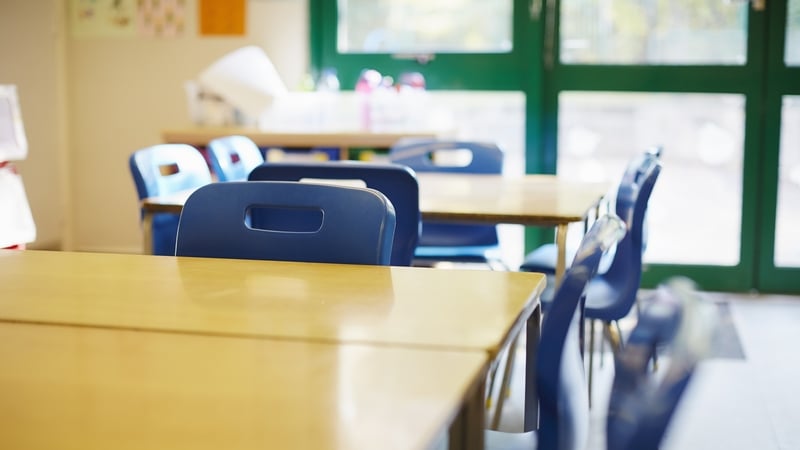

A new approach to the education of children with additional needs has been announced by the Department of Education and Youth.
A new type of class, called an Inclusive Special Class, is to open in five post-primary schools this coming September.
In what appears to be a hybrid of special class and mainstream provision, the department has said the classes will "help students with additional needs learn alongside other students in mainstream classes, while also having time during the day to receive extra support in a special class".
The department has also sanctioned an additional 40 new regular special classes for next year.
This brings the total number of new special classes sanctioned for the upcoming school year to 427.
'A new approach' to supporting students
The department has described inclusive special classes as "a new approach" to supporting students with additional needs, which formalises good practice and allows students to learn alongside other students in mainstream classes, while also having time during the day to receive extra support in a special class.
It said the approach allows schools to support more students within the same school setting and builds on what is already working well in some schools.
"This approach reflects the demand from schools across the country for more flexible and inclusive ways to support students with additional needs", it said.
Each Inclusive Special Class will be staffed by one teacher or 1.5 teachers at post-primary level, and two SNAs.
Schools will receive a grant of €30,000 for furniture and equipment, as well as funding for minor building works if needed.
The five schools that will open inclusive special classes next September are Clonakilty Community College, St Mary's CBS in Laois, Limerick City East Secondary School, St Brendan’s Community School in Offaly, and Coláiste Éamonn Rís in Wexford.
Minister for Education Hildegarde Naughton said the development marked "another important step in ensuring that every child can access the education that best meets their needs".
"By expanding both special classes and introducing Inclusive Special Class models, we are strengthening our ability to support students in their local communities while also responding to increasing demand.
"Our focus remains on early planning, sustained investment, and delivering real, practical supports for families and schools across the country", the minister said.
The department and the NCSE will closely monitor and evaluate the implementation of inclusive special classes.
Post-primary school management bodies have welcomed the new model, saying it formalises and strengthens practices already established in many schools and aligns with national policy developments in inclusive education.
Watch: Education correspondent Emma O'Kelly discusses the new Inclusive Special Class approach on RTÉ's Six One News
We need your consent to load this rte-player contentWe use rte-player to manage extra content that can set cookies on your device and collect data about your activity. Please review their details and accept them to load the content.Manage Preferences
In a shared statement, the Joint Managerial Body (JMB), the Association of Community and Comprehensive Schools (ACCS), and Education and Training Boards Ireland (ETBI) said it was a "positive step in supporting students with special educational needs".
Autism charity AsIAm has responded cautiously to the news.
It said it was "mindful of the many children and young people who are without an appropriate school place for September".
"Whilst proposals or reforms can be welcome in creating a more inclusive education system, they must not fail to negate the right not just to a school place but for that school place to be appropriate", it said in a statement.
Commenting on the use of the word 'inclusive' in the name of the new classes, it said, "we would remind the department that all autism classes in the system should be inclusive and promote opportunities for autistic young people to participate in mainstream activities with their peers".
The charity said it was concerned that today’s announcement had come without advanced consultation, and it called for urgent clarity on how schools will be supported to operationalise such a model and the impact it will have on students.
It said it had written to the department today seeking an urgent meeting.
Analysis
The creation of this new kind of hybrid model for students with additional needs is an attempt to address two problems in the system.
The first is capacity. The level of need is unprecedented. In the budget for this year, the Government committed to creating over 400 additional special classes next September.
That target has already been reached, with 427 new special classes already sanctioned to open next year, and further approvals are expected in the coming weeks.
Demand may be unprecedented, but the capacity is not there to meet it.
Two of the five post-primary schools that will open one of these new inclusive special classes told RTÉ News there were young people with additional needs that they wanted to accommodate, but they simply cannot.
"In an ideal world, we would open another proper autism class, but we just don't have the space", one principal said. Cue this hybrid model, which paves the way for schools to take in more students with additional needs within their existing physical capacity.
Inclusiveness
Eyebrows were immediately raised by the name of the new model - Inclusive Special Class. It is an odd name, given that special classes are supposed to be inclusive anyway.
The existing model is supposed to allow for a flow between special and mainstream education. The idea being that a student in a special class can join a mainstream class as appropriate.
But in reality, the model has become very segregated. In many cases, children consigned to special education can get stuck there.
This new model aims to encourage a better flow, to soften the divide between special and mainstream education, by encouraging the participation of students with additional needs in mainstream classes, while also giving them time during the day to receive extra support in a special class.
That is something to be welcomed.