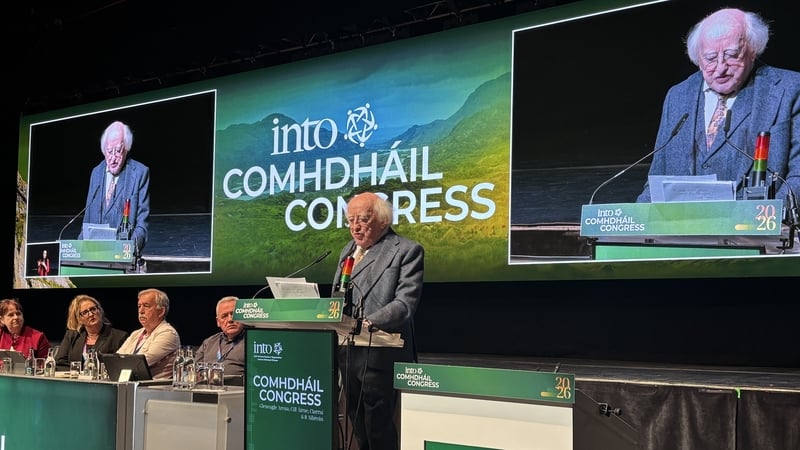

Michael D Higgins has told primary teachers that in a world where war has become "normalised," educators must become defenders of democracy.
Addressing a crowded hall of delegates at INTO congress in Killarney, Mr Higgins in his opening remarks referred to the latest ceasefire.
"As I waited this morning I was very anxious at what has been unleashed in the world," he said. "Whatever respite we have from the most outrageous of language and suggestions, it's good to be with trade unionists."
These opening comments drew strong applause.
'Outrageous language' - Higgins
In a speech that lasted more than half an hour, Mr Higgins outlined his vision of the role of the teacher and the educator in a challenging global context.
"[War] has become normalised in so much of the discourse," he told teachers, "resulting in unnecessary death, destruction of critical infrastructure, mass displacement, hunger and starvation, and in terms of discourse a drive towards ever-increased militarisation, in every aspect of life."
"Security defined as lethal capacity; that is, in fact, a species failure," he added.
Mr Higgins went on to say that he was very proud to say that he always defined security as "freedom from hunger, [and] the right to participate, rather than, in fact, wanting to possess the most lethal equipment."
"That is not security, that is danger," he said.
He attacked not just war but capitalism too and the power of unregulated corporations.
"The capitalism without regulation being sought and given prominence by unaccountable corporations is, as a recent critic put it, 'disaster capitalism’," he said.
He told teachers that the greatest challenge to democracy was from power that is not accountable. "For example, through unrestrained, unregulated, as they would wish it, corporations."
He made a plea for an education system that educates young people to become "engaged, informed and participative citizens... equipped with the skills to question and challenge decisions made by individuals and institutions in positions of power and authority."
"We have, in recent decades, come under ever-increasing pressure to narrow our education system to one which focuses on what is immediate and utilitarian, that which is immediately applicable, most promising remuneratively, and which it is perceived will clone our young people for the labour market, even at the cost of the development of life-enhancing skills such as imaginative and analytical thinking."
He said to view schools purely as places to educate children as a future labour force would be "a dangerous road."
Urging teachers to "be the arrow, not the target," he said, "Be the target and you are marginalised. Be the arrow and you are an instrument of change in your life and the lives of others."
"May I suggest that we seek to inspire our students to become engaged citizens, with critical capacity, unafraid to question the status quo, to look beyond the barriers of perceived wisdom, and to resist the easy but dangerous group-think which is responsible for so many of the injustices in our society, facilitated by an unaccountable social media," he said.
Mr Higgins celebrated the role of teachers, saying the profession was "among the most noble and important of professions."
"It is such a privilege to influence and shape the young minds who will be the decision-makers and activists of tomorrow, the voices of change who will be charged with the responsibility of tackling the ongoing and future challenges which we will face on our shared vulnerable planet," he said.
Mr Higgins received a sustained standing ovation from teachers, both as he entered the room before his address and as he concluded by wishing teachers "gach beannacht don todhchaí in bhur n-obair fíor thábhachtach".
Conference told of class where half of children are homeless
A Dublin school principal has told delegates at INTO congress that half of the children in his school are homeless.
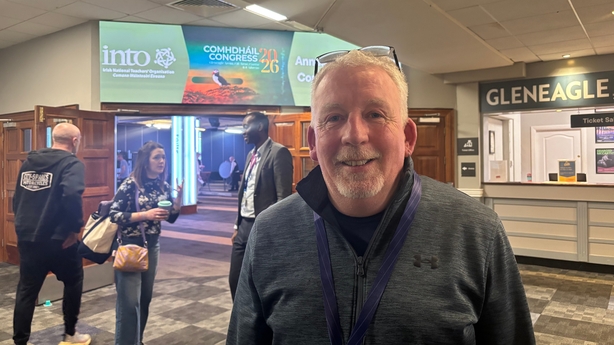
"It's just my reality, it is my norm", Principal of St Laurence O'Toole School Mark Candon said during a debate on the issue.
Speaking to RTÉ News after the debate he said: "Every now and then I think 'that can’t be right’ and I go back and count them again and it is".
He said in addition to his 50% of homeless pupils, there was more "invisible homelessness" in the school.
"There’s mothers with their kids living with her mam, because they can’t get a home", he said.
Another delegate called homelessness "the biggest issue facing our children and their families".
"We need to make noise about this, we need to get loud," he said.
A school principal in a school in Limerick city spoke of one child in her school, a five-year-old child in junior infants who has spent the last three years living in a hotel. Tracie Tobin said it was "devastating" to look at this child knowing that.
She said the housing crisis was also leaving school staff homeless.
"We have to do everything in our power to help our children and our families, and our colleagues who find themselves homeless," she said.
Delegates supported a motion expressing horror at the continued and ongoing housing and homelessness crisis and the impact it was having on the physical and emotional health of children, as well as their ability to engage in education.
They have instructed their union to work with ICTU "to make campaigning for decent social and affordable homes for all a priority for the coming year".