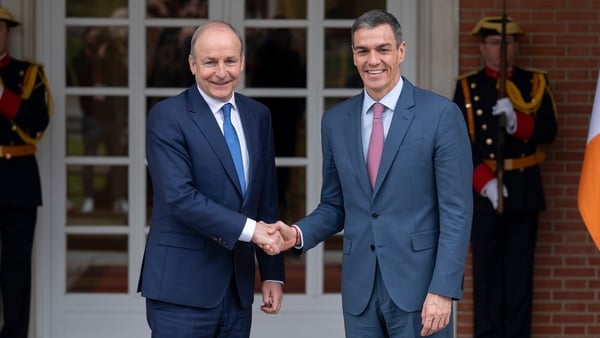
Taoiseach Micheál Martin has described as "unacceptable" Israel's attack on Iran’s South Pars gas field, which in turn prompted Iran’s retaliatory strike on Qatar’s Ras Laffan facility, the world’s largest liquified natural gas complex.
He is joining EU leaders for a summit in Brussels this morning as Europe confronts a deepening series of challenges brought on by the Iran war.
Mr Martin told reporters: "Any further attacks on energy infrastructure in the Middle East is unacceptable. It will have long-term repercussions for the energy market and all sides need to desist from such attacks."
Asked if Europe should do more to help reopen the Strait of Hormuz, the Taoiseach said: "The most effective way to all of that is a de-escalation of this conflict. The Iranians have responsibilities. Their reckless and irresponsible attacks on the Gulf are absolutely unacceptable. They're threatening EU citizens by those attacks, endangering them and people who have no involvement in this.
"But I think in all conflict situations, all actors have a role in terms of enabling a de-escalation and an end to the conflict.
"Europe has channels, and I think Europe will be ready to play a constructive role in endeavouring to resolve those outstanding issues."
On energy costs, Mr Martin said the Government had instruments within social protection which could be used to support people through soaring energy costs, but he warned about the risks of inflation.
"We will look at the full gamut of areas where we can give some support to people. What's important is to point out the volatility of all of this. We've just had a significant escalation this morning in terms of gas prices because of further action in Qatar and elsewhere, so we're very conscious of the volatility of this."
He said there would be a short- and medium-term dimension to the Government’s response.
"We've got to look at the broader potential implications over the rest of the year. It is a very serious situation, and we're very conscious of the impact this can have.
"Our immediate priority is to try and alleviate pressures on people, on families in particular, and then to make sure that we can do it in a way that doesn't do any damage to the economy or doesn't create any secondary effects in terms of inflation," added Mr Martin.
As well as the growing energy crisis, leaders in Brussels are due to address the continuing calls for support from the Trump administration to help reopen the Strait of Hormuz.
Leaders are also expected to confront Hungarian Prime Minister Viktor Orbán over his continued blocking of a €90 billion loan for Ukraine.
The challenges that EU leaders were supposed to be dealing with at today's summit - how to boost competitiveness, and reduce energy costs - have been overshadowed by the US-Israel attack on Iran, but they are also linked.
European leaders are still largely hostile to military support for Donald Trump’s war of choice - for many reasons, but not least because he consulted none of his European allies.
Yet, officials admit that saying this is not our war is not a long-term strategy if the Strait of Hormuz remains closed and oil and gas prices continue to rise.
The EU is also increasingly angered by Israel’s assault on Lebanon, which has internally displaced a million people, and the European External Action Service called on Israel last night to cease its operations there.
Officials have pointed out the huge volume of missiles and drones that Iran has launched at tiny Gulf states, whose progress had been based on the notion that they were islands of stability in a turbulent region.
For this and other reasons, diplomats have said that Europe cannot simply wish the war away.
Of equal concern is Hungary’s continued blocking of €90bn in loans for Ukraine.
What makes this a deeply personal dispute is that Mr Orbán agreed to the loan in the presence of fellow leaders in December before reneging on it.
Read more:
Government finalising 'appropriate intervention' in response to rising fuel costs
UN body proposes safe corridor for Middle East shipping