


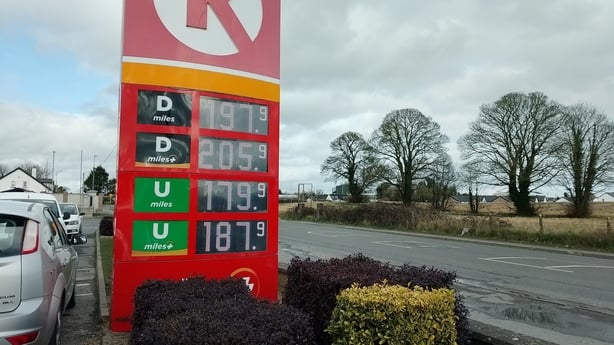
There has been a surge in global oil prices, as the ongoing conflict in the Middle East intensifies, with Israel targeting oil depots in Iran over the weekend, prompting an Iranian military spokesman to warn the cost of a barrel of oil could reach as high as $200, if the US and Israel continue hitting Iran's energy infrastructure.
Oil prices have risen to more than $119 a barrel, hitting levels not seen since mid-2022, as some major producers cut supplies, and fears of prolonged shipping disruptions gripped the market.
Our Economics and Public Affairs Editor, David Murphy, joined Behind the Story to outline the far-reaching implications of the conflict on energy and fuel prices, and what levers are at the Irish Government’s disposal to alleviate the burden on consumers.
Food security
Food security is another major concern for Gulf countries, with up to 90% of the food imported into the United Arab Emirates coming through the Strait of Hormuz, the vital waterway that has effectively remained shut since the conflict began.
Associate Professor of Middle Eastern Studies at Leiden University in the Netherlands, Christian Henderson, joined Fran on the podcast and explained how reliant countries in the region are on foreign food imports.
"You're talking about a region in which the vast majority of food is imported. I would say at least upwards of 80% of the food that is consumed within the Gulf states is imported from abroad, and in some cases, that figure rises up to about 90%," he said.
"Because of the effective closure of the Straits of Hormuz, shipping that would normally access the ports within the Arabian Gulf, such as Kuwait or Qatar or Jebel Ali in Dubai, is no longer able to do that.
"That means that a key logistical route into the region is essentially closed and all of the food being imported is essentially no longer able to reach its destination," the associate professor said.
He added: "The whole Gulf region, and indeed the Middle Eastern region, is really reliant on Jebel Ali Port, in Dubai. It’s one of the biggest ports in the world outside of Asia, so if that is not functional, then I think this will have a big knock-on effect on the logistics of food within the whole region.
"There is also a great deal of fresh food that is often flown into the region by air freight. And of course, because of the attacks on airports, some of the air freight has been disrupted, so that fresh food will perhaps become less available, the longer this war goes on."
The Middle East remains an important market for Irish food and drink exports, currently valued at approximately €370 million annually, with dairy exports accounting for 85% of total export value.
With transport delays causing serious issues for the import of certain dairy products, this remains a major concern for many Irish exporters.
With the UAE’s dependency on imports estimated at between 80% to 90%, could it potentially run out of food if this becomes a prolonged conflict?
Read more: Home heating oil reaches €880 for 500 litres
Mr Henderson said: "They've done their best to prepare for some of these eventualities, and I think that in terms of basic commodities, whether it be flour or cooking oil or sugar, certainly things that you can store for a long period, I think they have about two to three months, maybe even six months, supplies of food.
"If the situation worsens, they will be able to ship or truck food in from other ports in the region, similar to what Qatar did in 2017 when it was subject to an embargo by its neighbours."
Water supplies
Water desalination plants have also come under attack in Iran and on the Persian Gulf island of Bahrain over the weekend, threatening a resource vital to life in the harsh desert climates of the region.
Experts say it can take plants three to six months to get back up and running after an attack, so how much danger does this pose to a region in which Gulf states depend massively on desalination of seawater to produce their drinking water?
"If it becomes a tactic of this conflict to target desalination plants, it'll be catastrophic because the moment those types of utilities are targeted, then essentially that means that water supply is jeopardized. And I think that would be a real crisis," said Mr Henderson.
You can listen to Behind the Story on the RTÉ Radio Player. You can also listen to the episode on Apple here, or on Spotify here.
