
Ukrainians joke about Kharkiv's obsession with its well-groomed streets.
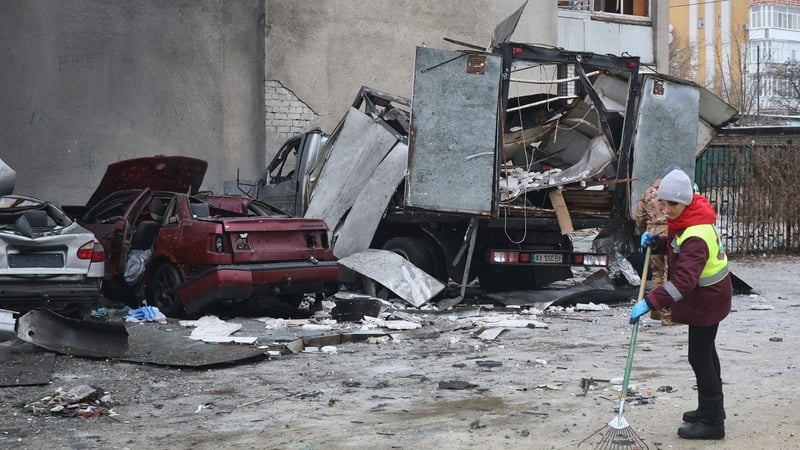
On Friday morning, as we emerged from Lyceum No. 105, an underground school built to save children from being killed by Russian airstrikes, municipal workers were hacking away at the ice layers on the pavements, and scrubbing the slushy street surfaces clean.
The city authorities currently have their work cut out for them. Vladimir Putin has been bombing Ukraine's second city - population 1.4 million - vindictively since February 2022.
With each residential block struck, an army of workers swiftly appears alongside the Red Cross, carving chipboard panels to cover shattered windows almost as soon as they are blown out, and sweeping up the broken glass.
Located just 20 kilometres, as the drone flies, from the Russian border, Kharkiv also prides itself on its contradictory identity: majority Russian-speaking, but strongly Ukrainian.
Belgorod is just over the Russian border and families would often straddle the frontier when living and working. "Kharkiv had never been Russian," says Natalia Zubar, a Ukrainian activist and war crimes investigator. "It was always multicultural, almost like Odesa."
Although established as a joint Ukraine-Muscovy cossack fortress against Tatar raids in the 17th century, Kharkiv by the 19th century had acquired a distinctively European and multicultural flavour.
The city’s university counted Goethe among its board members, while British and Belgian investors were drawn to mining and metalworking opportunities. Before Russia’s invasion, the city boasted 230,000 university students, including 27,000 from overseas.
RTÉ News takes you inside one of Kharkiv's underground schools
After the Bolshevik Revolution, Kharkiv was designated the capital of the new Ukrainian Socialist Soviet Republic until 1934. During the first waves of collectivisation, a huge influx from the countryside changed the city’s demographics from two-thirds Russian to two-thirds Ukrainian.
However, the policy of Ukrainisation, through which Stalin tolerated a limited national identity, was abandoned in the 1930s.
The Soviet leader destroyed Kharkiv's reputation as an educational hub by shooting many of the intellectuals and poets - confirmed Bolsheviks - who had thrived in a purpose-built arts centre known as the Slovo Building. They later became known as the Executed Renaissance.
"We used to see Russians - and I am not exaggerating - as our brothers."
When the Euromaidan protests erupted in Kyiv in 2014, pro-Russian activists - many suspected to have been bussed over the border - launched an abortive attempt to seize the regional headquarters and proclaim Kharkiv a "people’s republic" similar to ventures in Donetsk and Luhansk.
The Ukrainian flag was restored on the regional administration building, but not before bloody street fights in which a number of people were killed.
61% of Kharkiv were Russian speakers in 2001
Whether the people of Kharkiv in 2014 were relatively favourable towards Russia is a moot point. The 2001 census showed that 61% defined themselves as Russian speakers.
Natalia Zubar, who was on a Russian "kill list" when special forces stormed the city, says: "People here were not pro-Russian, They were mostly indifferent, or pro-Soviet - which doesn't mean pro-Russian at all."
Whatever about the city’s loyalties, 24 February, 2022 changed everything.
In the early hours, Russia launched airstrikes on military bases around the city and 20,000 troops, camped over the border in Belgorod, streamed into the Kharkiv region, reaching the city’s ringroad within hours.
Expectations that a russophone city would welcome the invaders proved as delusional in Kharkiv as elsewhere.
The Battle of Kharkiv, involving full scale clashes between Russian and Ukrainian troops, as well as bombardments from the air, was ferocious. It claimed the lives of over 600 civilians and lasted for three months, with much of the city’s fin-de-siècle boulevards destroyed.
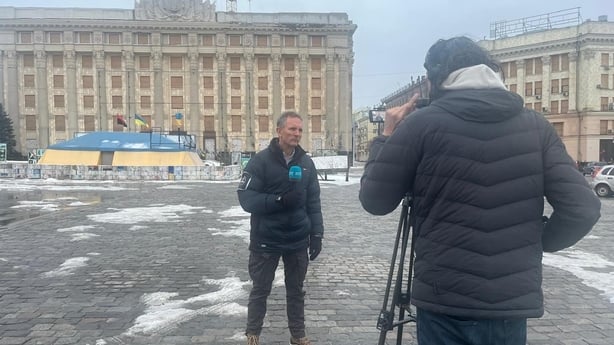
With a Russian capture still looming, mayor Ihor Terekhov told the Wall Street Journal’s Yaroslav Trofimov: "We used to see Russians - and I am not exaggerating - as our brothers. Every fourth person here either hails from Russia or has family there. But not even in our worst nightmares could we imagine that they would bomb our residential areas, destroy our city’s infrastructure."
"Our people are in shock. The mindset has reversed completely," he said.
Four years later, I meet Mayor Terekhov deep in a reinforced bunker, the location of which we have been asked not to disclose. Surviving on just over an hour’s sleep per night, his attitude to Russia has hardened further.
"If people talk about Kharkiv being a Russian city they’re wrong," he says. "A Russian city is Moscow, or Saint Petersburg. Kharkiv is a Ukrainian city, and always will be."
Today, Mayor Terkhov manages the most bombed city in Ukraine, with 13,000 buildings damaged or destroyed. 3,500 of those include schools, kindergartens, medical facilities and administration buildings, according to the mayor’s staff.
Margarita Belkina, a retired Russian-speaker who worked for a South Korean company, fled Kharkiv for Kyiv in 2022 after her apartment was struck by falling debris when air-defences intercepted a Russian missile.
In December, her son urged her to come home: the capital had become too dangerous. In the early hours of Thursday morning, her Kharkiv apartment was struck again, this time by a Shahed drone. Now retired, she’s living on €100 per month and unable to rent somewhere new.
"Before the war I wanted to work abroad while I still had my health and strength," she said gazing tearfully through a shattered window. "But when the war started something changed in me. I became a [Ukrainian] nationalist. I love my country and if I die, I want to die here. I won’t leave. I will be with my president and my people."
Watch: 'If I die, I want to die here,' says Kharkiv pensioner
After four years of war, however, Kharkiv has not succumbed to fatalism.
Nowhere is the city’s growing resolve better expressed than at the National Academic Opera and Ballet Theatre, a vast post-modern leviathan - known as the aircraft carrier - built in 1991, the year of Ukraine’s independence from the Soviet Union.
Just hours before the invasion the vast auditorium was spellbound by a performance of Giselle, a romantic 19th century ballet by French composer Adolphe Adam. In the months that followed, the theatre lost almost a third of its professional staff (one was killed at the front).
"The first months were difficult, the city was under constant shelling," says 67-year-old director Ihor Tulusov. "The theatre was very badly hit, two thousand square metres of glass ripped off the building." An unexploded Russian missile still lies on the theatre’s roof.
Undaunted, Tulusov, a former theoretical physics student, moved operations down four flights to the basement and built a stage just six by eight metres, eight times smaller than the vast space above.
The theatre remained dark. But back in March 2022, the Russian assault on the city was faltering. On 1 April, the Institute for the Study of War (ISW) reported that "Russian forces on the Kharkiv axis have abandoned efforts to take the city."
Across Ukraine, resistance had forced a humiliating Russian retreat. As early as 19 March, the Kremlin had given up on capturing major cities like Kyiv and Odesa and switched the focus to the Donbas, the region comprising Donetsk and Luhansk.
Over the following two years, some 250 ballerinas who had fled to Slovakia and managed to find work touring European capitals, gradually returned to the Kharkiv opera house.
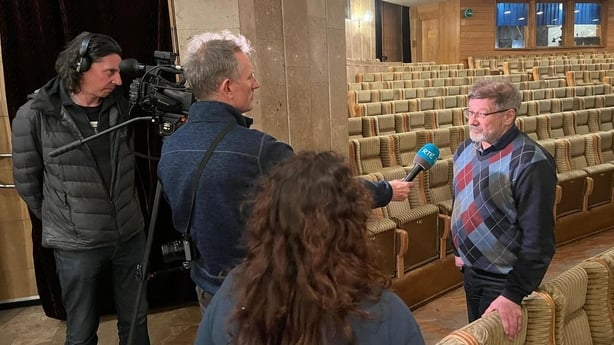
By 2025, the ballet troupe was back to 70% strength and in May they performed their first full performance: an adapted ballet by Frederick Chopin. The 400-strong audience, hunkering in the basement, was enthralled.
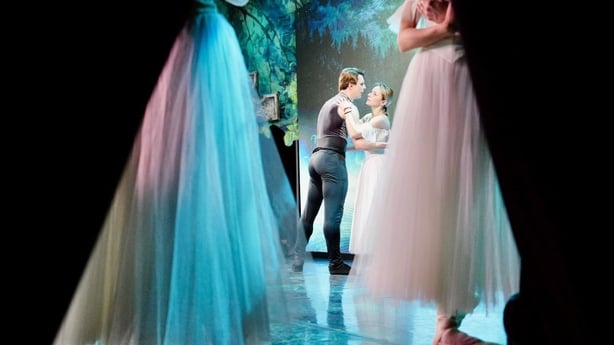
On Wednesday afternoon, we descended to the bowels of the theatre to watch an enchanting rehearsal of Giselle, the same opera last performed on the eve of the invasion. Despite the cramped space, concrete walls and overhead pipes, there was a full orchestra and stage performance, the ballerinas decked out in white against a projected moonlit forest.
"No matter what, we'll keep going," ballerina Olga Sharikova told me between rehearsals, "especially when we see that the audience is grateful, when they’re inspired. In times like these, I hope we can distract them at least for a while, so they can lose themselves in a fantasy world."
Kharkiv's ballet dancers perform in defiance of Russia's invasion
For Olexander Kobylev, chief of the regional police investigations department, there is no such escapism.
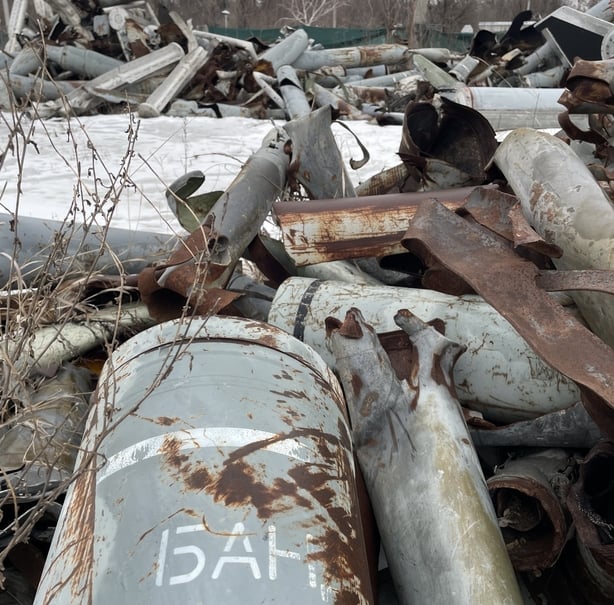
We meet him outside Kharkiv at what has been dubbed the "drone cemetery", a vast snow-encased collection of twisted, rusted metal, circuit boards, cables and serial numbers, representing just a tiny fraction of the death and destruction Russia has rained on the Kharkiv region - piles of Tochka-U, Soviet-era tactical missiles, Uragan multiple rocket launched missiles, as well as Shahed and Gerbera drones.
Far from being a used munitions dump, the drone cemetery is a key part of a vast evidence chain.
For six months in 2022, Russian troops had occupied around one third of the Kharkiv region. As a Ukrainian counteroffensive gathered strength they left in a hurry, leaving a trove of incriminating evidence behind.
"Investigators encountered a massive amount of war crimes evidence," says Mr Kobylev. "Air assaults, shelling, murder, torture, looting - each case was registered for further investigation."
With the Ukrainian government prioritising those oblasts that bordered Russia, regional police joined forces with the SBU, the state security services, and public prosecutors.
Everything was meticulous registered, from mass graves to torture chambers to the basic criminal damage inflicted by a drone on an apartment block.
Mr Kobylev says his department alone, run by a small but determined staff in the basement of a residential building, has opened 25,000 alleged war crimes cases already, and with each passing day the volume increases.
"We document every circumstance and all those who could be involved," Mr Kobylev explains. "We don’t just document cases and interview witnesses, we also try to understand who from the Russian military might be involved.
'The enemy wants to enter our homes'
The walls of the office - location kept secret - are decked with elaborate posters showing Russian suspects and harrowing crime scenes. On a four-screen monitor in his office, Mr Kobylev shows a horrific 3D display of the mass grave discovered at Izium after Russian troops fled: of 448 bodies exhumed, 420 were civilians.
"Our job is extremely important," he says. "The enemy wants to enter our homes, they want to kill and to loot. We have to fight it.
"I don’t know what to say about the attitude of the Russian Federation, their soldiers," he says. "It’s inhuman, in terms of attitude and behaviour. They know they’re hitting civilian infrastructure and that they’re killing civilians. They don’t stop."
"God forbid, if they invade, the people here will tear them apart with their bare hands."
By last summer, the Ukrainian Prosecutor General's Office had documented more than 150,000 alleged war crimes and submitted over 500 indictments to Ukrainian courts under the country’s criminal code. The courts have sentenced more than 100 Russian military officials in absentia.
In Kharkiv, as in other regions, the hope is that a body of indictments will end up at the embryonic International Centre for the Prosecution of the Crime of Aggression against Ukraine (ICPA), established by the EU on the basis that Russia is not a signatory to the International Criminal Court (ICC).
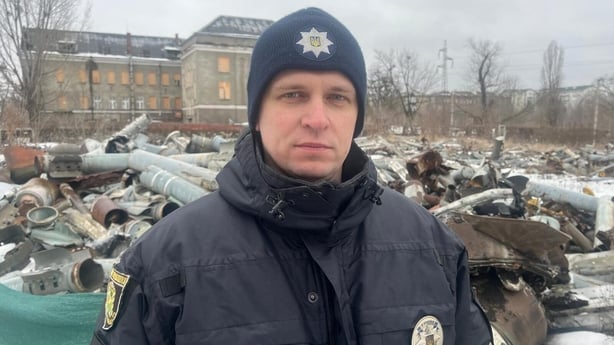
"It's very hard to prove the guilt of the perpetrators," says Natalia Zubar, the citizen war crimes investigator in Kharkiv. "Ultimately our objective is justice. It’s justice for the victims, justice for the country as whole, because a democratic Ukraine cannot be built without the sense of justice, and no war can end without a sense of justice."
'We were a nation - and we remain a nation'
Today, Kharkiv operates on a surreal equilibrium. People have returned, shops are open, restaurants are busy enough, even if they close early.
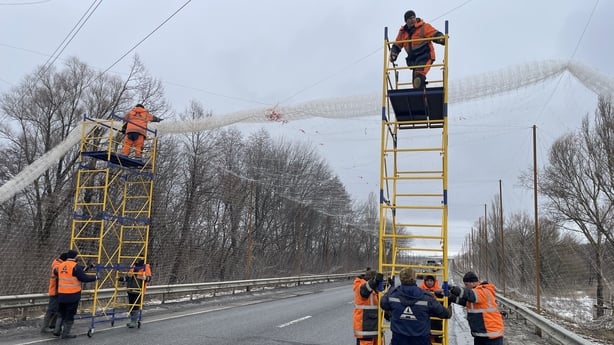
Yet, the skies echo with air-raid sirens every hour, Russia casually kills civilians in their apartment blocks (there were 318 air attacks last year), and cheap but deadly fibre-optic drones (difficult to jam electronically) are getting so close that the authorities are having to erect dozens of kilometres anti-drone nets to create safe road corridors for citizens and logistics.
"Russian forces are now able to conduct fiber-optic [drone] strikes against Kharkiv City itself," the Institute for the Study of War (ISW) reported this week.
"Such increases in fiber-optic [drone] range will also allow Russian forces to harass civilian populations in Kharkiv City, similarly to how Russian forces have been using tactical drones to make life near the frontline untenable for civilians."
The residents of Kharkiv metabolise such realities with grim determination; indeed, the country as a whole has been marking the fourth anniversary of Putin’s war with a blend of anguish and defiance.
"We were a nation - and we remain a nation," historian Yaroslav Hrystak told Ukrinform, an online media, this week.
"The only difference is that before 24 February, 2022, somewhere deep down, we still doubted it. Today, that doubt is gone. In philosophy, there is the concept of a 'thing-in-itself.’ It applies to social phenomena as well: sometimes a community exists without fully recognizing its own existence - until something transformative occurs.
"In essence, we have moved from existing ‘in ourselves’ to existing ‘for ourselves.’ And that is a colossal change."
Antonina Radievskaya, the principal ballerina who plays the tragic, eponymous heroine in Giselle, dismisses talk that Moscow will persist until it captures Kharkiv, so tantalisingly close to the Russian border.
"I’ve never had such thoughts, neither then nor today," she tells me. "Kharkiv is powerful. We won’t let anyone invade, we’ve already shown that. God forbid, if they invade, the people here will tear them apart with their bare hands."
Read more: