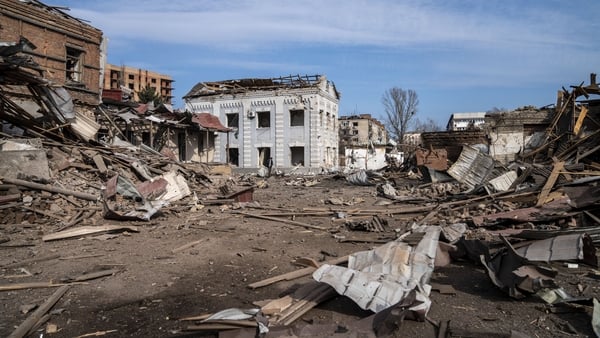
In Saltivskyi, a northern suburb of Kharkiv, a residential apartment block bore the impact of a Russian-launched Shahed drone that struck the building just before 4am.
No casualties were reported but there was extensive damage to the block with windows shattered across the facade.
Russian air attacks of this kind are a regular occurrence for residents in this city of 1.2 million inhabitants, located 30km from the frontline and the border with Russia.
One of the residents, Margarita Belkina, a pensioner, told RTÉ News at the scene of the attack that she had only moved back to the building in December after living as an internally displaced refugee in Kyiv for almost four years.
The windows of her second-floor studio flat had been shattered by this morning's drone strike on the block.
"It’s scary now because this district has not been hit since the start of the invasion and, for four years, it was safe here. It’s only now that the Russians are bombing this area," said Ms Belkina.
She explained that debris from a downed Russian warplane had landed around the complex during the first week of the war, but this was the first direct hit by a drone on the building.
She had spent the night at her son’s apartment nearby and received word of the attack on the block via her neighbourhood mobile chat group
At 3.52am, one of the text messages read: "Is everyone alive?".
By late morning, city council workers had begun their daily task of boarding up shattered windows and Ukrainian Red Cross staff provided aid to residents whose homes had been damaged.
"I regret coming back," said Ms Belkina, whose monthly pension totals 3,000 Ukrainian hryvnia, equivalent to about €60.
She said she only returned to Kharkiv because her son, concerned that Kyiv had become more frequently targeted by Russian drones, had asked her to return to her home city.
The war, said a tearful Ms Belkina, had made her a Ukrainian nationalist.
"I want to stay here with my people, with my president and if I'm going to die, I'm going to die here," she said.
Watch: Europe Editor Tony Connelly reports from on the ground in Kharkiv
We need your consent to load this rte-player contentWe use rte-player to manage extra content that can set cookies on your device and collect data about your activity. Please review their details and accept them to load the content.Manage Preferences
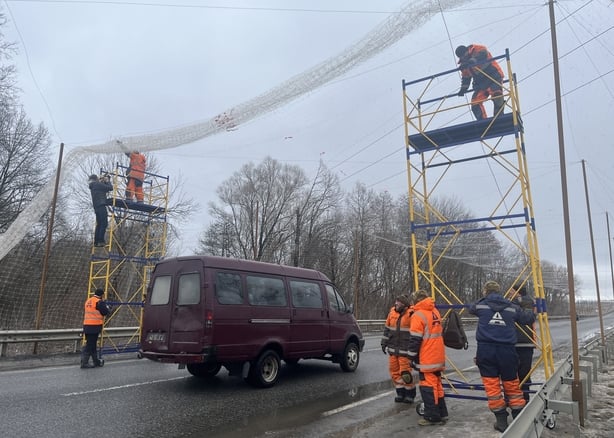
On the city outskirts, construction workers laid anti-drone nets along a stretch of motorway to protect a key logistics and civilian transport route in and out of the city.
Workers had already laid 18km of nets on the city outskirts, they said, and were slowly working their way back towards central Kharkiv.
The nets are being fitted as a deterrent against Russian fibre optic drones (FPVs), which are attached to long fibre optic cables to avoid electronic jamming by Ukrainian forces.
FPVs can travel up to 40km, placing Kharkiv within range if fired from within Russia itself.
Ukrainian officials reported that a Russian FPV had reached the northern outskirts of Kharkiv city on Wednesday for the first time, marking an ominous shift in Russia’s use of the weapon.