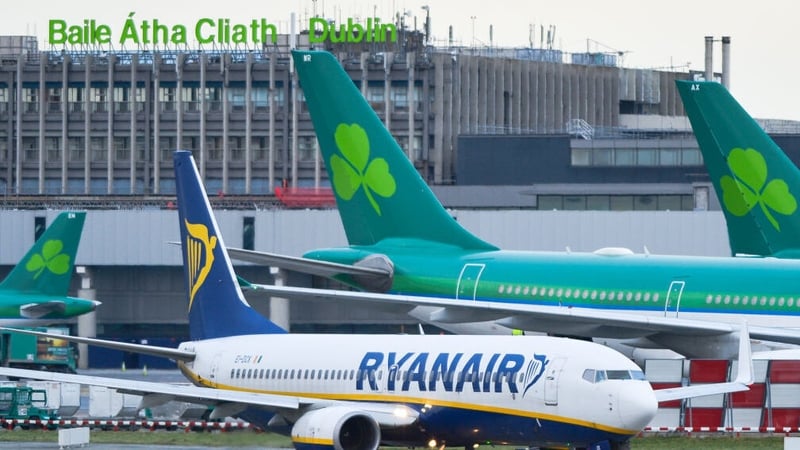

It's just over 86 years since the first flight took off from what is now known as Dublin Airport, a scheduled Aer Lingus service from Collinstown Airport to Liverpool Airport in January 1940.
It took two years for the number of passengers to reach 10,000 a year and a further 20 years before the level topped 1 million for the first time.
From those humble beginnings, the growth in passengers at Dublin Airport has soared.
The numbers travelling through the two terminal buildings reached a record 36.4 million last year.
The figure was well in excess of the 32 million passenger cap, which was introduced almost 20 years ago.
The currently suspended restriction was among the conditions attached to a planning permission granted in 2007 for the construction of Terminal 2.
It set a limit on passengers due primarily to concerns over congestion on access roads.
That year, Dublin Airport handled just over 23 million people.

Lifting the limit was a key pledge in the Programme for Government and this week, in the wake of mounting pressure, the Cabinet approved draft legislation to abolish the cap.
Speaking as he arrived at Government Buildings on Tuesday for the meeting, the Minister for Transport was adamant it had to go, describing it as "a false inhibitor" to growth.
Darragh O’Brien said Dublin Airport is "a critical employer" and "a critical piece of infrastructure" for connectivity and foreign direct investment.
The Dublin Airport (Passenger Capacity) Bill 2026, when passed, will empower the Minister for Transport to make an order to revoke or amend the existing cap and to preclude any future passenger cap from being introduced.
Darragh O’Brien said he hopes the new law, which will now undergo pre-legislative scrutiny in the Houses of the Oireachtas, will be enacted before the end of the year.
Wider impacts debated
A former Cabinet colleague of Minister O’Brien has accused the Government of "pump priming" the growth of Dublin Airport.
Roderic O’Gorman, the leader of the Green Party, claimed it is being done "without any consideration of the immediate impact on the communities around, in terms of noise and the wider climate impact".
"My concern is that there seems to be no even consideration of constraints put in the new legislation, and that it's growth without any consideration of those wider impacts," he told RTÉ News this weekend.
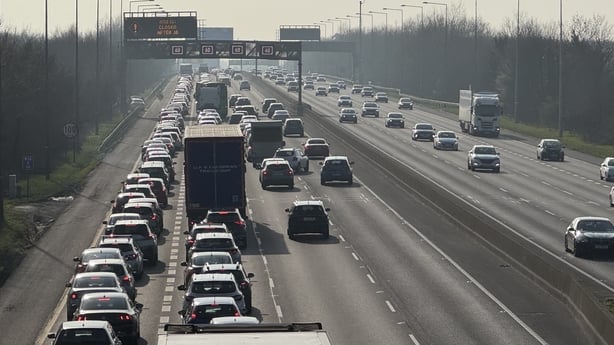
For example, he said significant increases in passenger numbers "are absolutely going to have an impact in terms of the road infrastructure around the airport."
"It has obviously improved since the original cap came in, but all of us saw across December and January major traffic snarl-ups and they were primarily along the north of the M50."
"The M50 is at capacity," he said.
Mr O’Gorman, who served as the Minister for Children, Equality, Disability, Integration and Youth in the last government, said he doesn’t believe activity at Dublin Airport should be regulated by passenger numbers.
"It should look at the level of noise and the level of pollution generated at the airport," he added.
The Dublin West TD said while provision for air connectivity from Ireland to the rest of the world has to be made, "but we cannot forget about the climate impacts, and the localised impacts as well of 100s of additional flights".
"The fact the Government is bringing forward legislation that has absolutely no consideration of climate impact is another example of a government that's basically now barely paying lip service to climate."
He claimed it is "a further indication of this Government's lack of interest in tackling the real challenge that our emissions represent".
Environmental concerns have also been raised by Friends of the Earth Ireland.
The campaign group’s chief executive, Deirdre Duffy, said from a climate perspective, it's "a step in the wrong direction".
"It's disappointing to see the level of urgency that's being attached to lifting the passenger cap when we have other areas where we need similar urgency, like around carbon budgets and climate action plans."
Ms Duffy said aviation is one of the most polluting industries and she said in Ireland, "it takes up 10% of our carbon emissions".
"International aviation emissions are excluded from our carbon budgets but that doesn't mean that the pollution is not going into the atmosphere and causing harm," she added.
The Friends of the Earth CEO also said the draft legislation around the passenger cap is "really concerning".
Head 12 of the Dublin Airport (Passenger Capacity) Bill provides that the provisions of section 15 of the Climate Action and Low Carbon Development Act 2015 "do not apply to any functions or exercises undertaken under this Bill".
Deirdre Duffy said it means "it's exempting the Bill from the Climate Act itself and that's the obligation on public bodies to take into account as far as practicable, national climate objectives".
Legality of the passenger cap
The passenger cap was suspended after the High Court referred legal questions raised in a case in December 2024 to the Court of Justice of the European Union (CJEU) for determination.
The judicial review proceedings were taken by a number of airlines, including Ryanair and US lobby group Airlines for America, and Dublin Airport operator daa over the use of aircraft take-off and landing slot limits at the airport under the EU Slot Regulation.
The legal action challenges the imposition of passenger capacity limits at the airport by the Irish Aviation Authority (IAA), based on the 2007 planning condition.
But an advisor to Europe’s top court this week said the passenger cap "may be taken into account" when allocating slots.
Read more:
Dublin Airport cap may be taken into account for landing slots, says ECJ
In a non-binding Opinion, an Advocate General of the European Court of Justice said it is his view that "an annual passenger limit imposed by a planning authority may be taken into account when allocating slots at an airport with capacity problems".
Manuel Campos Sánchez-Bordona, who is dealing with the case, said the technical, operational or environmental factors affecting airport capacity "are not only physical or material factors, as the air carriers suggest, but also the legal constraints imposed by the rules which, directly or indirectly, affect the use of the airport".
In his Opinion delivered in the Luxembourg-based court on Thursday, he said in his view, "compliance with the limit of 32 million passengers a year can be classified as one of the operating constraints".
An Advocate General's legal opinion is not binding, but it is often reflected in the court's final judgement, which in this case is expected in the coming months.
But it raises the question what happens if the EU court rules that the cap is legally sound before the legislation is enacted?
The Department of Transport said it will "now await the full judgment of the CJEU on this matter".
A spokesperson noted that it is the role of the Advocates General to propose to the Court, in complete independence, a legal solution to the cases for which they are responsible.
"The Advocate General’s Opinion is not binding on the Court of Justice, and the Judges of the Court are now beginning their deliberations in this case."
The spokesperson said in the meantime, the Minister "remains committed to addressing the passenger cap planning condition through the progression of the Dublin Airport (Passenger Capacity) Bill 2026".
The Green Party leader said he "always believed, from a legal point of view, there wasn't an issue with the cap".
Roderic O’Gorman served in Cabinet alongside his party colleague and former Minister for Transport Eamon Ryan, who during his time in office rejected that he could intervene in the issue, saying he had to abide by planning conditions and adding that raising the passenger cap was a matter for the planning authorities and Fingal County Council.
Mr O’Gorman said the legal advice received during the last government was that "the only way to address this was through the planning system, through a planning application".
Following the ECJ Advocate General’s Opinion, he said he thinks the Government "won't be changed in their approach".
"I think it makes it clear that the suggestion put forward that there was some illegality in terms of the existing system is incorrect and it was legal."
"I don't think it's going to change the approach the Government is taking," he added.
People under the flight paths
The legislative move is also facing criticism from local residents.
Dr Niamh Maher, a medical consultant, lives with her husband and two children under the flight path of the North Runway.
She said she is "pretty devastated" at the decision.
The St Margaret’s The Ward Residents Group member said her disappointment is "not just to do with raising the cap, it's the environmental effect, the noise effects that are already occurring in real time to residents that are affected by flight paths in North County Dublin and in East Meath".
"We just feel ignored and that things are just going to play on regardless, that we’re collateral damage really.
"You'll hear a lot about the balanced approach, and particularly in relation to aviation. This is completely unbalanced and it's not really factoring in the effects that this noise, and particularly an increase in air traffic numbers, is going to have on people that are already suffering very significant noise effects."
'A lot of pent-up demand’
The operator of Dublin Airport said it "strongly welcomes the decisive move by the Government".
The daa Director of Communications, Sarah Ryan, said the passenger cap "created a lot of uncertainty for the airport and for Ireland".
She described the decision as "very positive in terms of Ireland's attractiveness as an investment location, as a tourist location, providing opportunities and jobs".
"There's huge unmet demand from places like South America, in particular Brazil; from India, from further in Asia. So, there's a lot of pent-up demand and right now we don't have direct connectivity to those countries."
On the concerns being raised about the current road infrastructure around the airport, Ms Ryan said daa is "very encouraged that about a third of all passengers today come to the airport by public transport, particularly by bus."
She said Dublin Airport is "very well connected by bus across the country".
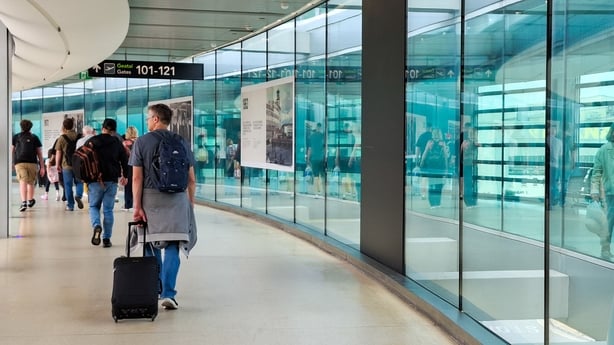
"Recent progress on the Metrolink is fantastic news. Ultimately, the more people coming by public transport, the better, so we're very supportive of infrastructure blockages being removed."
In response to the criticism of the move from environmental groups and local residents, the daa Director of Communications said the Transport Minister "has been very clear that all plans will have the appropriate environmental assessments" and that the local community is a consideration.
Sarah Ryan said the Dublin Airport operator takes its responsibilities to the local community "very seriously".
She said there are some people who are "impacted by noise and by our operations, we're very aware of that, we do our best to minimise it".
"We've actually invested €23 million in home buyouts, in home insulation and school insulation, and we'll continue to do more, so it is something we take very seriously."
Airlines ready to take off
Aer Lingus said it "strongly disagrees" with the Advocate General's Opinion that the IAA was entitled to take account of the passenger cap when determining capacity at Dublin Airport.
The airline said regardless of the ultimate outcome of these legal proceedings, "it is incumbent on the Government to now immediately accelerate the enactment and commencement of the legislation which will enable the Minister for Transport to remove the passenger cap and provide the certainty that is required for the Irish economy".
The Ryanair Group Chief Executive has renewed his call on the Taoiseach Micheál Martin to "pass this urgent legislation before he visits the White House on St Patrick’s Day".
Michael O’Leary said Ireland cannot wait until the end of the year for the legislation to be passed, because he said the Advocate General’s Opinion "may enable the IAA to reimpose this 32 million cap".
He claimed such a move "would not just stop Dublin Airport growing but would require the existing airlines to reduce traffic by up to 6 million passengers annually".

US lobby group Airlines for America (A4A) has called for a "swift adoption" of the draft legislation to ensure US-Ireland aviation connectivity can continue to support economic growth, tourism and competition on both sides of the Atlantic.
The trade association, which represents US airlines, said each day the cap remains in place "compounds legal, commercial and operational uncertainty for airlines".
A4A represents both passenger and cargo carriers, including Delta, American Airlines, United, JetBlue and Air Canada, as well as FedEx and UPS.
Chambers Ireland said removing the cap will "create meaningful gains for trade, investment and employment" across the country.
Chief Executive Ian Talbot said the long‑standing passenger cap has "held back our connectivity over the past number of years".
"The decision to remove it is an important step that will signal to international partners and investors that Ireland is open for business."
Ibec called for the legislation to abolish the Dublin Airport passenger cap to be passed by the summer.
The business group’s Head of Infrastructure and Environmental Sustainability, Aidan Sweeney, said the cap, if left in place, "would cause significant damage to our international reputation, travel, trade and the experience economy".
"Our airport infrastructure needs to be capable of handling future demand to realise our economic and connectivity growth potential without unduly restrictive passenger caps, which will also require prompt approval of the airports Infrastructure Application by the planning authorities."
'Whatever the rules are, we will implement them.'
Under the draft legislation, planning responsibility for Dublin Airport would be moved away from Fingal County Council to An Coimisiún Pleanála.
While the Bill is making its way through the Oireachtas, an Infrastructure Application lodged by daa to the local authority, aimed at raising the passenger cap limit to 40 million and constructing new piers and aircraft stands at Dublin Airport, will continue to be progressed.
In a statement to RTÉ News, Fingal County Council said: "Whatever the rules are, we will implement them."
The local authority said the application is currently the subject of a noise assessment by the Aircraft Noise Competent Authority.
"Having sought information required for the noise assessment from daa in March 2024, ANCA received it in November 2025 and are now working on their draft decision which will go out to a statutory public consultation as quickly as possible.
"The submissions received during the public consultation will feed into ANCA’s final decision which will be given to the Planning Authority prior to the final decision on the planning application being made," the statement continued.
Fingal County Council said every effort is being made to deliver a final decision as soon as possible.
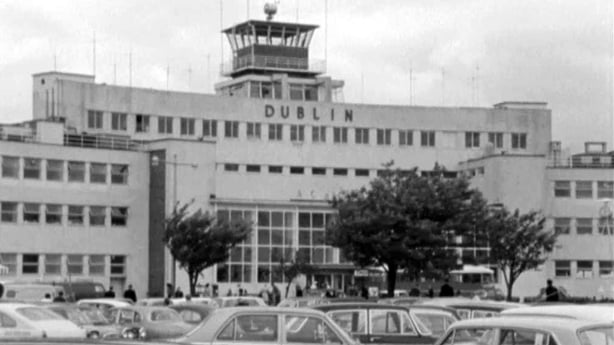
Dublin Airport’s passenger cap has proved highly contentious in recent years.
The lifting of the limit through a legislative approach, rather than through the planning system, may be a welcomed move for some, but for others, it’s a retrograde step.
And while the move paves the way for passenger numbers at the country’s main airport to take off in the years ahead, expect the turbulence to continue too.