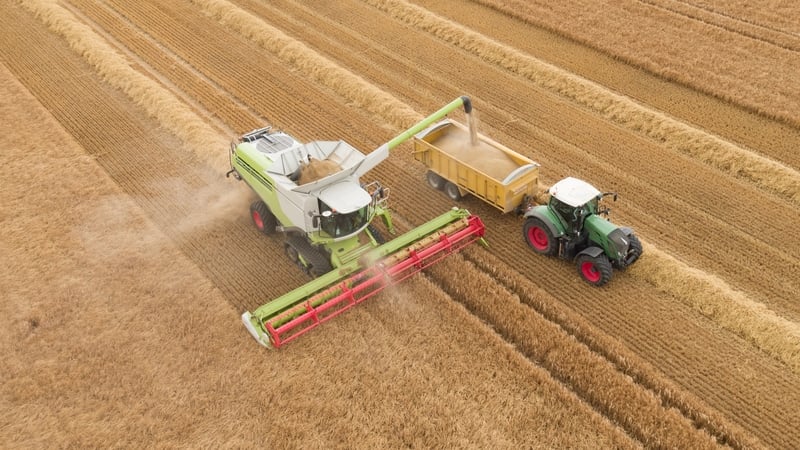

The European Union's budget watchdog has warned that a radical overhaul of farm payments envisaged under the next seven-year EU budget could result in payment delays, greater uncertainty and unpredictability for farmers, and could undermine the ultimate goal of reducing the regulatory burden.
The European Court of Auditors warned that the new way of managing the Common Agriculture Policy (CAP) as part of the overall budget requires further changes before the next budget system is adopted.
"Our message is very simple," said ECA member Iliana Ivanova.
"Clarity, predictability and fairness are essential for a Common Agricultural Policy that truly supports farmers and rural communities.
"This proposal on the table is not completely ready yet to be harvested."
The next €2 trillion budget - known as the Multiannual Financial Framework (MFF) - runs from 2028-2034, and there is pressure on member states and the EU institutions to agree its broad outline before the end of the Irish presidency in the second half of this year.
The current proposal, presented by the European Commission last July, foresees a radical departure in how the budget is structured, with greater emphasis on innovation and competitiveness, and a change in how farm spending is organised.
For the first time since 1962, there will be no separate funding for agriculture.
Instead, the traditional breakdown of supports between direct payments to farmers and rural development funding - known as Pillar One and Pillar Two - will be scrapped and replaced by a single allocation for each member state which will also include cohesion and other regional supports.
The new allocations would come under a single 'European Fund' - worth €865 billion, and the largest part of the MFF - that covers agriculture, rural development, fisheries and maritime sectors.

Each pre-allocated national financial envelope would be managed jointly by member states and the European Commission and implemented through National and Regional Partnership Plans (NRPPs).
The current proposal foresees CAP money that would be ringfenced and non-ringfenced.
Direct payments to farmers have been ringfenced €293.7 billion, as have some other supports previously allocated under Pillar Two.
The non-ringfenced funding will cover cohesion, agriculture, fisheries and security, and will include traditional CAP supports such as LEADER programmes, support for the EU’s outermost regions and the EU school scheme.
The current proposal foresees this amounting to €453 billion, to be managed jointly by member states and the European Commission under the NRPPs.
However, while auditors have welcomed several aspects of the new system, they warn that the legal architecture, and the adoption of the new rules, could be complicated, risking unpredictability for farmers, with a potential delay in the receipt of funds.
The unpredictability could be because the overall CAP budget will not be known until after NRPPs have been adopted.
Adoption of plans may lead to payment delays, warn auditors
Due to the new element of flexibility in allocating CAP money by national capitals, auditors warn that assessing and adopting such plans could delay the disbursement of money to farmers.
The report by auditors acknowledge that the current CAP proposal gives member states a common toolkit of measures with which they can build their National and Regional Partnership plans, and that the flexibilities enshrined in the new system will help countries address specific rural and agriculture challenges they might face.
However, auditors also warn that such flexibilities could lead to an uneven playing field between member states.
"This…creates a risk for the common character of the policy," says Ms Ivanova.
"A significant divergence across member states may hamper the alignment of CAP spending with the EU’s priorities, and it could lead to distortion of competition and an uneven playing field."
The ECA also warns that efforts to simplify how the CAP interacts with climate goals under its "green architecture" - by merging eco-schemes with agri-environmental and climate measures - could backfire.
"All these efforts may be undermined by the fact that the CAP interventions are really scattered across several legal proposals," said the ECA’s Iliana Ivanova.
"This, we think, may create confusion for national authorities and also for beneficiaries when trying to understand and implement the regulatory provisions."
EU agriculture commissioner says changes possible
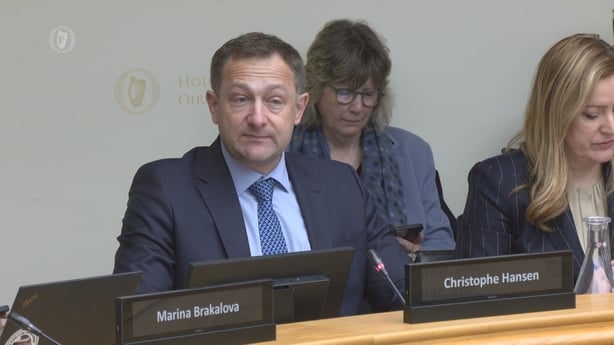
Christophe Hansen, the EU agriculture commissioner, acknowledged the challenges during last week’s hearing before the Oireachtas European Affairs Committee, suggesting changes were possible.
He told the committee: "This is not a sprint, it is a marathon. Now that the proposals are on the table, the co-legislators have to contribute to this fine tuning. And this fine tuning will be about the governance, it will be about the change, it will be about uncertainties."
The Irish Farmers Association (IFA) has criticised the current MFF proposal, saying it will mean a cut of over 20% in the agriculture budget, and has called for the restoration of Pillar Two with a specific farm budget that is ring-fenced.
Member states are currently examining changes to the proposed budget that could see relevant articles switched from the NRPPs back to a CAP regulation, a move the IFA would support.
IFA President Francie Gorman said: "We would share many of the observations noted within the Auditors report and have highlighted them in our interactions on CAP both at National and European level.
"Undoubtedly, there is more risk than opportunity with the Commission proposals; more complexity, and more financial uncertainty which won't be of benefit to genuine active farmers - either existing or the next generation."
He said a 20% cut in the farm budget would put more financial pressure on Irish farmers.
"It's going to mean even lower farm incomes which in turn will have environmental, social and economic consequences in terms of economic activity and jobs supported throughout rural Ireland," he said in a statement to RTÉ News.