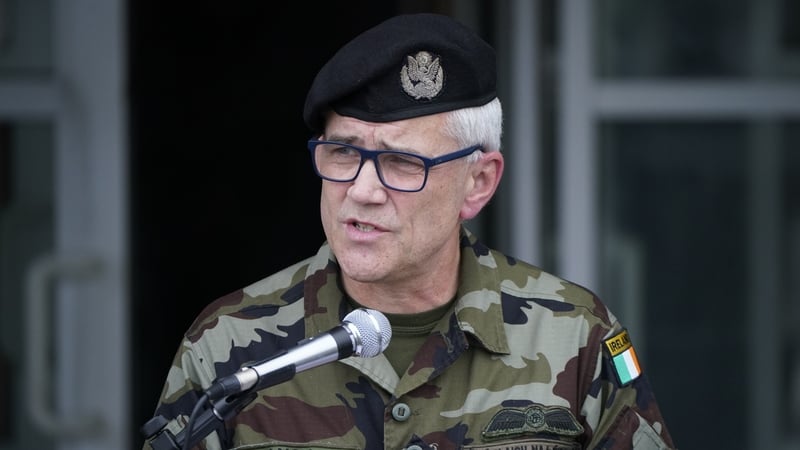

The Irish head of the EU's military committee, General Seán Clancy, has warned that Russia could threaten European countries within the next five years.
In an interview with RTÉ News, General Clancy said billions of euro in EU support for Ukraine was not charity but were part of Europe’s own resilience and readiness.
He also said he had every confidence that Ireland will mount an effective security operation during the EU presidency in the second half of this year.
Asked about Sinn Féin’s criticism of the EU’s €90 billion loan for Ukraine, General Clancy said: "I'm here as chair of the EU Military Committee, and it's not my place to comment on the political dialogue in any particular individual member state.
"Just because I'm from Ireland, of course, I keep abreast of the conversations throughout. This is not actual charity. This is strategic foresight in terms of our support for Ukraine, and it is not a binary choice.
"We're also very conscious of the effort that they're putting in and the resistance that they're putting up in terms of their fight against Russia … Fundamentally, this is a question of sovereignty. It's a question of democracy, and it's a question of a stronger and more secure Europe for the future."
Paradigm shift
General Clancy, who was chief of staff of the Defence Forces from 2021 until he was elected by secret ballot as chair of the EU Military Committee in June 2025, admitted that there had been a paradigm shift in terms of the EU-US security relationship, in particular in light of the recent crisis over Greenland.
"[The relationship] will change. And of course, what is being asked now is for Europeans to share more of the burden. This is not something new. It's over a decade since the US made very clear that they were shifting their focus towards the Indo Pacific," he said.
He said Europe was responding to the challenge through upgrading its defence industry and plugging capability gaps.
General Clancy said strategic autonomy meant "diversifying our dependencies, being more outward looking in terms of relationships and partnerships. It means building our own industry and becoming more self-reliant in terms of our capabilities".
He rejected claims that this amounted to the creeping militarisation of the EU.
"This is not about militarisation. This is about resilience and preparedness. These are lines that Europe is espousing in a very clear, deliberate strategy and approach to what the European Union is doing and is creating the conditions to enable countries to be prepared for the environment that it is currently experiencing.
"That environment… covers everything from the potential of kinetic attack but being prepared and to deter [in a way] that will sustain the peace and the values and the way of life that we currently enjoy."
He said such resilience was necessary so that Europe could "protect the cable systems and the data and economic flow that comes through them".
"It ensures that the trade routes that Ireland is highly dependent on as a member state remain free and open, and where the laws of the sea and maritime law as a whole are observed and understood."
He said Europe had been subjected to hybrid warfare over the past number of years, including cyberattacks, drone incursions and assaults on electoral processes through disinformation.
"This is the reality of the world we now face," he told RTÉ News. "And these are not binary choices. This is about making sure we keep the lights on in hospitals. It's about ensuring we have the economic well-being to have the houses built that need to be built in a state. It is all of these things, and they are no longer isolated in their own silos."
We need your consent to load this rte-player contentWe use rte-player to manage extra content that can set cookies on your device and collect data about your activity. Please review their details and accept them to load the content.Manage Preferences
'Sense of urgency'
General Clancy said NATO states on the European continent could be subject to a Russian attack within five years.
"The understanding and analysis would suggest that Russia would have the capacities and capabilities to test NATO states in a timeframe of approximately five years or less.
"This gives the sense of urgency. No one would have foreseen that we would have war on the continent of Europe again that is now moving into its fifth year. Nobody would have foreseen that five years ago. The reality is we are there.
"We have seen the atrocities that have been unjustifiably, illegally and immorally [carried out in] Ukraine.
"We can no longer take the norms that we would have had in terms of the pre-2020 [world]."
General Clancy said he had no doubt that Ireland would mount a successful security operation during its hosting of the EU Presidency in the second half of this year, adding that suspected Russian drone attacks had been experienced by a range of member states.
"There is a high degree of confidence in Ireland's ability to execute its presidency and fulfil all of its aims and goals.
"The drone threat, if you like, is part of the overall hybrid threats we have spoken about, and this is not unique to Ireland. We have seen this weaponised against Denmark during their presidency. We have seen it in Belgium. We have seen it in most of the Eastern Bloc countries.
"The approach is a Pan European one, through the Drone Defence Initiative … I have every confidence that Ireland will be able to respond and, through partnerships, be able to succeed in terms of securing the security apparatus required for the presidency."