
As the world reels from the latest eruptions of President Donald Trump, the Government is taking stock after a whirlwind week.
There is relief that the prospect of an imminent trade war has receded but the reverberations from the turbulent events remain.
Government ministers have been agreeing with the conclusion of the Canadian Prime Minister Mark Carney, who told the World Economic Forum in Davos that the world order has suffered a "rupture".
It has been clear for some time that the transatlantic alliance has been sundered but Europe has not yet addressed its own self-sufficiency.
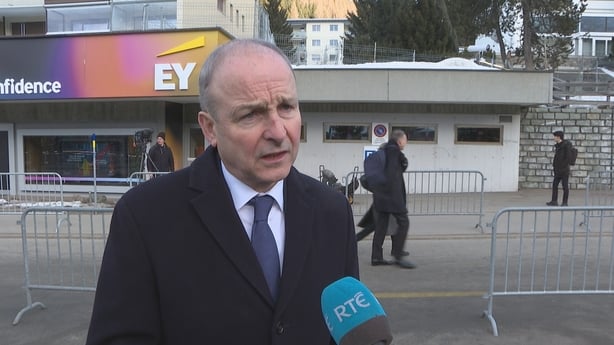
That was on the mind of Taoiseach Micheál Martin, reacting to President Trump's backing down from increased tariffs, as he spoke of the need for Europe to become more autonomous.
"Europe needs to develop stronger self-reliance across the board. That is clear and already that has been happening in respect of the impact of the war in Ukraine. That has really transformed the whole psychology around European security," he said.
But while Europe is having intense discussions on self-reliance, Ireland finds itself in a difficult place as a small, open economy with an uneasy position between the US and Europe.
On the US, it remains a core Government belief that Ireland must maintain cordial relations with the US President.
This was clear from the emphasis placed in the past week by Irish leaders on dialogue and de-escalation.
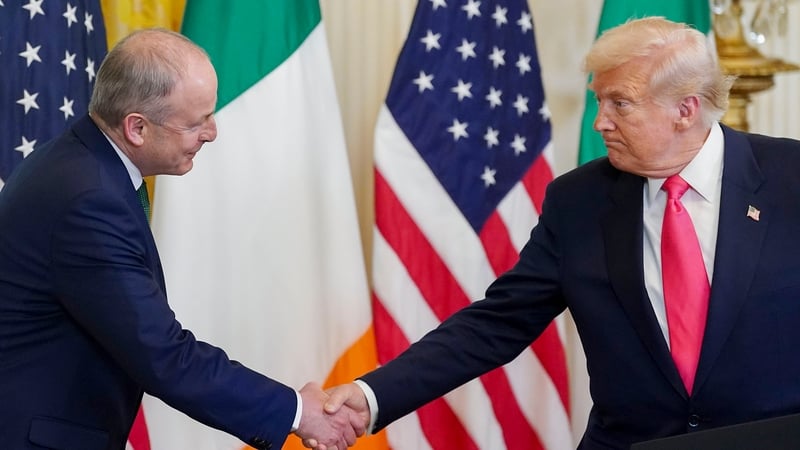
However, all this adds up to another politically tricky visit to the White House for the St Patrick’s festivities.
In the Dáil this week, People Before Profit revisited the political perennial of calling for the visit to be cancelled.
Labour also says that the Taoiseach should not attend this year’s shamrock ceremony, with party leader Ivana Bacik calling out the "creeping fascism" of the US administration.
But delivering a diplomatic snub is not a course of action supported by other opposition parties.
Sinn Féin and the Social Democrats believe it is important that the Taoiseach attends as the Head of State.
It is clear that the Government is preparing for the visit and refusing the expected invite is just not an option.
Mr Martin has stressed the importance of the US-Irish relationship, couching the necessity to maintain good relations for the health of the Irish economy.
"Economically, it’s very critical in terms of the number of jobs that are created both ways: Irish companies create jobs in America, multinationals from America create many thousands of jobs in Ireland," he has said.
But the visit brings with it the perils of another tense rolling news conference in the Oval Office.
Last year’s encounter was fraught with danger as it happened shortly after the mauling given to Ukrainian President Volodymyr Zelensky.
This year brings a heightened tension over the exact tone the Taoiseach should strike with the increasingly erratic President Trump.
Among world leaders at Davos, there was a notable hardening of language and posture towards the US.
Many believe that the previous approach of pandering or flattery is a pointless exercise.
The real political argument here is over what exactly the Taoiseach should say during his prime audience.
The Social Democrats believe Mr Martin should use the opportunity to stand up for Ireland and the EU.
In the words of one operative, "this cannot be just a photo op".
Ms Bacik went further, again calling for an end to "appeasement".
"The EU must use every lever at its disposal. The first thing the EU has to do is to take a new stance, no more appeasement of Trump, no more flattery, no more capitulating, because we've seen that simply doesn't work," she said.
This discussion is also raging in the UK, where British Prime Minister Keir Starmer’s obsequious stance had been seen as yielding results initially securing a less punitive tariff deal.
But President Trump’s rounding on Mr Stamer over the Chagos Islands plan illustrates the perils of negotiating with a capricious leader.
The mantra from the Government is that the visit will be used to highlight the importance of the economic relationship between the two countries.
Tánaiste and Minister for Finance Simon Harris has cited the value of Ireland’s contribution to that relationship with Irish companies employing 200,000 people in the US.
A tense visit lies ahead with huge attention on how the Taoiseach pitches his message to the US President.