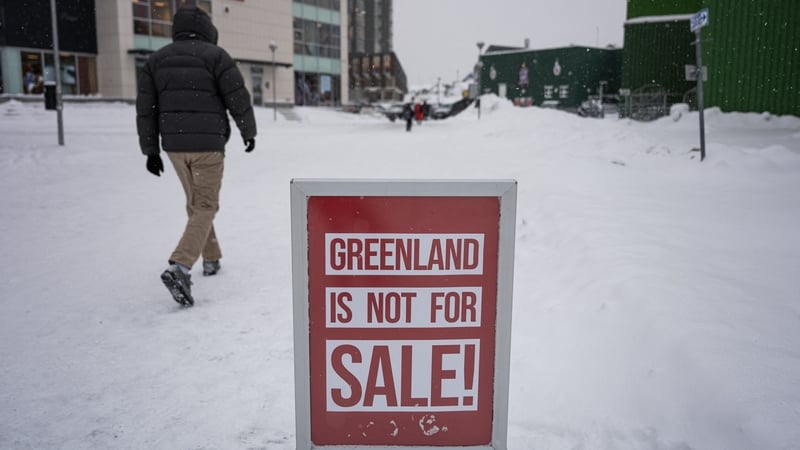

In the summer of 2019, it was reported that Donald Trump wanted to buy Greenland.
It was instant fodder for late night TV comedians but dismissed as another example of a president operating on fantastical whims.
The Danish government responded that it wasn't for sale. Mr Trump cancelled a trip to Copenhagen and called Danish prime minister Mette Frederiksen "a nasty woman".
The world moved on.
However, Mr Trump appeared to be serious.
Researching their book 'The Divider: Trump in the White House 2017-2021', The New Yorker’s Susan Glasser and New York Times chief White House correspondent Peter Baker discovered that throughout his first term, he had badgered cabinet secretaries and national security council staff to figure out how the US could grab Greenland.
I love maps. And I always said: 'Look at the size of this. It's massive. That should be part of the United States.
Mr Trump's college friend, Estée Lauder heir Ronald S Lauder had put the idea in his head, offering himself as a back channel to Denmark. Mr Trump's national security advisor John Bolton assembled a team, including the president's Russia advisor Fiona Hill, to look at options.
They engaged in "secret talks" with the Danish ambassador in Washington; Mr Trump suggested taking Federal money from Puerto Rico and using it to buy Greenland.
Yet he did not appear to be motivated by national security. When they interviewed President Trump in 2021, Ms Glasser and Mr Baker were astonished at how he framed the island's appeal.
Mr Trump told the reporters: "I said, 'Why don't we have that?’...You take a look at a map. I'm a real estate developer. I look at a corner, I say, 'I've got to get that store for the building that I'm building', etc. It's not that different."
He went on: "I love maps. And I always said: 'Look at the size of this. It's massive. That should be part of the United States'."
'One way or the other'
When he returned to the White House last year, Mr Trump lost no time in reviving the Greenland idea.
He immediately threatened to tariff Denmark "at a very high level" if it blocked a takeover and wouldn't rule out military force.
In his State of the Union speech in March, he said the US would get Greenland "one way or the other". In December, Mr Trump appointed Louisiana Governor Jeff Landry as special envoy to Greenland.
The operation to abduct President Nicolas Maduro from Venezuela saw Mr Trump ramp up the national security argument.
"There's not a thing that Denmark can do about it if Russia or China wants to occupy Greenland, but there's everything we can do. You found that out last week with Venezuela," he said.
On 9 January, military force was once again threatened. The US would "do something on Greenland whether they like it or not…if we don't do it the easy way, we're going to do it the hard way," Mr Trump warned.
Yet, if it was a clear imperative for national security, then surely it would have figured prominently in December's National Security Strategy (NSS)?
A quick search reveals not a single reference to Greenland in the 29-page document. Nor does it mention the Arctic.
Asked by the New York Times on 7 January why he needed to acquire Greenland, the President said: "That's what I feel is psychologically needed for success. I think that ownership gives you a thing that you can't do, whether you're talking about a lease or a treaty."
Yet the treaty the US had with Denmark - dating back to 1951 - gave Washington enormous scope to expand its military footprint on the island. The US Denmark Defence Agreement meant the United States could maintain its three wartime bases and add more if deemed necessary by NATO.
Bid for immortality
In an interview with the Bulwark Podcast on 13 January, Susan Glasser was in no doubt that national security was a ruse: this was really about the craving of a US president - pushing 80 - to secure his legacy.
"This is my bid for immortality," she said of Mr Trump's motives. "I want to rewrite the map of the world essentially with my name on it."
Last Saturday evening, Mr Trump's obsession became a full-blown crisis when he threatened 15% tariffs from 1 February on eight European countries who had participated in a small Denmark-led reconnaissance mission to Greenland.
As fury rippled across European capitals, the World Economic Forum's slogan for 2026 - a Spirit of Dialogue - was looking absurdly out of kilter. Davos was about to witness a potentially permanent transatlantic rupture.
"We have to have it," the US president barked at reporters as he arrived at Andrews Airbase from Florida en route to Switzerland. "We need it for national security."
Key Northwest Passage transit route
Greenland is, indeed, relevant to US (and European) national security.
The melting of ice caps has opened up maritime routes. It's estimated the Northwest Passage, which runs through Canada's Arctic Archipelago and links the Atlantic to the Pacific, may soon be open for transit every summer.
That would cut the East Asia to Western Europe route by 7,000km, rendering the passage shorter than the route which goes through the Panama Canal.
"Control of these Arctic waters will be key to unlocking the economic and security advantages of the emerging global passage," writes Meredith Schwartz and Gracelin Baskaran for the Centre for Strategic and International Studies (CSIS).
"Greenland's advantageous position along this route lends it strategic importance to the United States, China, and any other power looking to access the Northwest Passage and project power globally."
NATO says it is already alert to potential power projection.
"One of the most concerning changes in the security situation has been the growing collaboration between Russia and China in the Arctic," US Supreme Allied Commander in Europe (SACEUR) Alexus Grynkewich told reporters on Thursday.
"It's been both in the maritime domain with increased joint patrols as well as in the air domain, with long range bomber patrols being conducted jointly."
Greenland’s wealth in critical rare earth minerals (it’s ranked eighth globally with deposits measured at 1.5 million tonnes) further heightens its strategic importance.
China, which enjoys a near monopoly in rare earths, critical to the production of electronic and military goods, forced President Trump to drop his punitive tariffs after Beijing restricted rare earth exports.
China already has a foothold in Greenland: Shenge Resources is the second largest shareholder in the Kvanefjeld mine, one of two enormous deposits holding critical rare earth minerals. No mining has taken place to date because of the minus 40C temperatures.
The US has also been exploring options. The first Trump administration signed a memorandum of understanding with Greenland for joint surveys and to exchange technical know-how. In June 2025, the US Export-Import Bank offered Critical Metals Corp a $120 million loan to develop the rare earth mine in Tanbreez.
Indeed, Washington's efforts to keep China at bay were already bearing fruit, without the need for the US to invade the island.
Beijing's efforts to invest in Greenland had been curtailed by both US and Danish restrictions (the developer of the Tanbreez site sold the rights to the Critical Metals Corp for a lower price than the Chinese offer).
Yet President Trump dismissed the importance of rare earth minerals moments after he climbed down from his threat to invade Greenland or to use tariffs to crush opposition from his European allies.
"I don't want [Greenland] for anything else," he said. "We have so much rare earth, we don't know what to do with it. We don't need it for anything else. And in terms of Greenland, you have to go 25 feet down through ice to get it."
NATO led to a precipice
Whatever the US president's motives, by threatening military force to acquire Greenland, and relentlessly mocking Europe's resistance, he had wilfully led the transatlantic alliance to a precipice and threatened to deliver the fatal shove when he landed in Davos on Wednesday afternoon.
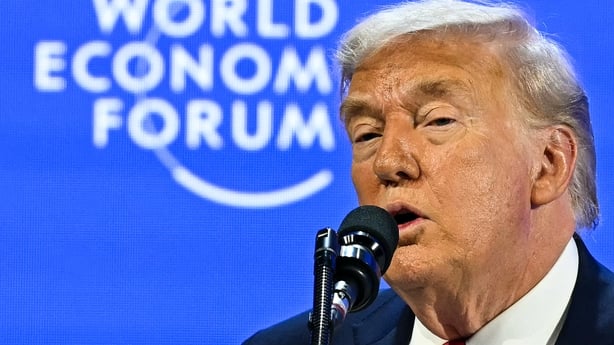
In an invective-rich 90-minute address to delegates in Davos, Mr Trump produced an eye-watering rationale for his right to Greenland: the US had taken it during World War II and had foolishly given it back to Denmark, which had done nothing to protect it; the US was paying "100%" for NATO and all it wanted in return was a "big piece of ice".
Yet, in a tone of wounded innocence he announced he would not use force.
A few hours later there was a further stunning twist.
Mr Trump posted on Truth Social that "we have formed the framework of a future deal with respect to Greenland and, in fact, the entire Arctic Region. This solution, if consummated, will be a great one for the United States of America, and all NATO Nations".
The tariffs on European countries he had declared last Saturday were dropped.
Credit is due to Mark Rutte, the NATO secretary general who had been widely ridiculed for his gushing flattery towards Mr Trump at last year's Hague Summit.
Even in the teeth of the President's threats, Mr Rutte bullishly praised his ability to force recalcitrant European members to increase defence spending to 5% of GDP.
Mr Rutte is understood to have pushed back against Mr Trump's mockery of Europe’s contribution to NATO, reminding him of the sacrifice of Danish, British and other European soldiers after 9/11.
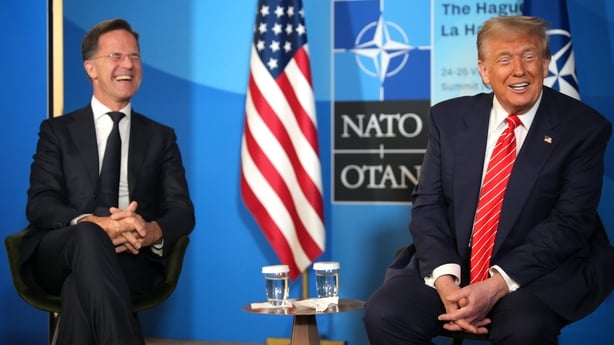
"In Davos, Rutte was the only one capable of playing that role - not Macron, von der Leyen or even [Finnish president Alexander] Stubb," says Oana Lungescu, a former NATO spokesperson and now senior fellow at the Royal United Services Institute (RUSI).
"Rutte doesn't have elections or domestic agendas to consider, he doesn't have to grandstand on social media to boost his personal ratings, he can be the honest broker looking for pragmatic solutions."
Mr Rutte managed to convince Mr Trump to make his national security concerns a NATO problem, and to let the diplomatic track - launched last week between the Danish and Greenlandic foreign ministers and the US, under vice-president JD Vance and Secretary of State Marco Rubio - run its course.
The 1951 agreement could be the starting point: the US could expand its military bases. There were comparisons with the British bases in Cyprus which have remained sovereign UK territory since Cypriot independence in 1960.
It was packaged as a win that would not cost the US a cent and would avoid a catastrophic military clash between one NATO member and another. While Danish Prime Minister Mette Frederiksen was predicting the end of NATO, it seemed NATO had ended the crisis.
What forced Trump to blink?
US markets had lost more than $1 trillion the day before he landed in Davos, the worst slump since his so-called Liberation Day tariffs in April.
The European Union was showing more unity and determination than it had during last summer's stand-off over the Trump administration’s punitive across-the-board tariffs.
Retaliatory measures were deployed: some €93 billion in tariffs on sensitive US imports would be ready to go if Mr Trump's tariffs had taken effect on 1 February.
Europe cannot afford to be weak, neither against its enemies or [its] ally.
French President Emmanuel Macron, who had put Mr Trump's designs on Greenland on a par with Vladimir Putin’s invasion of Ukraine, called for the trade bazooka, the Anti-Coercion Instrument (ACI), which could do serious damage to the US digital, banking and services sectors.
"Appeasement is always a sign of weakness," posted Polish Prime Minister Donald Tusk. "Europe cannot afford to be weak, neither against its enemies or [its] ally."
Denmark was unflinchingly standing up to Mr Trump, repeating on a daily basis that its sovereignty was not up for discussion.
Yet, Europe had to strike a careful balance: avoid escalation, keep the threats on the table, and hope for a diplomatic breakthrough.
"We need to ensure that people sit around the table to discuss this before February 1," Minister for Trade and Employment Peter Burke said in Davos on Monday evening, urging caution over deploying the ACI.
"The risks [of a trade war] are very significant for a small, open economy like Ireland, which really depends on investment, which gets its life blood from trading with other partners, no more than the EU and US.
"We don't want to pull out the Anti-Coercion Instrument. It has never been used and is very significant in terms of procurement rules, locking individuals out of the single market, which is an extreme option to take. We'd like to work with the US, work through our interlocutors and try to ensure that we get a pathway for an agreement."
Whether Mr Trump backed down due to a combination of the above factors, we are not going back to Kansas anymore. The US-led world order, which had cossetted trade and enabled the spread of liberal democracy since 1945, is over, and not just because of Donald Trump.
The rise of great powers - the US, Russia, China - has shattered long standing alliances and reordered the nature of trade.
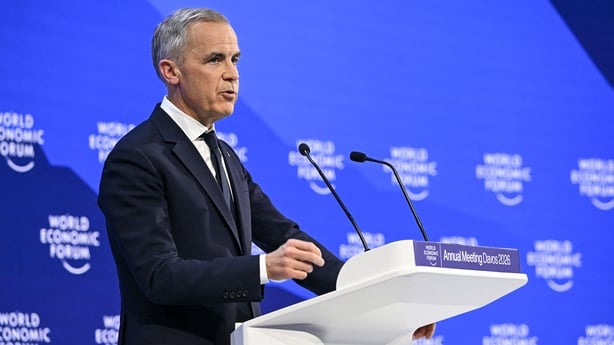
This was captured in Canadian Prime Minister Mark Carney's Davos speech, widely lauded as one of the best in decades.
"Let me be direct: We are in the midst of a rupture, not a transition," he told delegates.
"Over the past two decades, a series of crises in finance, health, energy and geopolitics have laid bare the risks of extreme global integration.
"But more recently, great powers have begun using economic integration as weapons. Tariffs as leverage. Financial infrastructure as coercion. Supply chains as vulnerabilities to be exploited… And as a result, many countries are drawing the same conclusions - that they must develop greater strategic autonomy: in energy, food, critical minerals, in finance and supply chains."
Europe needs 'to pack its velvet gloves with steel'
Within this reordering, Europe is having to rethink its relationship with a US president who will think nothing of publishing the private text messages of another world leader - Emmanuel Macron - and Mark Rutte.
"The past few days underscore the extraordinary stakes of a debate among Europe's leaders that remains unresolved," writes Thomas J Wright, a senior fellow at the Brookings Institution.
"Should they take a conciliatory approach toward Trump, in the hope of coaxing him to their side? Or should they stand firm when he threatens them, imposing costs on him even if it means risking their relationship with his administration?
"The lesson that Europe is likely to draw from the past year - and particularly from the Greenland fiasco - is that it must do both. It needs Trump whisperers who will flatter him, but it also needs to pack its velvet gloves with steel."
There is a growing consensus that standing up to Mr Trump alone will not be sufficient.
"The seismic change we are going through today is an opportunity, in fact, a necessity to build a new form of European independence," European Commission president Ursula von der Leyen told delegates in Davos.
"This need is neither new nor a reaction to recent events. It has been a structural imperative for far longer."
Europe had responded swiftly on defence, raw materials and the digital sphere, she said, yet "we will only be able to capitalise on this opportunity if we recognise that this change is permanent".
Whether the EU is up to the challenge remains to be seen. The clarion calls of the Draghi and Letta reports to increase public investment, boost competitiveness and remove barriers to the single market have been only sluggishly embraced.
During a panel discussion in Davos on the European economy, Taoiseach Micheál Martin criticised the European Parliament for blocking legislation to simplify EU regulations and wondered whether the national veto could be dropped in certain areas of EU policy making.
"We're not a company," he told delegates. "We're 27 member states, all political entities, polities that have parliaments. This is complex and that's challenging in terms of efficiency and getting things done quickly."
Yet, Europe remains heavily dependent on the United States for its security umbrella, but also its computing power.
According to the European Digital SME Alliance, just three US-based companies account for 65% of the EU's cloud services market. These companies, says the Alliance, "are investing billions to augment this dominance. The result is a deep and dangerous structural dependency".
The European Commission is due to bring forward a Cloud and AI Development Act, and that could take up some of the bandwidth in the Irish EU presidency later this year.
On the security front, the EU is now effectively alone in paying for Ukraine's defence against the Russian invasion (and buying US weapons in the process).
Part of the careful management of Donald Trump's attention-span when it comes to the Western alliance has been the promise that Europe will gradually take on the burden of continental defence.
"Europeans are getting more capable but still can't defend themselves without the Americans at least for the next five to ten years," says RUSI’s Oana Lungescu.
"So, we need to see a major and urgent rebalancing in the alliance, including some front-loading of defence investment and ramp up of defence industrial production."
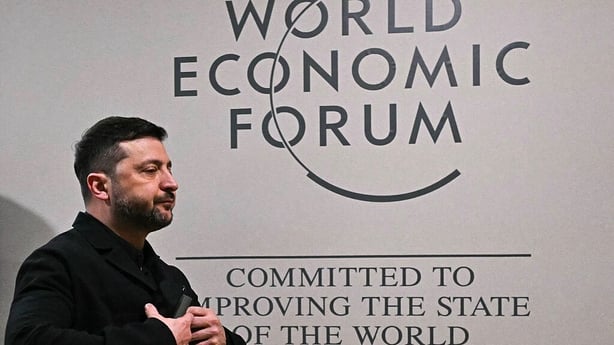
Just when EU capitals were breathing a sigh of relief, a blistering attack came from an unlikely source: Ukraine's president Volodymyr Zelensky.
Speaking in Davos on Thursday, he berated Europe for its timidity in confronting its adversaries, its failure to use frozen Russian assets and its unwillingness to seize tankers trafficking sanctioned Russian oil.
"Putin managed to stop Europe, unfortunately," he told delegates.
"What's missing? Time? Or political will? Too often in Europe, something is more urgent.
"Europe loves to discuss the future but avoids taking action today.
"Too often, European leaders turn against each other … instead of standing together to stop Russia," he said. "Europe needs to learn how to defend itself."
At the end of the most consequential and drama-fuelled gathering of the World Economic Forum in its 59 years, that message seemed to resonate across the snow-frosted Alps.