Gardaí have said there are 200 active investigations into child sexual abuse-related images generated by the xAI chatbot Grok.
It comes after the head of the Garda National Cyber Crime Bureau confirmed there is an ongoing investigation in relation to Grok.
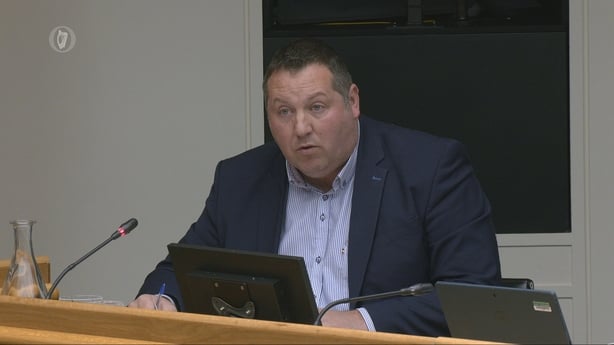
When asked during a hearing of the Oireachtas Arts and Media Committee whether the 200 images under investigation were all from Grok, Detective Chief Superintendent Barry Walsh confirmed they were.
Gardaí said they will conduct thorough criminal investigations with a view to prosecuting offenders.
It said prosecutions could commence under the Harassment, Harmful Communications and Related Offences Act 2020, the Non-Fatal Offences Against the Person Act 1997, the Criminal Justice Act 1994, and the Child Trafficking and Pornography 1998.
Gardaí said they are "fully committed to supporting victims of sextortion and the non-consensual sharing of intimate images to feel fully safe and protected".
During this afternoon's committee, Mr Walsh said the investigation will take some time as the content has to be assessed to make sure it is criminal.
People responsible would then be identified, if that is possible, he added.
Supt Walsh said gardaí have been in contact with Coimisiún na Meán over recent days and will meet them again tomorrow to discuss the situation.
Supt Walsh highlighted that there has been a year-on-year increase in such investigations into this sort of material.
He said last year there were 25,000 referrals of suspicious activity indicative of child sexual abuse material last year.
In comparison to 2024, there were 13,300 such referrals, he said.
Speaking during the hearing, Social Democrats TD Sinéad Gibney said there was a lot of confusion around how online crimes were investigated.
It comes after her party announced it was leaving X citing "the lack of moderation, the promotion of racist and toxic material and the dissemination of appalling images through Grok AI".
In response, Supt Walsh said there were complexities involved in investigating online crime - which often involved going outside the jurisdiction.
"That can create a complication and can create a time delay," he said.
Supt Walsh said he wanted to reassure the public that where a complaint was made, they would investigate as quickly and efficiently as possible.
Meanwhile, the European Commission said it will carefully assess changes X has said it would make to its Grok chatbot.
"We take note of the additional measures X is taking to ban Grok from generating sexualised images of women and children," EU Commission spokesperson Thomas Regnier said in a statement.
"We will carefully assess these changes to make sure they effectively protect citizens in the EU", he said.
"Should these changes not be effective, the Commission will not hesitate to use the full enforcement toolbox of the Digital Services Act," he added.
We need your consent to load this rte-player contentWe use rte-player to manage extra content that can set cookies on your device and collect data about your activity. Please review their details and accept them to load the content.Manage Preferences
X has 'given two fingers' to tech regulations, says TD
Fianna Fáil TD Peter 'Chap' Cleere said he was "absolutely sickened" by the concerns around Grok.
"It's a feeling that is shared by thousands of parents," he says.
He said the challenge being faced by Government is trying to keep legislation up to speed with technological advancements.
However, he said blame ultimately lies with the big tech companies, including X.
"They (X) have given two fingers to tech regulations and two fingers to children in this State, in my opinion, and it's disgraceful what they've been allowed do," he said.
He said AI tools are being exploited by "degenerates in this country for their own sexual gratification".
Mr Cleere said as legislators, they have a duty of care to children, and more needs to be done.
Deputy Joanna Byrne said she felt particularly vulnerable online as a woman.
Women particularly exposed to exploitation online - Sinn Féin TD
Deputy Joanna Byrne said she feels particularly vulnerable online as a woman.
The Sinn Féin TD said there was a huge and realistic fear that youth and women were particularly exposed to exploitation online.
Deputy Byrne asked Mr Walsh about what he called the "robust response" to the sharing of explicit images online.
She said the first thing anyone would want would be the removal of such images.
Mr Walsh said it was hard to disagree with the deputy in terms of the hurt caused by such images.
He said that An Garda Síochána had been very active at school, in college and meeting parents, and trying to tell parents that if something went online, it was very hard to get rid of it.
He said they worked productively with Hotline.ie to make sure images were taken down.
Deputy Byrne asked if there was sufficient legislation in place, and Mr Walsh said there was.
Labour Party TD Alan Kelly, who chairs the committee, said three of four social media platforms have confirmed they will attend the committee on 4 February.
He said the issue is not all about legislation, it is also to do with the companies and personal behavior.
He made the point that drug companies are licensed under a licensing system, but social media companies are not.
"Would you a license a social media company to come into your country and operate in the way that Twitter/X/Grok is operating on - you wouldn't," Mr Kelly added.
Ministers to meet next week on strategy to combat abuse content
Government ministers are to meet next week to decide how best to combat AI-generated and child sexual abuse-related content.
The matter was discussed at ameeting between the Taoiseach and the AI Minister Niamh Smyth this afternoon. A round table meeting will take place next week.
It will include the Taoiseach, Tánaiste, the Attorney General, the Minister for Justice, the Minister for Culture, and AI Minister Niamh Smyth.
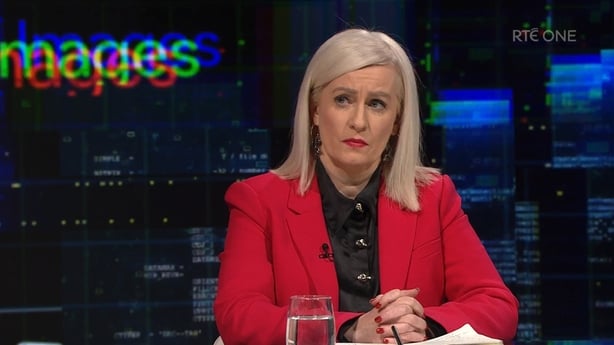
Minister Smyth has said that Grok should be banned in Ireland if X fails to abide by Irish law regarding the creation of sexualised images of both children and adults.
Speaking on RTÉ's Prime Time, the minister said laws are in place regarding the creation and dissemination of AI-generated sexual imagery and that enforcement is needed.
Asked if AI chatbot Grok should be banned, the minister said: "My own view is if X are not going to abide by the laws here in Ireland, yes, it should be banned," she said.
"I have disabled my account, and I know many of my colleagues in government have also disabled their accounts," she said, adding, "I have no doubt that that Taoiseach, along with his Cabinet colleagues, will take a collective decision on this in the very near future".
Ms Smyth said she has written to the Garda Commissioner about the AI chatbot Grok, and similar apps.
Victims of AI-generated material urged to come forward
The CEO of Hotline.ie, a service dedicated to combatting illegal online content including child sexual abuse material (CSAM) has urged those who are victims of AI-generated material to report it to An Garda Síochána.
Mick Moran, who is a retired garda, spending much of his career investigating child sexual abuse, said there are 20,000 to 30,000 reports of CSAM made every year from platforms like X.
Speaking on RTÉ's Drivetime, Mr Moran said: "Those figures are pretty shocking when you hear them because each of those cases involves an investigation into CSAM activity, be it uploading it, be it distributing it, be it producing it, whatever".
Mr Moran said each case requires a full investigation, stating that in Ireland the Garda Protective Services Unit and Detective Chief Superintendent Barry Walsh’s unit are heavily involved in investigations into CSAM crime.
Mr Moran said CSAM was previously only being produced from children were actually being abused, "whereas now we have the spectre… that AI will be able to produce it without children being abused".

"We saw here in Ireland that the law has been changed, in Europe we saw the DSA (Digital Services Act) coming in, then to the formation of the regulator, Coimisiún na Meán, who will regulate these platforms if they don’t take down illegal material or they don’t properly treat illegal material to the values of Ireland," he said.
He said there are laws in relation to 'nudification’ apps and the replacing of people’s photographs into bikinis, adding that it is things like Grok AI that "bring it into sharp focus", that "AI is moving towards changing how we do business".
Mr Moran said in this changing regulatory authority, certain individuals may be irreverent and a little bit edgy around it, adding that "we saw it with Elon Musk, who was basically laughing at people’s upset by the fact that these bikini photos can be produced on his platform".
He said that that Mr Musk is very quick to ridicule efforts to regulate.
However, Mr Moran added that he believes "regulation will win out in the end".
Mr Moran said he has urged anybody who has been a victim of such material to make a complaint to gardaí or report to Hotline.ie, to have it taken down.
Hotline.ie provides an online platform for the public to report illegal online content.
"It is not on, because it is touching on people’s sense of wellbeing and touching on issues of bodily integrity.
"It is exactly what the law around intimate images was brought out, what Coco’s law was brought out for, it is exactly what we were fighting against. So please report it," he said.
Mr Moran said gardaí and worldwide police forces will never have enough resources to deal with this, "because it is such a huge issue".
However, he stressed that it is important not to conflate nudification apps with CSAM.
"CSAM has always been illegal. CSAM is something that has existed since the beginning of time," he said.