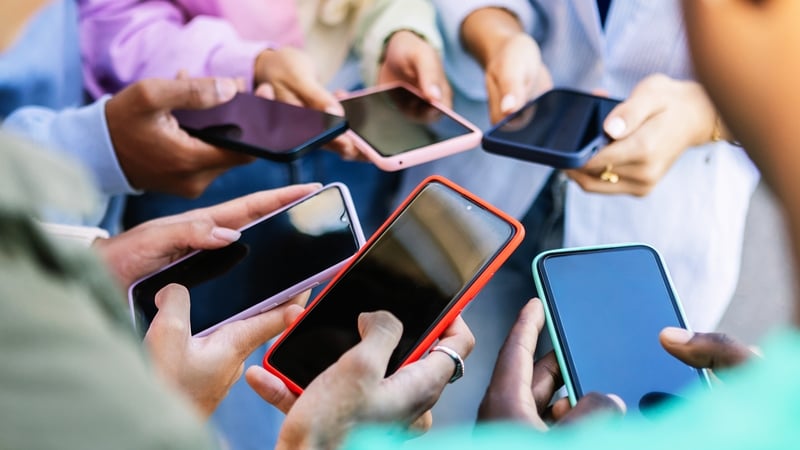

Australia's world-first social media ban for under-16s has come into effect.
Platforms including TikTok, YouTube, Instagram and Facebook have been ordered to block children or face fines of up to €28 million.
The ban is being closely watched by countries around the world, including Ireland, as governments and regulators everywhere try to enforce greater online protections for children.
Would a similar ban work in Ireland?
Many legal commentators and campaign groups have warned that an Australian-style ban could be very problematic if it were to be introduced in Ireland.
Simon McGarr is an internet law expert with McGarr Solicitors.
"I think the Australian ban has been implemented more as an experiment than anything else," Mr McGarr said.
"Australia obviously isn't a party to European Convention on Human Rights or covered by the EU's Fundamental Rights Charter.
"We have to remember that Australia is working in a very different constitutional and human rights framework to anybody inside the EU.
"This move involves explicitly banning a group of people from taking actions, which are free for other people to do on the basis of their age.
"Of course, we are able to ban things for children if they're bad for them, if there's evidence, as there is with smoking for example.
"The difference here is that this is being implemented without any evidence presented," he said.
What is Ireland planning in this area?
Minister for Communications Patrick O'Donovan has said the Government is not considering an Australia-style social media ban on under 16s at this time.
"But we hold an Australia-type in reserve if we have to," he said.
Yesterday, Mr O'Donovan discussed a plan with Cabinet colleagues to introduce an age-verification mechanism system to prevent children from accessing adult content on the internet.
He said this will work by using an "online wallet" which would be linked to a person's PPS number.
The Irish Council for Civil Liberties (ICCL) and Digital Rights Ireland (DRI) have expressed concerns about any plan that would introduce state-run digital identity checks for internet users.
"This kind of disproportionate response to a very real issue veers into the realm of authoritarianism," said ICCL Executive Director Joe O’Brien.
Chair of Digital Rights Ireland Dr TJ McIntyre also expressed concern.
"Giving government data about identity to social media platforms will give them even more information about individuals than they have already," Dr McIntyre said.
Campaign groups say there are better ways of protecting children online such as making platforms turn off algorithms by default; and by introducing tougher regulations for online advertising.
The Department of Communications previously said that Ireland, along with other European Union member states, is examining the question of prohibiting access by children and young people to social media platforms.
"Ireland is of the view that it would be preferable for any decision to be taken by the EU and EU Member States together and that we should have regard to the rights of children and young people," the department said.
What are the social media platforms saying about the ban?
YouTube described the Australian ban as unfortunate and "an extreme position".
"As other governments around the world consider how to tackle the very real challenge of helping young people stay safe online while also helping them access positive material, it's clear that blanket account bans will have extremely negative consequences," the platform said.
Last week Meta started to remove under-16s in Australia from Instagram, Threads and Facebook ahead of ban.
The company said it was committed to complying with the law but warned that compliance will be "ongoing and multi-layered".
Meta also repeated its call for app stores to be held accountable for checking ages instead.
TikTok said it would comply with the ban but told users the changes "may be upsetting".
"We understand that these changes may be upsetting, but they are necessary to ensure that TikTok complies with Australian law," the company said in a statement.
TikTok, Meta and YouTube parent Google all have their European headquarters in Ireland.
They are big employers and pay billions in corporation tax here.
If the EU does start discussions on an Australia-style ban, how loud will Ireland's voice be given the importance of the social media giants to our economy?