
The Cabinet has approved the designation of Sligo as an eligible county under the Defective Concrete Blocks (DCB) Scheme.
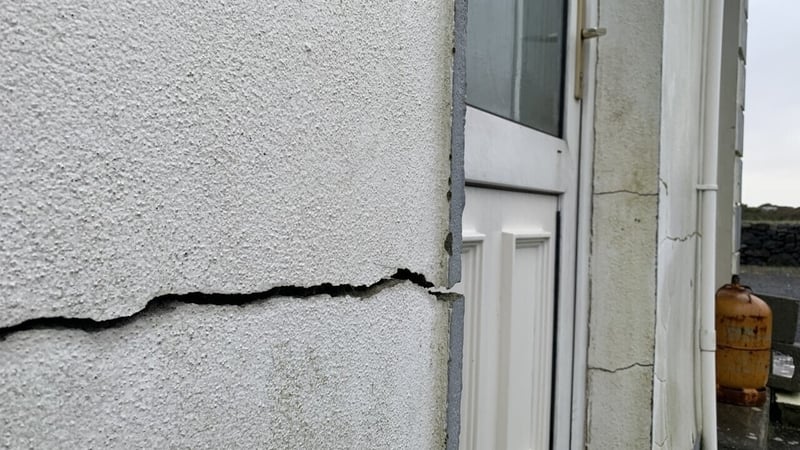
A report last February by the Housing Agency noted pyrite damage to between 250 and 350 dwellings in certain parts of the county.
Homeowners impacted by the same issues in Donegal, Mayo, Clare and Limerick are already eligible to apply for assistance under the scheme.
It was set up to provide support in cases where dwellings are damaged due to the use of blocks with excessive amounts of pyrite or mica.
Local authorities are responsible for the administration of the scheme, with applications referred to the Housing Agency to determine if properties meet the 'damage threshold' for entry to the scheme.
Funding for 100% of the cost of remediation works can be approved, subject to a cap of €420,000.
The scheme is only open to those whose homes were built before 31 January 2020. Qualifying properties must be owner occupied or have been registered with the Residential Tenancies Board before November 2021.
Works can range from entire demolition and rebuilding of an impacted dwelling, to partial repair of external walls.
Holiday homes and vacant properties are not covered by the scheme.
Cabinet set to approve retail, hospitality support scheme
The Cabinet was also due to consider a new targeted enterprise support package to help retail and hospitality businesses hit hard by higher costs.
The plan, expected to be approved by the Cabinet, is set to include more generous sustainability grants.
It will be funded by tapping unused monies in a €257m business support scheme. That allowed businesses to claim 50% of last year's rates bill up to €10,000, giving business owners a maximum grant of €5,000.
Minister for Enterprise Peter Burke will suggest another round of grants for eligible businesses in the retail and hospitality sector.
The sustainability element will involve the department altering the level of funding it provides, likely paying more than the previous 50/50 split.
Last month, Taoiseach Simon Harris said a key priority for him would be to provide new supports for businesses, amid complaints from the sector that they were being burdened with higher costs.
For example, the minimum wage was increased to €12.70 this January but employers argued they were landed with higher costs because the PRSI threshold for the higher rate remained the same.
It is understood Mr Burke's memo to Government could see this changed as well.
The Restaurants Association of Ireland maintains, however, that while the top-up in cash support will be welcomed - the "key measure" the sector needs "is a reduction of VAT to 9%".
Childcare funding model
Minister for Children Roderic O'Gorman will seek Cabinet approval for a new childcare funding model for children experiencing disadvantage.
It is understood the new scheme will be called 'Equal Start' and is similar to the DEIS model in schools.
Its primary focus will be providing supports targeted at childcare settings operating in areas of disadvantage, as well as child-targeted and universal supports.
Around 800 settings and more than 35,000 children in these settings are expected to benefit from the setting-targeted supports.
If passed by the Cabinet, the roll-out of the scheme will commence in September, with €4.5m provided this year to fund start-up costs such as additional staff time.
The investment is expected to be equivalent to €13.5m in a full year.
Literacy strategy
A new Literacy, Numeracy and Digital Literacy strategy will be brought to Cabinet by Minister for Education Norma Foley and Mr O'Gorman.
The strategy is set to run for ten years, but it includes an implementation plan for the first five years.
The previous national literacy strategy in 2011 led to reforms in teacher training courses, professional learning opportunities for existing teachers, extensive curriculum reform, extra supports for learners in most need, and increased parental and community involvement.
Ministers will be told that this played a role in Ireland's improved international rankings in tests of reading and mathematics in the OECD's Programme for International Student Assessment tests.
Read more:
Payments for Ukrainian refugees to be cut under Govt plan
Additional reporting Paul Cunningham