
The EU's top diplomat has warned that a "weaker" Russian President Vladimir Putin would pose a "greater danger" after Wagner's aborted mutiny sparked the largest political crisis in decades in the nuclear-armed country.
"A weaker Putin is a greater danger. So we have to be very much aware of the consequences," Josep Borrell said ahead of a gathering of EU leaders in Brussels.
"Until now we were looking at Russia as a threat because it was a lot of force and force has been used in Ukraine. Now we have to look at Russia as a risk because of internal instability," Mr Borrell told reporters.
Mr Putin confronted the biggest challenge since he came to power in 1999 after Wagner chief Yevgeny Prigozhin spearheaded a mutiny at the weekend.
EU chief Ursula von der Leyen said the rebellion would lead to "aftershocks" and insisted it was "important that we double down on the support for Ukraine, be it military capability or financial support".
Leaders were joined by NATO Secretary General Jens Stoltenberg, with the focus on what kind of security guarantees Ukraine can expect, short of NATO membership, which is not on the cards so long as the war continues.
Mr Stoltenberg pointed to the "cracks and divisions" in Russia, exposed by Wagner's actions.
But he warned it was "too early to draw any final conclusions".
Mr Stoltenberg said he expected new announcements of military support to Ukraine during a NATO meeting next month in Vilnius.
Mr Borrell also said Europe needed to support Ukraine for the "long haul", supporting the country "during the war and after" and recommended a "Ukrainian defence fund".
The fund, he said, would support the modernisation of the Ukrainian army, with a commitment from the EU to ensure the war-torn country's security.
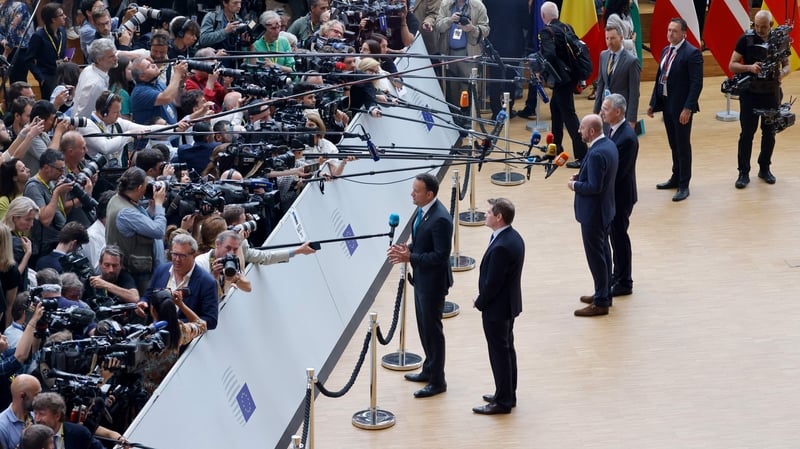
Taoiseach Leo Varadkar joined other EU leaders at the two-day summit.
Ireland, alongside Austria and Malta, has secured language in the final communique that any security commitments towards Ukraine will take account of Ireland's tradition of neutrality.
Leaders are also expected to approve a French initiative to ensure that the EU will be part of any such guarantees, by way of what is being called a security commitment.
It is understood this will in effect be a continuation of what the EU has provided so far - ie, training missions for Ukrainian troops, and military support through the so-called European Peace Facility.
However, because of the general, and potentially open-ended nature of the promise, Ireland, along with Malta and Austria, secured language to the effect that any security guarantees will be "taken in full respect of the security and defence policies of certain member states".
Leaders will also discuss a European Commission proposals that immobilised Russian Central Bank assets could be used to help pay for the reconstruction of Ukraine, estimated by the World Bank to cost some €411 billion.
One idea is for a windfall levy on €100 billion in cash which is currently parked in a Belgian clearing house. However, a number of member states have taken note of the ECB's concerns that seizing such cash could lead to financial instability.
Additional reporting AFP