
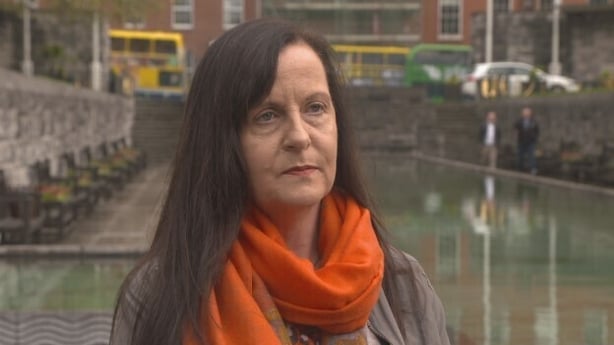
Jillian Brennan knows only too well the pain of losing a loved one in a work-related incident.
Her husband Paddy Byrne suffered fatal injuries in 2011 in an incident involving a vehicle recovery truck.
"His injuries were unrecoverable and I was catapulted into shock," Ms Brennan said.

"I saw the darkest days, weeks and years that anyone should endure and my life at that very moment came to an end when his life did."
"It simply shouldn't have happened, no one should go to work and never make it home," she added.
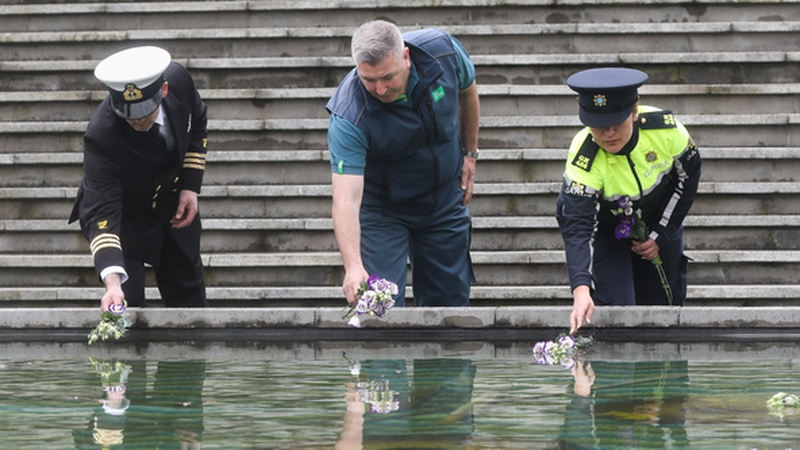
Ms Brennan was among those who attended the annual Workers' Memorial Day commemoration in Dublin's Garden of Remembrance which honours those who have been killed or seriously injured in work-related incidents.
The President of the Irish Nurses and Midwives Organisation (INMO) Karen McGowan addressed the event and called for the Health and Safety Authority (HSA) to be better resourced to enhance the safety of nurses, midwives and all other healthcare workers.
"The HSA has done phenomenal work in transforming workplace safety in the construction and agriculture industries – if given the resources it must do the same in healthcare," Ms McGowan said.
In Ireland, 461 people were killed in work-related incidents over a ten-year period from 2013-2022.
In the first three months of 2023, five people have been killed in work-related incidents.
Of the 27 work-related fatalities recorded in 2022, 10 were employees, 13 were self-employed and three were non-workers.
Farming continued to be one of the most dangerous sectors in which to work, with 12 fatalities recorded in 2022.
In the first three months of this year, there were 2,162 reported work-related injuries or illness, reflecting an increase of almost 3% compared to 2,100 for the same period in 2022.
The sectors with the highest number of reported injuries and illnesses in 2022 included human health and social work, manufacturing, wholesale and retail trade, repair of motor vehicles and motorcycles and construction.

"Last year we saw the lowest number of work-related deaths since records first began over 30 years ago, though 27 people sadly lost their lives," said Minister of State for Business, Employment Affairs and Retail Neale Richmond.
"While this is a reduction from 38 deaths in 2021, even one death in the workplace is one too many. It is incumbent on all employers and employees to make health and safety a top priority in their organisation," Mr Richmond said.
Irish Congress of Trade Unions General Secretary Owen Reidy said that part of the tragedy of these losses is that we know how to stop workplace fatalities and injuries.
"It involves workers and managers cooperating to create safe systems of work, to assess hazards and to reduce risks," Mr Reidy said.
"It involves education and training for workers and management and support for the role of safety reps in our workplaces," he added.
Later this year, the Health and Safety Authority will be launching the third edition of the Safety Representatives Resource Book which contains up-to-date information, practical guidance, and best practices for promoting workplace health and safety.
"As Ireland's labour force is aging, we must all look to our workplace practices, and ensure that health and safety is being prioritised across all workforce age groups," said Mark Cullen, Interim Chief Executive Officer of the HSA.
"We're urging employers and their workers this Workers’ Memorial Day to think about the task you’re asking others to carry out, or that you are about to undertake."
"Complete a risk assessment and make sure the right precautions are in place and nobody is putting themselves or others in danger," Mr Cullen said.
Marking Workers’ Memorial Day, Labour Party leader Ivana Bacik called on the Government to move to provide collective bargaining rights to all workers to ensure greater safety in the workplace.
"Every year on this date, we remember those who have died or have become injured or ill in the course of their employment," Ms Bacik said.
"Those who have died and their families who were left behind are foremost in our minds today. But we cannot forget the workers who have been left to cope with debilitating injuries and impacts to both their physical and mental health as a result of workplace incidents," she added.