


The Department of Health has confirmed 429 new cases of Covid-19, bringing the total in Ireland to 36,155.
There has been one further death, bringing the death toll here to 1,804.
The breakdown of the cases shows that 189 were in Dublin, with 60 in Cork, 31 in Donegal, and 28 in Galway.
There were 18 cases in Kildare, 15 in Clare, 12 in Limerick, nine in Meath, eight in Louth, seven in Cavan, seven in Longford, six in Laois, five in Offaly, five in Westmeath, with the remaining 14 cases in eight counties.
Of today's cases, 203 are men and 226 are women, with 65% of them under 45 years of age.
The National Public Health Emergency Team said 45% are confirmed to be associated with outbreaks or are close contacts of a confirmed case, with 77 cases identified as community transmission.
We need your consent to load this rte-player contentWe use rte-player to manage extra content that can set cookies on your device and collect data about your activity. Please review their details and accept them to load the content.Manage Preferences
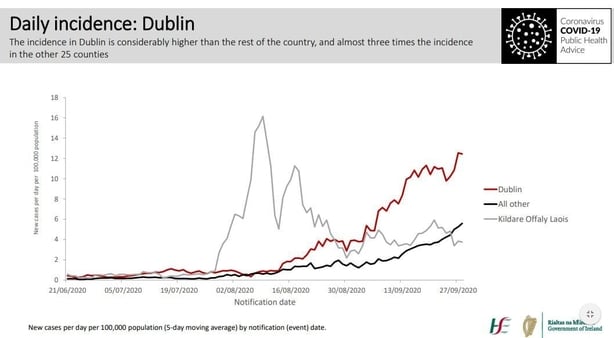
Acting Chief Medical Officer Dr Ronan Glynn said 4,384 cases have been notified over the past 14 days and there is a 14-day incidence of 92 cases per 100,000.
He said the median age is 33 years, with 67% in people under the age of 45 years.
Of the 4,384 cases, 2,147 (49%) are in Dublin, 414 (10%) in Cork, 336 (8%) in Donegal, 189 (4%) in Galway and 189 (4%) in Kildare. The remaining 1,082 have been spread across remaining 21 counties.
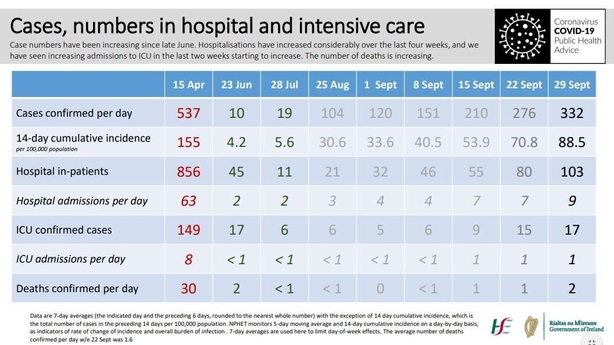
There are now 130 confirmed cases of Covid-19 in hospitals, with 15 new admissions in the last 24 hours. There are 20 patients in ICU.
Dr Glynn warned that the window of opportunity is now closing on containing the virus and called on everyone to act like it was the end of February.
He said the numbers are rising nationally, albeit at a slow pace, but it is going in one direction.
'If you can reduce contacts, if there are discretionary activities that do not need to happen at the moment, then please postpone them' - Dr Ronan Glynn says that if Covid-19 rates continue 'we are going to have a national issue' | Read more: https://t.co/jjRDjfUDro pic.twitter.com/jB48z1k2Qd
— RTÉ News (@rtenews) September 30, 2020
Professor Philip Nolan, chair of the NPHET Epidemiological Modelling Advisory Group, said the reproduction rate (R number) of the disease is estimated at between 1.2 and 1.4.
Prof Nolan said 12,500 tests are being taken on average per day for the last seven days, with a rising positivity rate of 2.8%.
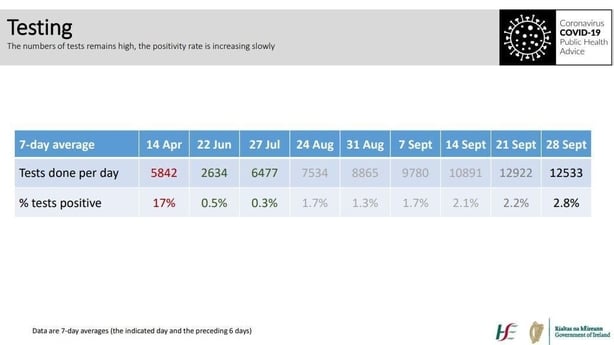
He said the average number of cases being confirmed across the country last week increased from 276 to 332.
The 14-day cumulative incidence yesterday was 88.5, and is now 92, he said.
The Covid-19 reproduction number is estimated to be between 1.2 and 1.4, Professor Philip Nolan has said | Read more: https://t.co/jjRDjfUDro pic.twitter.com/6c8ZEDuEgV
— RTÉ News (@rtenews) September 30, 2020
Prof Nolan said there has been a sharp rise in cases in the 19-24 age group.
He said the number of cases in primary and secondary school going age has been stable for number of weeks.
HSE Chief Clinical Officer Dr Colm Henry said that community transmission "represents the greatest threat to patients and staff in hospitals and residential care facilities".
He urged people who were planning to socialise this week to "consider our healthcare workers, who have been at the frontline since the beginning of the pandemic, in hospitals, in nursing homes and in our homes, caring for those who are ill and those who are the most vulnerable to this highly infectious virus".
424 new cases in Northern Ireland
Elsewhere, there have been 424 new cases of Covid-19 confirmed in Northern Ireland in the last 24-hour reporting period.
A further coronavirus-linked death has been reported to the department, although it did not occur within the last day.
The death toll recorded by the department now stands at 579.
Meanwhile, a new report shows that the largest number of Covid-19 outbreaks continue to be in private houses, with 2,810 now recorded, an increase of 349 in the last week.
There have been 36 outbreaks reported in schools, an increase of 13, according to the Health Protection Surveillance Centre (HPSC).
The number of outbreaks in pubs is seven, an increase of one in the last week. The number of outbreaks in restaurants/cafes is now 22, an increase of eight in the last week.
The number of workplace outbreaks has reached 139, an increase of 16.
In the last week, one further outbreak was recorded in a meat, poultry or fish processing plant.
We produce the infectious disease weekly report for Ireland - the latest report is available on the HPSC website now https://t.co/mlk44sB3fr #thisispublichealth #vaccineswork #infectiousdiseases pic.twitter.com/y15gMOCcmr
— HSE Health Protection Surveillance Centre (HPSC) (@hpscireland) September 30, 2020
Other data shows there have been 291 in nursing homes, an increase of five, and 214 in residential institutions, an increase of 11.
In the last week, there have been more outbreaks among vulnerable populations. The Roma community has seen one further outbreak, bringing the total to six.
The Irish Traveller community has seen one more outbreak, giving a total of 14. There have been four more outbreaks in Direct Provision Centres, bringing the number to 30.
Two more outbreaks have been reported among the homeless/people with addiction issues, giving a total of 12.
The number of outbreaks in prisons remains unchanged at six. The HPSC outbreak report is data up to midnight 26 September.
The European Centre for Disease Prevention and Control has said that Ireland and other "island nations" who can get transmission rates of Covid-19 close to zero could open borders to international travel once it tests incoming travellers for the virus and isolates cases.
ECDC Principal Expert for Emergency Preparedness and Response Dr Agoritsa Baka said that having a border closed to prevent the spread of a respiratory virus "that transmits so effectively from person to person" does not really make sense, as the virus is already in the community.
Speaking on RTÉ's Today with Claire Byrne, she said it is far more important to have a good public health system, along with testing, tracing and isolating as this is key to suppression, rather than stopping international travel.
Dr Baka said that European countries are keen to open borders and to allow travel and insist a traffic light system is needed to support their efforts, so the ECDC is assisting to make this system as harmonised or user-friendly as possible.
She said that the ECDC has always maintained that travel does not have to stop as the main way to confront the spread of the virus.
Additional reporting Fergal Bowers
