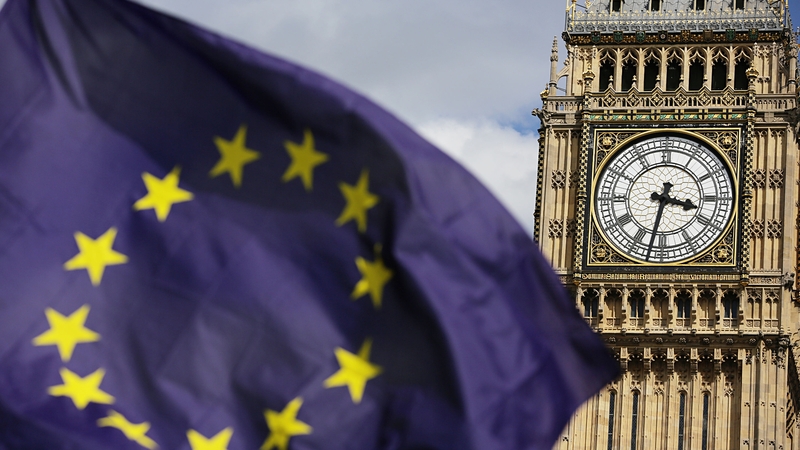

The UK Supreme Court has upheld a High Court ruling that the UK parliament in Westminster must pass a law authorising the UK government to submit an Article 50 notification to leave the European Union. So what?
This is, no doubt, an important ruling for the UK in terms of its own constitutional practice. But what about the rest of us? I think it’s pretty much irrelevant.
The question before the UK Supreme Court was a simple one – which branch of the state gets to push the big red button marked "Article 50". Is it the executive or the legislature?
The High Court decided, and the Supreme Court confirmed, that it is the Parliament. The reasons why are set out with admirable clarity in the Supreme Court judgement.
For anyone who is not British, it really doesn’t matter who pushes the big red button marked “Article 50” - the only thing of relevance is when is it going to be pushed?
For the non-British, all the noise around the Supreme Court ruling is just that - noise. We need to suppress the noise in order to find the signal - the important information that is of use to us in the forthcoming processes by which Britain will leave the EU and develop a new relationship with it.
If we expose ourselves to the noise generated by the minutiae of British Brexit reportage, and get sucked into trying to follow every twist and turn, we will be swamped by an overload of information - most of which is of no practical use to us. We also risk missing the real action elsewhere. And worst of all, we risk becoming nerdy spectators in someone else’s politics, whilst ignoring our own.
For example, we are all aware of the claims about how much Britain pays to the EU budget, and what the Brexiters say could and should be done with this money when Britain leaves. But Ireland is staying in the EU. And we have devoted very little time and attention - particularly in the media - to working out the implications of this for us and the four national priorities identified by the Taoiseach: the Common Travel Area, Northern Ireland, the Border and ....the future of the European Union.
As it is the national policy of this country to stay in the EU, the financing of the EU when its third-largest budget contributor leaves is a very important issue. With a new multi-annual budget due to be decided effectively in parallel with Brexit process, we need to think a little more about what we want in this process. Ireland is now a net contributor the EU budget: do we want to pay in more to help fill the gap left by the UK, or do we want to cut the overall EU budget by the missing amount? And if the latter, where should the axe fall?
Or what about an alternative method of funding the EU budget - could it raise more "own resources" for the EU Budget? Last week a report of an expert group chaired by former commissioner and Italian prime minister Mario Monti, which looked at this and other issues about the future of the EU budget, was published - to practically no coverage here. But unlike Boris and the his '£350m a week for the NHS' bus, this will have implications for the Irish Government's budgets in the years after 2020.
The media and public debate in Ireland on Brexit needs to concentrate less on what the British are doing and more on what we are going to do to advance our own national interests - which includes our national interest in how the EU works, and how it is funded.
The Other Brexit Case
Jolyon Maugham QC’s forthcoming case against Ireland in the Irish High Court on Article 50 is an interesting and important one – is Article 50 reversible once it has been triggered? For an English barrister to sue the Irish State in order to get a ruling out of the European Court of Justice about Article 50 is novel, and not unwarranted: As article 50 is part of the EU treaties, its operation is a matter of legitimate concern to all EU citizens and all EU member states.
But lets be clear – this case is only happening because of the Brexit vote. Article 50 came into the EU treaties as a result of the Lisbon Treaty of 2008. Its application could have been tested by a concerned citizen at any time over the following nine years. In particular it could have been tested in 2013, when David Cameron promised to hold a referendum if re-elected, or when the British government began its review of the impact of EU law on the British statute book, as preparation to an Article 50 move; or in 2015, when the Tories won re-election and set about delivering on the referendum promise; or it could have been tested at the start of 2016, when the UK negotiated its package with the EU prior to the setting of the referendum date.
Now Mr Maugham is trying for a date in the Irish High Court list in March, the month the British Prime Minster has promised to send her Article 50 notification to Brussels.
Again, the Irish media needs to keep this case in perspective – it is of fairly pressing importance for our neighbours in Britain, but knowing if Article 50 is reversible once it has been triggered is of considerably less urgency for states that are not about to trigger an Article 50 notification.
Other interesting things that happened on the day the UK Supreme Court ruled on Brexit:
- The EU Taxation and Customs Union Commissioner Pierre Moscovici was in Dublin, making speeches and answering questions in the Oireachtas Finance Committee. His main business was the Common Consolidated Corporate Tax (CCCTB) proposal. But as the Customs commissioner his observation that the UK’s departure from the customs union would inevitably lead to customs controls was important. He did stress to the Finance Committee that “we are certainly not trying to re-establish a solid border with Northern Ireland – we know this is a divided country, and we will take on board the specific circumstances of Northern Ireland in our negotiations”. But he was unwilling to get drawn into a detailed discussion of how customs controls might operate on this island, saying negotiations had not started, and they were a Matter for Michel Barnier.
- Martin Schulz will stand as Chancellor candidate for SPD in Germany. The leader of the SPD, and current deputy Chancellor, Sigmar Gabriel, stepped aside to give the former President of the European Parliament a clear run at unseating Angela Merkel. The SPD is facing a tough time in September's German election, but opinion polls suggest Mr Schulz could attract twice the support of Mr Gabriel as the party’s challenger to Ms Merkel, leaving it better positioned in the election aftermath. His high profile in the European Parliament has left him as one of the better known German politicians across Europe, and it has clearly done him no harm in seeking to return to domestic politics (Simon Coveney and Mary Lou McDonald also started off as MEPs)
- It was standing room only in the European Parliament’s biggest debating chamber in Brussels for a speech by Carles Puigdemont, the prime minster of Catalonia, who informed the house on his plans to hold a referendum on independence from Spain. The government in Madrid has already declared it unconstitutional. There is an obvious Brexit carry over from this fractious dispute - especially the issue of future EU status - to Scotland, and the periodic suggestion that it might try for a second referendum on independence in order to stay in the EU. The question of Spanish attitudes to breakaway regions and their future EU status is also of relevance to Northern Ireland. The Irish Government has correctly prioritised the importance of the Spanish government on these Brexit-related issues (as well as the status of Gibraltar), as reflected in the Taoiseach’s visit to Madrid this month to meet his EPP colleague and counterpart Mariano Rajoy.