

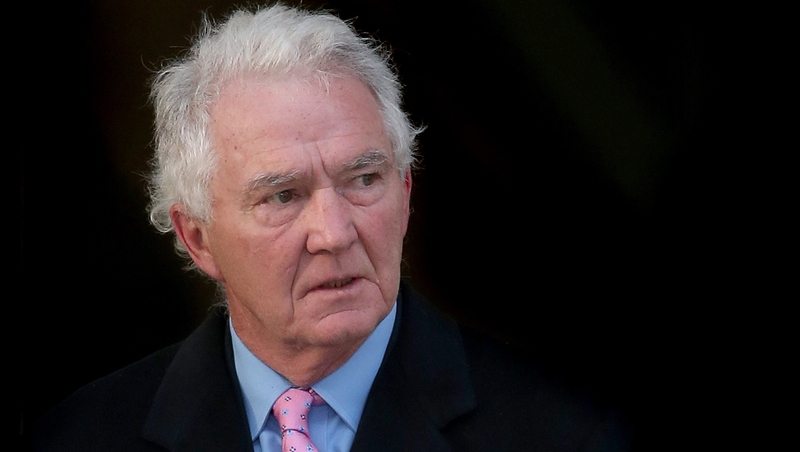
The High Court has ruled that the trial of former Anglo Irish Bank Chairman Sean FitzPatrick, which was due to start in October, should not take place until May 2016.
Mr Justice Michael Moriarty said due to recent publicity the trial should be deferred until next year.
The judge dismissed an application by Mr FitzPatrick to have the trial permanently stayed.
In his judgment, Mr Justice Moriarty ruled that the press coverage of Mr FitzPatrick fell into a different category. He said this had to be considered along with the recent coverage of the trial of three Anglo officials.
The judge referred to "recent reportage of events at the return of the guilty verdicts and the subsequent sentencing hearing after an overnight remand in custody" of the three Anglo officials whose trial concluded last July.
He said as a casual observer it engendered in him "immediate feelings as a member of the public who had read the press coverage, feeling that were not favourable to Mr FitzPatrick".
He said the fact of Mr Fitzpatrick's trial listed so soon after the conviction of the three other Anglo officials, one of whom was described as "a foot soldier", represented the unhappy succession of events and one not in accord with the effective "fade factor" sequence accorded to other defendants within what may be termed the Anglo Irish Bank ambit.
He said all of the factors rendered him of the belief that the requirements of justice necessitated a deferral.
"Of course it does not mean that all antipathy to the applicant will have subsided when the trial re starts but I believe some particular elements will have subsided by then," the judge said.
He added that having carefully considered the competing factors he ruled that the trial should be adjourned to 25 May 2016.
Referring to Mr FitzPatrick's application to have the trial permanently stayed, the judge dismissed the application and said such a drastic measure to abort a highly significant prosecution brought on behalf of the Irish people would only be taken in the most extreme circumstances.
He said a proposition that attaining a degree of high notoriety in the public eye constituted a bar to being duly tried by a judge and jury seemed untenable.
"One might also wonder how the three defendants recently tried, convicted and sentenced or indeed the public at large, would view such disparate treatment," he added.
Mr FitzPatrick had argued that he could not get a fair trial due to adverse publicity. He had asked the court to either stop or postpone his trial which was due to get underway in October.
The 66-year-old is facing 27 charges, including making a misleading, false or deceptive statement to auditors and of furnishing false information from 2002 to 2007.
He denies the charges.
Yesterday lawyers for Mr FitzPatrick told Mr Justice Moriarty that they believed Mr FitzPatrick could never get a fair trial and the court should grant an injunction stopping the trial permanently.
Senior Counsel Bernard Condon said the very least that should be granted to him was an adjournment of 12 months.
Mr Condon said Mr FitzPatrick had never sought to stop his trial going ahead. He was willing to go on trial and answer the charges put to him.
He said it was not Mr FitzPatrick's fault that his trial was to follow the trial of three Anglo officials which ended in July.
He said a "cascade of negativity" had been visited on Mr FitzPatrick as a result of that trial.
Incredibly damaging things had been said about him with impunity and reported with absolute privilege.
He said Mr FitzPatrick had suffered the "trashing of his character" in that trial and had no opportunity to protect himself against the allegations made which he said had gone into the public sphere as facts.
He said the air of vengeance stoked up by the media was extraordinary. Mr Condon said there was no need for Mr FitzPatrick's trial to be "railroaded" on in October.
Mr Condon said Mr FitzPatrick had only ever sought a fair trial. He was not seeking anything special.
He wanted what every other citizen in the country would get - a fair trial in front of an impartial jury. He said the public might hate him but they only knew the caricature, not the real man.
Lawyers for the Director of Public Prosecutors told the court there was no perfect time for this trial to take place from Mr FitzPatrick's point of view.
Senior Counsel Paul O'Higgins said there was a distinction between prejudicial comment and prejudicial comment which could prevent the trial going ahead.
He said there was no doubt that it would be "fairer" if a trial such as this could take place in circumstances of complete sterility. But he said almost no trial took place in such circumstances.
He said the issues in the case arose out of a series of events that took place some years ago and they were not going to disappear in two or four or six years time.
He said whenever this trial took place, it would not take place in a vacuum. He said it was unrealistic to suggest the "fade factor" would ever take effect in this case the way it would in some others.
He said it was true there had a been a large quantity of "unfavourable publicity" about Mr FitzPatrick but none of it related to the specific matters with which he was charged.
Mr O'Higgins said the concept of a fair trial was to ensure the fairest possible trial a person could have in the particular circumstances of his case.
He said if there was a groundswell against someone, it was up to the trial judge to ensure the jury focused on the charges in front of them.
He said the DPP would always prefer a situation where nothing had to be said to the jury by the trial judge in relation to matters like these. But he said just because the trial judge had to address these issues did not mean the trial could not go on.
He argued that the trial could go on fairly in October.
