



NASA's New Horizons space probe has made history by passing within 12,500km of the surface of the dwarf planet Pluto.
It has taken nine years for the spacecraft to travel the five billion kilometres to its target where it is gathering a mass of pictures and data as it passes.
The $700m probe, the size of a baby grand piano, has travelled at speeds of more than 58,000km/h making it the fastest craft ever to leave Earth’s orbit.
Although it is now considered a dwarf planet, Pluto is the final planet from the classical nine planet solar system to be visited by an unmanned reconnaissance spacecraft.
During the pass, New Horizons is gathering masses of images and data using its on board instruments which will be sent back gradually to Earth over the coming months.
The spacecraft will also take a look at Pluto's five moons including Charon which is just over half its size.
The data will be poured over by scientists looking for new information about the origins of the solar system 4.6 billion years ago.
After that, New Horizons will continue on into the mysterious object-packed area known as the Kuiper Belt to explore further unusual objects.
When the mission was launched in January 2006, the aim was to reach the outermost of the sun's family of nine planets.
Seven months into the probe's epic journey, international astronomers down-graded Pluto's status to "dwarf planet".
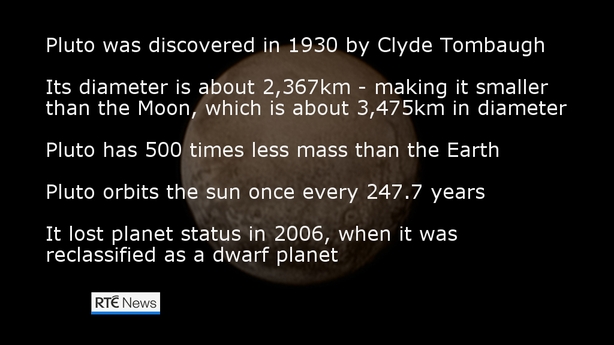
But despite its small size - just two thirds the diameter of the Earth's moon - Pluto looks and behaves like a fully fledged planet, having an atmosphere and no less than five moons of its own.
Currently, Pluto is just under three billion miles from Earth, one of a number of distant "worldlets" in a region known as the Kuiper Belt.
It is so far away that its light takes more than four hours to reach the Earth, making communication with New Horizons an exercise in patience.
More from RTÉ's Science & Technology Correspondent Will Goodbody
British astronomer Brendan Owens, from the Greenwich Royal Observatory in London, said: "This is really unexplored territory. The images of Pluto we got previously have been only a few pixels across, just showing areas of light and dark on this world.
"Now we're getting up close and personal, something that has never been done before. This whole region is hard for astronomers to explore because we rely on light, and at that distance so little sunlight falls on these objects that you have very little data to work with."
"Learning about the composition of Pluto may give us more of a handle on the make-up of the solar system."
The mission marks the conclusion of the American space agency Nasa's quest to explore every planet in the solar system, starting with Venus in 1962.
Today's encounter with Pluto coincides with the 50th anniversary of the first ever fly-by of Mars by the Mariner 4 probe.
A tantalising early image received from New Horizons last week showed Pluto as a copper-coloured globe bearing a large bright spot in the shape of a heart.
Later photos taken from a million miles away have revealed cliffs, craters and chasms larger than the Earth's Grand Canyon.
The mission's principal scientist Alan Stern told the Associated Press news agency: "We're going to knock your socks off.
"What Nasa's doing with New Horizon is unprecedented in our time ... the last picture show for a very, very long time."
Pluto has a thin atmosphere of nitrogen, methane and carbon dioxide, which expands as the dwarf planet's elongated 248-year orbit takes it closer to the sun causing icy material on its surface to vaporise.
Since its discovery, only a third of Pluto's year - the time it takes to complete one orbit of the sun - has passed.
Scientists believe the dwarf planet may bear signs of past volcanic activity and could even have liquid water beneath its frozen surface.
New Horizons team member Professor Bill McKinnon, from Washington University in St Louis, said: "I'm really hoping to see a very active and dynamic world."
The spacecraft will also take a look at Pluto's giant moon Charon, which is just over half its size, as well as its other moons Styx, Nix, Hydra and Kerberos.
As well as a telescopic camera, the probe also carries a suite of sophisticated instruments for analysing Pluto's composition and studying its atmosphere.
Pluto was identified in 1930 by US astronomer Clyde Tombaugh using a 13-inch photographic telescope at the Lowell Observatory in Flagstaff, Arizona.
Some of his ashes are being carried to the world he discovered on New Horizons.
Because of the probe's great distance from Earth and the slow speed of data transmission, it will take many months to process information from the mission.
