


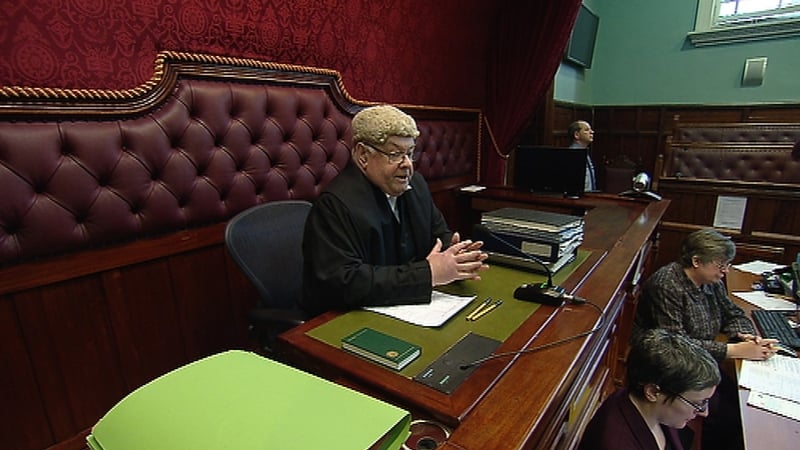
The country's most senior criminal judge retired from the bench this morning.
Mr Justice Paul Carney had been a High Court judge since 1991, dealing primarily with murder and rape cases.
He is estimated to have heard at least 150 murder and rape cases, more than any other judge in the history of the State, and to have dealt with hundreds more.
He told a packed court room full of his colleagues from the Supreme Court and the High Court that this was a black day for him.
He said he had worked for half a century and had spent a quarter of a century as a judge.
He said he had never "pulled a sickie" and had never taken a day off and had always resented the length of the vacations.
He also said there was "a better class of judge" and "a better class of garda" now, than there was when he started practising as a lawyer 50 years ago.
Mr Justice Carney, who is almost 72, was one of the longest serving judges in the country and many tributes were paid to him in Court number four this morning.
Attorney General Maire Whelan praised his important contribution to the administration of justice in this country.
She said he had a deep sense of civic duty and a commitment to uphold the rule of law.
She said while he was mainly associated with criminal law, he had been involved in many other significant cases.
He was a lawyer for the prosecution in the case that led to evidence obtained unconstitutionally to be excluded from criminal cases.
That judgment by the Supreme Court was struck down recently by a majority decision.
He was also involved "before his time" she said, in challenging aspects of the juvenile justice regime.
She said he was ever vigilant to ensure accused people received a fair trial and also to make sure victims of sexual assault or rape were not oppressed or intimidated.
She said he was a strong advocate and a progressive thinker in relation to the rights of victims.
She said he had heard more rape and murder trials than any other judge in the history of the State.
In a recent case, he dealt with queries from a jury from his hospital bed and insisted, against advice, on returning from hospital to receive the jury's verdict.
She said the people of Ireland were in his debt for his 24 years of dedicated service.
Chairman of the Bar Council David Barniville noted that the judge had heard and determined a vast range of cases - not just criminal matters.
He said he was recently a member of the divisional court who heard the case of Marie Fleming - the 'right to die' case.
Mr Barniville said Mr Justice Carney had become a household name and was probably the best known High Court judge.
He said he had left the Central Criminal Court in a far better place than he had found it.
He paid tribute to the process of 'judicial decentralisation' the judge began, by bringing the Central Criminal Court to sit in Limerick in July 2003.
He described Mr Justice Carney as absolutely irreplaceable.
Tributes were also paid to Mr Justice Carney by the Law Society, the office of the Director of Public Prosecutions, An Garda Síochána, the media, the Registrars of the Central Criminal Court and the Courts Service.
Mr Justice Carney said he did not recognise the person who was being talked about.
He said 50 years ago, every contested case involved an allegation of some sort of garda brutality or 'roughing up' to get an admission or a confession.
He said judges would almost always find in favour of gardaí.
But he said this no longer happened. He said there was a "better class of garda" a "better class of judge" and a better class of defence and prosecution counsel".
He said CCTV was also a factor in virtually every case.
The judge said he had been present at the imposition of six death sentences in two batches of three.
He said the first hearing was very tense but that by the time the second one came along, it was clear which way the Government was going to go.
