


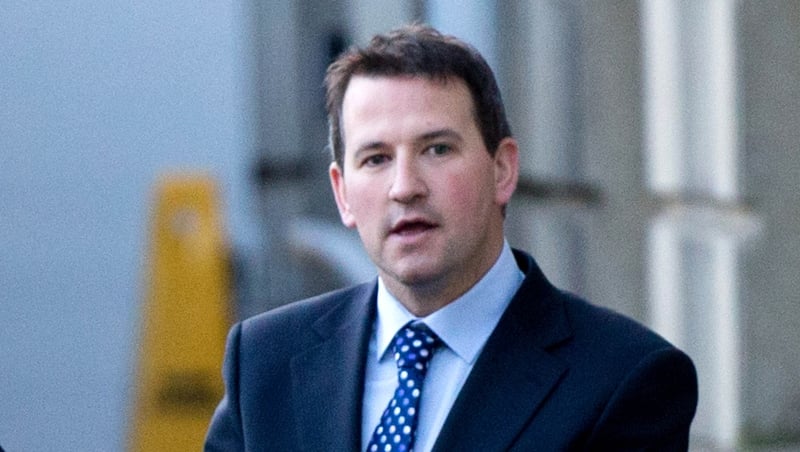
The jury in the trial of Graham Dwyer for the murder of Elaine O'Hara has gone home for the night after it was earlier sent out to consider its verdict.
Earlier, Mr Justice Tony Hunt summarised evidence given by members of Ms O'Hara's family.
He said their credibility had been raised as an issue by lawyers for Mr Dwyer.
He said this was an issue for the jury.
Mr Dwyer, 42, of Kerrymount Close in Foxrock in Dublin, has pleaded not guilty to the murder of Ms O'Hara, 36, on Kilakee Mountain in Rathfarnham in August 2012.
Mr Justice Hunt told the jury to approach their deliberations in a "logically way".
"The one thing that you can say with certainty is that two people met that day one person came home the other didn't".
He asked them to bring themselves to the shore side at 6pm on 22 August 2012 and see what they can infer or deduce.
"Where did they go, how did they go, what did they do when they got there. How did the stuff end up in the reservoir?"
He said suicide must be considered and they cannot convict if there is any reasonable doubt.
Mr Justice Hunt also read the evidence of Deputy State Pathologist Michael Curtis to the jury.
He said his evidence had been raised by Mr Dwyer's defence counsel, Remy Farrell.
He said Mr Farrell had said the absence of any impact marks on Ms O'Hara's remains should cause the jury to have reasonable doubt.
He said Mr Farrell was also concerned that the evidence of Mr Curtis would not be at the forefront of the jurors' minds by virtue of what they had heard since.
He said he wanted to place it back at the forefront of their minds.
In his evidence, Dr Curtis said the cause of Ms O'Hara's death could not be determined.
Only 60-65% of Ms O'Hara's remains were discovered, he said.
Dr Curtis agreed that if death had occurred by stabbing that this could have occurred without injury to the bones.
He agreed with lawyers for the defence that in many cases where death is caused by self harm, there is no evidence of bony injury.
He said where someone is killed by stabbing, the knife could go between the ribs.
He said this was less common but by no means rare.
He said that if someone was stabbed in the abdomen, it would almost certainly cause no bony injury.
Yesterday, Mr Justice Hunt told the jurors the facts in the case were entirely a matter for them but they must apply the law that he told them about in a clinical manner.
He said they had seen and heard "horrific" material but they must put aside any feelings they had about Mr Dwyer.
He said the prosecution was asking them to make a very large decision based on indirect evidence.
A person could be convicted based on circumstantial evidence he said, but they had to take care with such evidence.
He said to convict they had to be satisfied that there was no other reasonable conclusion, consistent with innocence.
He told them they had to be satisfied beyond reasonable doubt that Mr Dwyer murdered Ms O'Hara by stabbing her for his gratification.
Mr Justice Hunt also re-read the evidence of Mr Dwyer's wife, Gemma Dwyer.
He referred to her evidence that a spade found near the location of Ms O'Hara's remains was a spade missing from the Dwyers' Foxrock home.
He said the evidence about it being connected with Mr Dwyer depended on the evidence of Mrs Dwyer.
He said she had identified it as being their spade based on the label on it and the spatters of paint on it.
He said the evidence about the spade was perhaps more important.
He said they had to apply the presumption of innocence to the spade. He said every spade had a label - it was a mass produced item.
He said he did not think the label would not be enough in itself to lead them to conclude beyond reasonable doubt that the spade was a "guilty" item.
He said in light of the forensic evidence about the paint spatters they had to be very careful with this item.
He said they had to be satisfied beyond reasonable doubt before they could conclude that the spade had something to do with Mr Dwyer and placed him up the mountains.
He said a forensic scientist had given evidence that the paint on the Dwyers' fence and the paint on the spade was similar but not the same. He asked where that left them.
He said it may be that the spade was out of the case, that it doesn't have any significance. He said it may be that it had no relevance and no dramatic effect in the case at all.
He urged them to be very, very careful.
The judge said he will now deal with the issue of suicidality and the issue of the garda investigation and Mr Dwyer's garda interviews.
He said he hoped to be finished by 3pm and hoped the jury would be able to get the ball rolling with their deliberations at that stage.
He said there is no doubt that Ms O'Hara was troubled by thoughts of suicide.
He said the prosecution said that this issue ticked a box for Mr Dwyer in choosing her as a potential victim.
He said the defence case was that Ms O Hara had died by suicide. He said this was the case Mr Dwyer had made to his wife and his adult son in his own writings.
He said defence lawyers had said this was the working assumption in 2012 and it should not be readily dismissed in 2015 because of other things that had happened in 2013.
The defence said this was a reasonable possibility to explain the death and disappearance of Ms O'Hara.
He said this was something the jury had to face up to and he said even if they rejected the possibility of suicide they had to be satisfied the prosecution had proved its case beyond reasonable doubt.
Mr Justice Hunt said MS O'Hara was in hospital in July and August 2012 because she had had suicidal thoughts.
He said there was a clear evidential basis for the jury to consider whether or not suicide was a factor in Ms O'Hara's death.
He said the defence suggestion that suicide was a reasonable possibility depended on the jury's view of the facts.
If there is a reasonable possibility of suicide on the facts of the case, he told the jurors they should acquit, it was as simple as that.
He said when Ms O'Hara had talked about suicide the night before her disappearance with a fellow patient, she talked about a rope.
The judge referred to evidence of Mr Dwyer's interviews with gardaí after his arrest.
The judge said there was a considerable level of untruth in what was said in the interviews.
He said Mr Dwyer's defence counsel did not stand over these documents as being documents of perfect truth.
He pointed out that when the statement of Mr Dwyer’s former girlfriend Emer McShea was put to him in garda interviews, he suggested that she was making it up and that she was saying things out of spite and that gardaí had pushed her buttons.
He said that suggestion was not persisted with in cross examination.
Mr Justice Hunt said lies told were not in themselves evidence of guilt.
He said the jury should only treat them as supporting the prosecution case if they were satisfied beyond reasonable doubt that there was no innocent reason for the lies and that the lies were told for the purpose of covering up guilt.
He said they should not leap from a finding that Mr Dwyer had told lies to an automatic finding of guilt.
He said the jurors should ask why Mr Dwyer had told lies.
He said even when Mr Dwyer admitted a sexual relationship with Ms O'Hara, he still did not do so in a full and candid way.
He said that if the jurors accepted that Mr Dwyer was the author of the texts in the case, then his shock and horror when gardaí read the texts to him was to do with these matters coming out from deep underwater after 13 months.
He urged the jurors to look at the texts overall. He told the jurors to look at both people and who keeps harping on about certain things and who does not.
Mr Justice Hunt said the Buck Special knife found in Mr Dwyer's workplace in February last year was "odd", even if you take the most innocent view possible.
He said the knife was researched on Ms O'Hara's computer, Mr Dwyer went off and ordered the knife - it was sent, marked private and confidential, to his workplace.
He said it was an oddity. Even on the most innocent view that the knife remained in the offices for 18 months it was odd.
He said the jurors would have to draw their own conclusions.
He said they would have to consider the bag found in the reservoir and decide its significance.
He said the jury had information relating to around five years of both of these people - their desires, tastes, behaviour.
He said they were being asked to use all of that to come to a conclusion about what happened after 6pm on 22 August 2012.
He said if they brought the two people together at 6pm on the shore on that date, they had to deduce what happened next, where did they go, how did they get there, how did stuff end up in the reservoir, how does it all play out between 6pm and 9pm on 22 August 2012.
He said the jurors had to look at the evidence logically.
He said one thing that could be said for certain is that two people met that night. One came home. The other did not.
He asked them why the other person did not come home, and if the person who came home is responsible for stabbing her.
He referred to evidence that Mr Dwyer's work phone had been using cell sites which cover Kilakee Mountain on the evening before Ms O'Hara's disappearance.
He said if they were satisfied the scenario put forward by the prosecution could be established then they were obliged to convict.
If they thought it did not add up or there was a reasonable doubt, then they were obliged to acquit.
He asked them to come to a unanimous decision.
And he told the seven men and five women they could take as long or as short as they needed to reach a conscientious and properly considered verdict.
The jury foreman asked if they could have access to the videos of Mr Dwyer's garda interviews.
Mr Justice Hunt said they could not as these interviews were a "pain" to watch and they would have access to agreed memos of the interviews.
The jury foreman also asked what did they have to find Mr Dwyer guilty of.
Mr Justice Hunt said they did not have to find him guilty of anything - their options were to find him guilty or not guilty of murder.
