


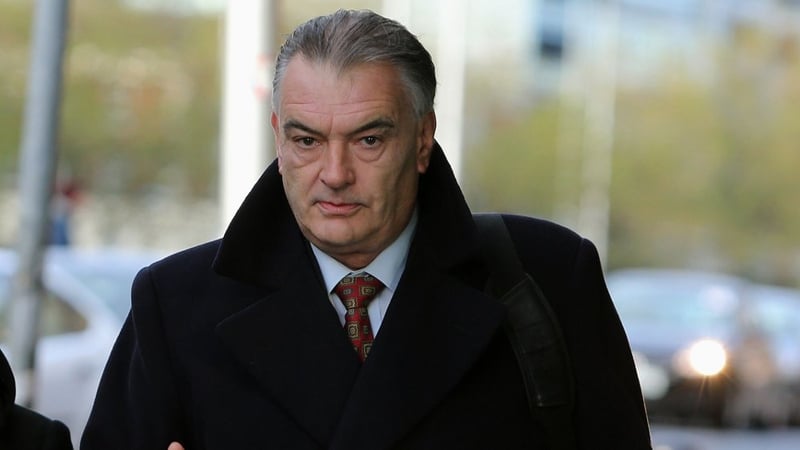
The jury in the Ian Bailey case has heard the case against the former journalist in the year after the murder of Sophie Toscan Du Plantier was weak.
Mr Bailey has taken a case against An Garda Síochána and the State for wrongful arrest.
The High Court has heard more recordings of phone conversations between gardaí this morning.
One recording was between Detective Sergeant Liam Hogan and Detective Chief Superintendent Sean Gamen in 1997, the summer after the murder of Ms Toscan Du Plantier.
During the recording Det Sgt Hogan can be heard saying "all we have is weak circumstantial evidence, a lot of it anyway".
He continued that even if they [gardaí] "have Ian Bailey in the area" the night Ms Toscan Du Plantier was killed he was still a mile-and-a-half from the scene and he said Mr Bailey roams around the place all of the time.
He can be heard saying "unless we break Jules, who I think must have f***** something for us, we need her broken and we need to have it because if you stand back from it, it is a very arguable, it is 50/50".
Mr Bailey’s partner Jules Thomas was also arrested in connection with the murder.
In a separate recording Detective Garda Jim Fitzgerald describes Marie Farrell as a tough cookie, saying she would make a good witness.
Ms Farrell initially made statements saying she saw Mr Bailey near the scene where Ms Toscan Du Plantier's body was found hours beforehand but has since said she lied.
The jury heard another taped phone conversation in which two gardaí discussed a statement by Beryl Thomas, mother of Ian Bailey's partner Jules Thomas on 23 June 1997.
In the statement Ms Thomas says her daughter would be "protective of your man and cover up for him".
Later in the conversation Detective Sergeant Liam Hogan, now deceased, said Mr Bailey had told a woman he had a theory that Sophie Toscan du Plantier's husband had hired a hit-man to kill her and inflict injuries to her hands that would give the impression a local madman had done it.
Det Fitzgerald replied that this was correct and described Mr Bailey as a self-admitting madman to which Det Sgt Hogan said yes, absolutely.
The Jury has also heard of Mr Bailey’s early career as a freelance journalist in the UK.
John Hawkins, who hired Mr Bailey as an intern in the 1970's, gave evidence via video link from Cheltenham Magistrates Court.
He described Ian Bailey as an outgoing, gregarious and sociable person.
Mr Hawkins said he was not terribly pleased when Ian Bailey left his job and set up on his own 10 miles away after finishing his training with his agency.
Under cross-examination Mr Hawkins was reminded of an article he wrote about Mr Bailey in 1997 in which he described his former employee as a confident, brass 19-year-old who became bored with the hum drum of local politics.
In the article he said Ian Bailey was more interested in social opportunities and at times chose to go to a party instead of the story he had been assigned.
When it was put to him that Ian Bailey would be "missing in action choosing fun over work" Mr Hawkins replied "you could say that, yes".
Michael Charity, a freelance news photographer, also gave evidence via video link describing working with Ian Bailey.
The trial has concluded for the day and will resume on the 13 January.
