


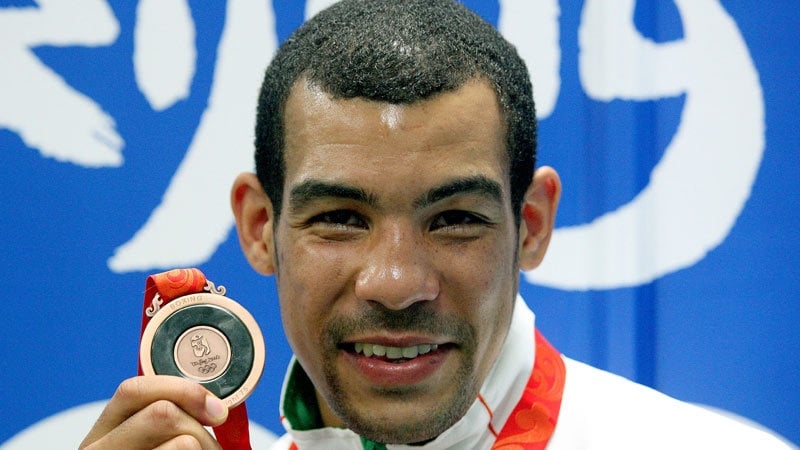
The detective who investigated the death of Olympic medal winning boxer Darren Sutherland has told an inquest in England that the athlete had put himself under an "enormous amount of pressure" before he died.
Detective Sergeant Lee Dunmore, who attended the flat where Mr Sutherland was found, said there was "no doubt in his mind" the sportsman had killed himself.
But the senior officer revealed that a mysterious note addressed to the boxer's manager Frank Maloney has never been recovered by officers.
Another note, left by a friend of Mr Sutherland and found at the scene, warned that if he quit boxing: "Frank will destroy you for the rest of your life and he will be right."
Mr Sutherland, 27, was found dead by Mr Maloney at his flat in Bromley, Kent, in September 2009.
In his report to the coroner, Det Sgt Dunmore concluded the athlete had been "under pressure" in coming to terms with uncertainty surrounding his future.
In an extract read out to the hearing, he concluded: "Darren had placed himself under enormous pressure in coming to terms with his decision over whether to continue his career as a professional boxer.
"It is apparent from the statements obtained from friends, family and medical professionals that he was experiencing a crisis in confidence in his boxing ability, the financial implications that would arise should he breach his contract and sleep related issues."
Giving evidence to the inquest, the officer told Croydon Coroner's Court: "I was completely satisfied and there was no doubt in my mind there was no third party involvement.
"That remains my conviction today."
The inquest was told that notes and documents were recovered from Mr Sutherland's Bromley flat by police officers who attended the scene.
But further documents were later found by family members and handed to police.
A letter was also discovered and passed to police by a private investigator employed by Mr Maloney, the inquest was told.
Det Sgt Dunmore said: "A number of documents were gathered up and placed on the table. I take responsibility if something was left. It shouldn't have been and I'm not seeking to justify it in any way."
Among the notes discovered was one, written by friend and advisor Declan Brennan, which spelled out Mr Sutherland's fears over his future if he turned his back on boxing.
The note, which was previously read to the court, said: "Frank will destroy you and your family in the media. He will hunt you down and do articles about how you f****d up. Frank will destroy you for the rest of your life and he will be right."
It also said Mr Sutherland would have to pay Mr Maloney £75,000 +VAT as well as returning his car and flat if he broke his contract.
The court also heard that when Mr Maloney made a second statement to police he mentioned seeing a note addressed to himself, which has never been recovered.
He told police: "On the day I discovered Darren's body I noticed a pile of letters on the kitchen table. I noticed one addressed to myself."
Michael Topolski QC, the Sutherland family barrister, asked Det Sgt Dunmore: "Where is that note?"
To which he replied: "In the context of when I took that statement that he hadn't recovered a note and the police haven't recovered a note and I certainly haven't seen a letter addressed to Mr Maloney, and none was brought to my attention by anyone else.
"My understanding was that he didn't take it. He saw a note, he didn't take it."
Earlier, the court heard that boxing legend Maloney had taken to Twitter to describe the inquest as a "witch-hunt".
Writing overnight, he described evidence given in open court as "lies" and urged others to look at their role in his death.
Sutherland 'traumatised' by last fight
The inquest also heard that Mr Sutherland was left "traumatised" by his last professional fight.
Psychologist Michele Roitt, who assessed the boxer five days before his death, said he was suffering from depression triggered by fear of entering the ring after suffering a cut to his face.
The injury, which had become infected and would not heal, had left him "frightened of being hurt again" and questioning his future in boxing, she said.
He was suffering from "clinical depression" but showed no signs of being suicidal, the inquest was told.
Ms Roitt, who has been practising for 35 years, described how he appeared "down, uncomfortable and flat" when he attended a consultation with her, accompanied by his mother, five days before his tragic death.
She said she was left in no doubt the sportsman was depressed and "needed help", but did not think he was suicidal.
"Darren talked about feeling anxious and not sleeping well, feeling very low, feeling that he doubted himself and that he was feeling worried about the thought of having to go into another fight," she told the court.
"And he started to wonder whether he could face that, whether he wanted to carry on in boxing or not. It seemed that that had been stirred up following having been injured in a fight six weeks previously.
"Mostly what he was talking about was how he didn't know whether he could face another fight and didn't know whether he could carry on in boxing.
"He felt guilty he would be letting down a lot of people, his fans, his friends, his family and his management team who had invested heavily in him."
The hearing will continue tomorrow.
