


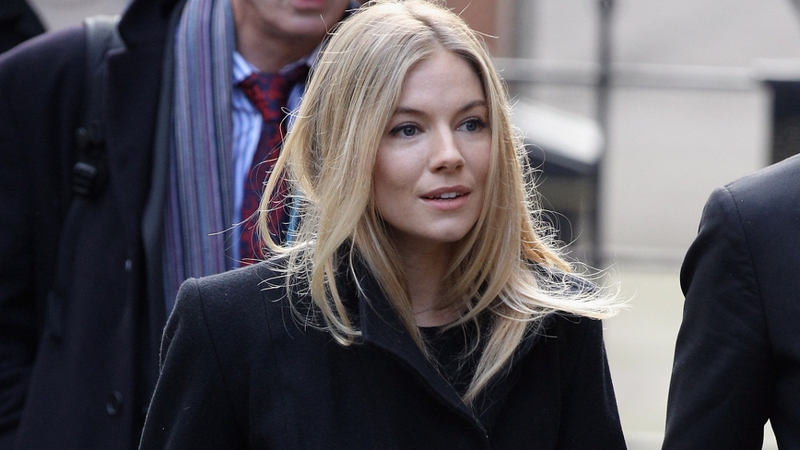
Actress Sienna Miller and author JK Rowling have given evidence about their experiences of media intrusion at Britain's government-ordered press standards inquiry today.
A mystery witness, identified only as HJK and granted anonymity by a court order, addressed the inquiry behind closed doors.
JK Rowling told the Leveson Inquiry that she has had to take action against newspapers about 50 times over breaches of privacy and misreporting.
The author said journalists "drove her out" of the home she bought in 1997 with the advance from the first of her seven Harry Potter books.
She told the inquiry into press standards she felt like a "sitting duck" after a photograph was published of the house number and street name, and it became "untenable" to remain there.
Ms Rowling also described her anger when she found a note that a reporter had slipped inside the bag of her elder daughter when she was in her first year at primary school.
She recalled: "I unzipped her schoolbag in the evening, and among the usual letters from school and the debris that every child generates, I found an envelope and a letter addressed to me from a journalist.
"The letter said that he intended to ask a mother at the school to put this in my daughter's bag.
"I can only say that I felt such a sense of invasion. It is very difficult to say how angry I felt that my five-year-old daughter's school was no longer a place of complete security from journalists."
Earlier, Sienna Miller said she had been placed under a "web of surveillance" by a tabloid newspaper that listened into her messages and read emails, prompting her to accuse family and friends of leaking stories to the press.
She told the inquiry she had felt violated by the constant coverage of intimate details of her private life in the press.
"(There was) this breeding of mistrust amongst all of us. Nobody could understand how this information was coming out ... It was impossible to lead any kind of normal life," Ms Miller said.
The 29-year-old actress won £35,000 from the Sun and the now defunct News of the World in November 2008 over her claims they had breached her privacy.
"I wanted to understand the extent of the information that they had on me," she said of the court case.
"I wanted to know who knew, who had access to my telephone numbers, who had been listening to me ... I wanted to get to the bottom of it."
UK government 'in thrall' to newspaper bosses
Former Formula 1 boss Max Mosley accused British government of having been "completely in the thrall of" newspaper bosses.
Mr Mosley, who was the subject of a News of the World article alleging he had a "sick Nazi orgy", wanted the European courts to force journalists to notify people before publishing damaging stories about them.
He told the Leveson Inquiry he had not thought it worth asking the British government to introduce such a law.
Explaining why, he said: "The UK government were, to put it bluntly, completely in the thrall of Mr Murdoch and the other big newspaper people, who would have objected.
"That spell has now been broken, I think, fairly conclusively, and I don't see any reason why such a law should not be brought in."
Mr Mosley was awarded a record £60,000 in privacy damages at the High Court after taking legal action against the News of the World for its Nazi orgy story published on 30 March 2008 - a story he strongly denied.
But, he said: "Once the information has been made public it can never ever be made private again."
The Leveson inquiry, set up in July and expected to last a year, has given celebrities and others featured on newspaper front pages a chance to throw a light on how these stories were obtained and the impact they have had on their lives.
The first part of the Leveson Inquiry is looking at the culture, practices and ethics of the press in general.
The second part, examining the extent of unlawful activities by journalists, will not begin until detectives have completed their investigation into alleged phone hacking and corrupt payments to police and any prosecutions have been concluded.
