


The European Union lifted sanctions on Libyan ports, oil firms and banks as foreign ministers met to discuss how to help the country's transition from four decades of Muammar Gaddafi's rule.
The EU's Official Journal listed 28 Libyan entities freed from restrictions, including the ports of Tripoli, Al Khoms, Brega, Ras Lanuf, Zawiya and Zuara.
Also listed were Libyan Arab Airlines and energy firms including the Ras Lanuf Oil and Gas Processing Co. and the Sirte and Waha oil companies.
Banks listed were the National Commercial Bank, Gumhouria Bank, Sahara Bank and First Gulf Libyan Bank.
The formal lifting of the sanctions came a day after world powers meeting in Paris freed up billions of dollars to help Libya's new rulers rebuild the nation after 42 years of Gaddafi's rule and six months of civil war.
EU ministers meeting in Poland
EU foreign ministers meeting in the Polish seaside resort of Sopot today and tomorrow were to discuss how to help to stabilise Libya after the conflict.
Polish Foreign Minister Radoslaw Sikorski said the United Nations would have a leading role in helping to demilitarise Libya and ensure safety after the conflict ends, but Europe had shown it has capabilities in this area.
"The way the EU will assist Libya depends firstly on what the Libyan authorities want," he told Reuters.
"We have a trust credit among the new authorities and we will want to use it to support peaceful transformation towards a democracy in Libya," he said, adding that oil-exporting North African state was a valuable ally for Europe.
"Libya is potentially a wealthy country, key because of Europe's drive to diversify energy sources," he said.
EU member states have been discussing the possibility of helping Libya with security sector reform and in police training. The transitional administration has called for help in reforming the judiciary reforms and improving governance.
"Everybody agrees this has to be a United Nations-led involvement, which is not likely to be of any military nature. The Libyans have said no to both military observers and any peacekeeping mission," said Finnish Foreign Minister Erkki Tuomioja.
"A police mission looks perhaps the likeliest possibility at the moment," he added.
Earlier this week, NATO allies, most of whom are EU members, started mapping out ways the military alliance could support Libya's ruling interim council in ensuring a peaceful transition.
One option being discussed is for NATO to deploy forces to maintain an arms embargo in Libya, even after a no-fly zone mandated by the United Nations is lifted and hostilities cease.
NATO has conducted an air campaign that includes enforcing the no-fly zone and a ban on weapons imports to Libya since late March to protect civilians during the civil war.
In the Paris talks with Libya's National Transitional Council, France, Britain and other powers vowed to keep up their military backing as long as needed, but said the focus was now on reconstruction.
Frozen Libyan assets released
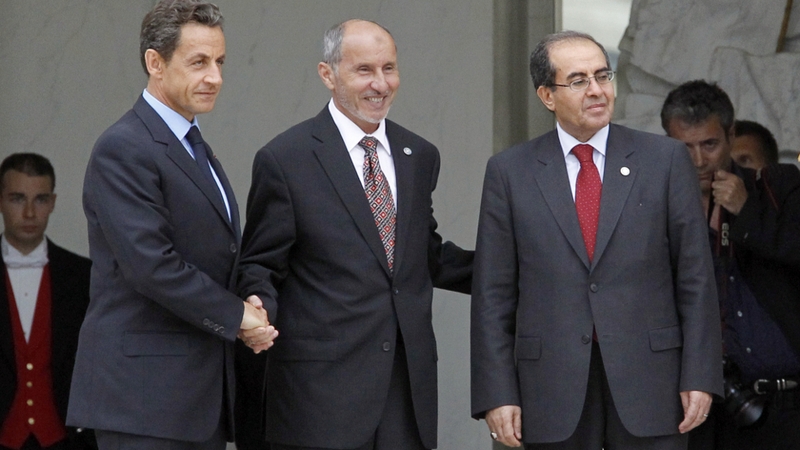
French President Nicolas Sarkozy has said $15 billion in frozen Libyan assets will be released in the short-term to help the country's National Transitional Council restore vital services and start reconstruction after ousting the Gaddafi regime.
''We have committed to unblock funds from the Libya of the past to finance the development of the Libya of the future," Mr Sarkozy told a news conference.
He said the option of NATO airstrikes would continue as long as pro-Gaddafi forces posed a threat to the transition to democracy.
The French president was speaking following a conference in Paris attended by representatives from more than 60 countries and international organisations, and Libya's National Transitional Council.
''The world bet on the Libyans and the Libyans showed their courage and made their dream real," Mahmoud Jibril, the prime minister in Libya's interim government said.
Gaddafi urges supporters to fight on
Meanwhile, Muammar Gaddafi has urged his supporters to fight on.
''Let it be a long battle. We will fight from place to place, from town to town, from valley to valley, from mountain to mountain,'' Gaddafi said in a message relayed by satellite TV yesterday.
''If Libya goes up in flames, who will be able to govern it? Let it burn," he said, speaking from hiding.
In further comments broadcast later, he vowed to prevent oil exports: "You will not be able to pump oil for the sake of your own people. We will not allow this to happen," Gaddafi said.
"Be ready for a war of gangs and urban warfare."
Amid conflicting reports of where the 69-year-old might be, a commander in the forces of the new ruling council said he had fled to a desert town south of the capital, one of several tribal bastions still holding out.
Seeking to avoid more bloodshed, opposition forces also extended by a week a deadline for Gaddafi's hometown of Sirte to surrender.
