


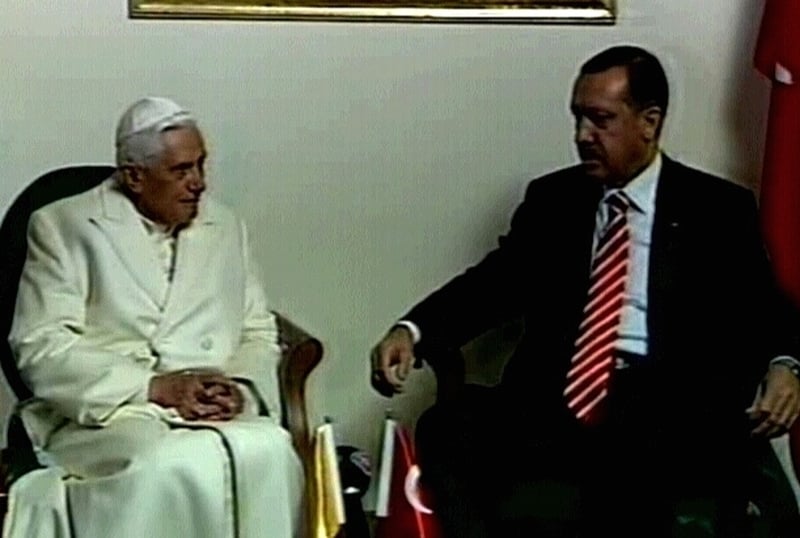
Pope Benedict has told Turks that freedom of religion must be granted to all believers in order to secure their loyalty to society.
The Pope was speaking at the start of a four-day visit to Turkey.
At a meeting with the country's top Muslim official, Pope Benedict was told Islam was not a religion of violence and arguing so would only encourage those who abuse religion to do wrong.
Earlier, the Turkish Prime Minister, Tayyip Erdogan, said the Pope had indicated he now supported Turkey's bid to join the EU.
Mr Erdogan revealed the Pontiff's change of mind on his country's application after welcoming him at the beginning of his first visit as Pontiff to a Muslim country.
On his flight from Rome to Ankara, Pope Benedict told reporters he hoped his calls for understanding between religions would soothe anger over his comments last September in Germany that were seen here as insulting to Islam.
The 79-year-old Pope looked tense as he disembarked his plane to be welcomed by Prime Minister Erdogan.
Following talks between the two, the Prime Minister told reporters that Benedict had assured him that he supported Ankara's EU bid.
Before becoming Pope last year, Benedict had said Turkey's Muslim religion meant it did not belong in the EU and that admitting it would be a grave error against the tide of history.
Guarded by thousands of police and soldiers, including snipers posted on roofs, the Pontiff drove in a closed car to the burial place of Kemal Ataturk, the founder of modern Turkey.
After placing a wreath on the tomb of the avowed secularist, Benedict prayed briefly and bowed reverentially.
He also met the Turkish government's Director of Religious Affairs, who last September strongly criticised the Pope's Regensburg address, which quoted a medieval Christian's criticisms of Islam as violent and irrational.
Some 20,000 people protested against the visit yesterday, and the Pope will be ferried around by armour-plated cars instead of the famous popemobile.
However, Turkish officials have insisted that the Pope will not be in danger during his time in the country.
