


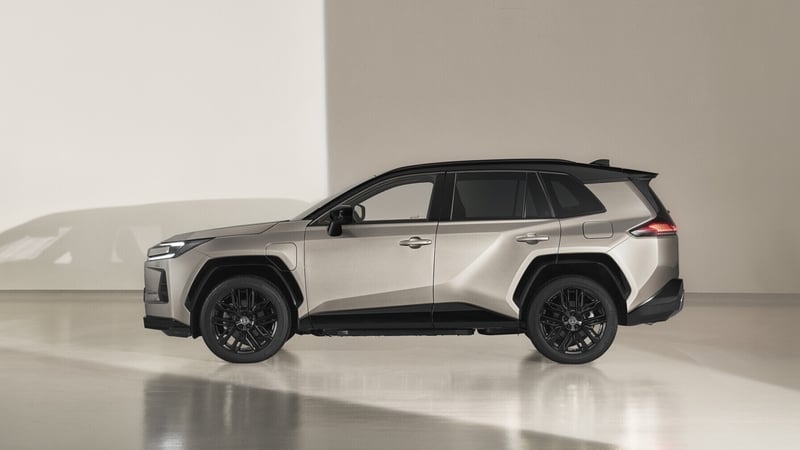

With some 15 million Rav 4s sold worldwide - 2.5 million of them in Europe - Toyota was never going to dramatically alter its latest iteration of the car and run the risk of alienating a loyal customer base.
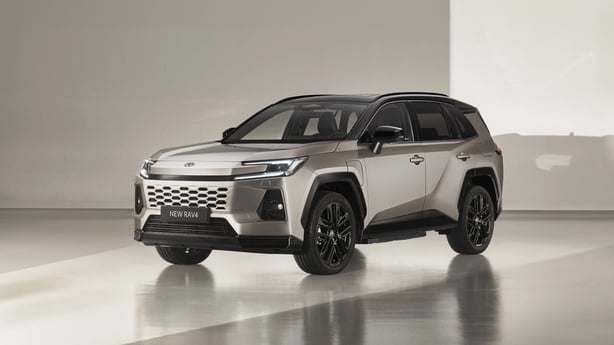
However, when you get close to the new version, you realise that the design curve is a little more adventurous than you might have expected, because the designers have drawn distinctly from the latest Land Cruiser.
It’s not simply a slimmed-down version of the Land Cruiser, but there are clever cues, such as the angled and flared wheel arches and narrower LED headlights, to make it more than a passing nod. It makes the Rev 4 a deal more rugged-looking.
Of course, the new Rav 4 is a family car and needs to please a much wider audience in terms of its functionality and practicality. Our first drive with it indicates that Toyota has accomplished much of what it set out to do.
The main focus is on the hybrid front-wheel-drive version, which will be the entry-level model here. It has a 2.5 litre petrol engine that works with a 20 kWh battery and produces 183 horsepower.
It is smooth and quiet and delivers power evenly, but because this hybrid system works with a CVT gearing system - a belt system that delivers an infinite number of gears rather than a selected number - you will feel its power delivery a little challenged on hills, for example.
It is, however, an improved system that even delivers more torque than the previous model.
The hybrid technology comes into its own in city and average driving conditions. Toyota claims an efficiency rating of five litres of fuel per 100 kilometres, a figure I have no major qualms about because I’ve driven previous Toyota hybrids delivering an average of 5.2 litres under mixed conditions.
They are impressive figures, especially in light of current fuel supply and price concerns, and Toyota has a track record of delivering on reliable technology.
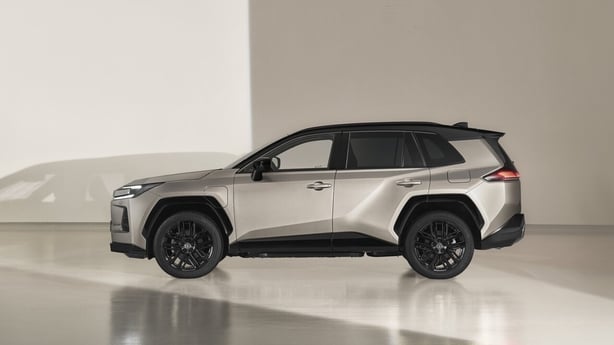
There will be a plug-in version of the car, for which Toyota is claiming an electric-only range of over 100 kilometres, arriving this summer. There is also a GR sports version for the more adventurous.
The new Rav 4 comes in at 4.6 metres long, 1.6 metres high and 1.8 metres wide. The standard wheels are 18", the grille is large, and its road presence is distinctive rather than exciting.
Most cars sold in Ireland will be front-wheel-drive, and the base Sol version starts at €46,795. Standard equipment is pretty generous.
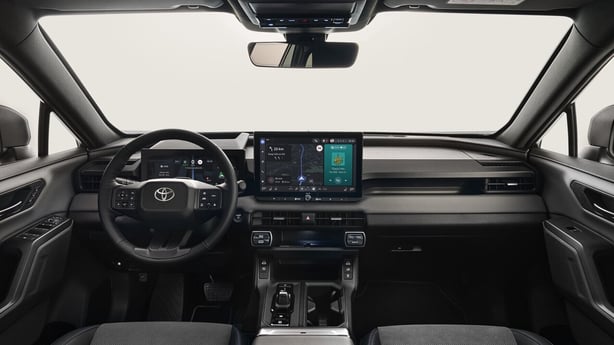
The interior is spacious and comfortable up front and in the rear, with good headroom too. There is a 12.3" driver information screen and a 12.9" infotainment screen that has had a significant upgrade. Running Toyota’s Arene software, the screen is a lot more attractive to look at, responds far more quickly and is clearer than previous versions. We’ve waited a long time for this.
There are some buttons, but not enough to make me feel entirely comfortable. This is likely to change as car companies meet more pushback from customers who, rightly, feel more reassured by physical buttons. The climate control function on this car, for example, is on the screen.
Toyota has come up with a very clever innovation by integrating dash cam functions with the car’s camera system. It records in 90-minute loops and, in the event of a collision, the system automatically records what happened immediately before and during a collision, thus obviating the need for a separate dash cam unit. It’s a very welcome addition to the standard safety systems fitted to all Toyota models for some years now.
Inside, the roof lining is dark and, combined with a lot of plastic in and around the cockpit, the overall effect can be more drab than one would wish for.
A combination of grey and black is certainly not uplifting, and it would not take a lot to brighten the interior, as even more budget manufacturers manage to do. A few strips of extra faux chrome or some stitching would be very welcome.
The floor-mounted battery gives the new Ram 4 an improved centre of gravity, making it feel well planted on the road in a way the previous generation did not. The steering is light, but not at all imprecise, and the car has a very good capacity to absorb more challenging surfaces.
The boot has a decent capacity of 514 litres, enough to make it capable of accommodating average family requirements.
One of the challenges for car manufacturers that sell significant volumes of cars, such as the Rav 4, is how to please everyone, which isn’t really feasible. However, with this car, Toyota is likely to please most of the people most of the time.
The fact that the company’s entire allocation for Ireland has already been sold underscores that point.
The views expressed here are those of the author and do not represent or reflect the views of RTÉ.
Read more: Citroen turns a corner with new well-priced SUV crossovers
