


Words by Donal Byrne. Video by Leah Carroll.
Stellantis, the car group that owns brands as diverse as Opel and Fiat, has been said to have given more design investment to Peugeot at the expense of its stablemate, Citroen.
It looks like things may have changed, however, with the arrival of the new C3 and C5 SUV crossovers.
They may lack some of the flair of Peugeot models, but they have both been given much more distinctive designs than I had expected. They now have a much stronger appeal, but that appeal is not limited to the drawing board.
A brief drive in both this week revealed them as honest family propositions but, more importantly, very good packages for their price. This is important when they are fighting for space in the second most important segment in the Irish market, after the C-segment crossover, which is now dominated by slightly bigger family SUV crossovers.
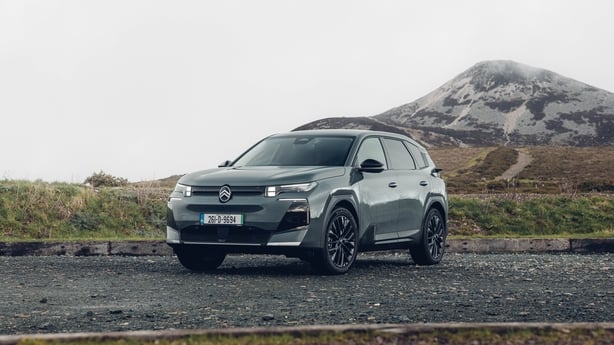
Apart from their design, Citroen has now concentrated on better levels of comfort for both cars, and the standard list of equipment isn't bad either. They’re also bigger, and the interior dimensions have been increased to offer more passenger comfort.
The smaller of the two, the C3, is now defined by bigger wings, wider wheel arches and more sculpted bumpers, giving it a rather rugged look. As an option, you can have a white or black two-toned roof, which looks quite smart.
There are three versions. The basic one is a 1.2 litre three-cylinder petrol 100 horsepower petrol which starts at €27,790 - a good price for a small family car with this kind of space inside. This is followed by a hybrid version that produces 145 horsepower, and which Citroen claims will deliver up to 20 per cent more fuel efficiency than its current offerings. It costs €29,390.
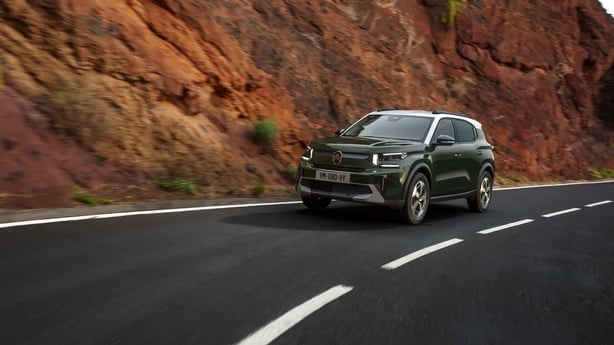
Finally, there is an electric version, with a modest 54 kWh battery and a claimed range of up to 400 kilometres, but we’ll wait to see what that figure is in real-world conditions.
There will be a seven-seat option on the petrol and hybrid versions, but those last two rear seats are small, very small.
The infotainment screen is again modest, at 10.25", and Stellantis appear to have listened to the critics of its screen design and functionality.
The bigger C5 has an impressive 13" screen that is a big improvement on what we have seen before on Stellantis cars.
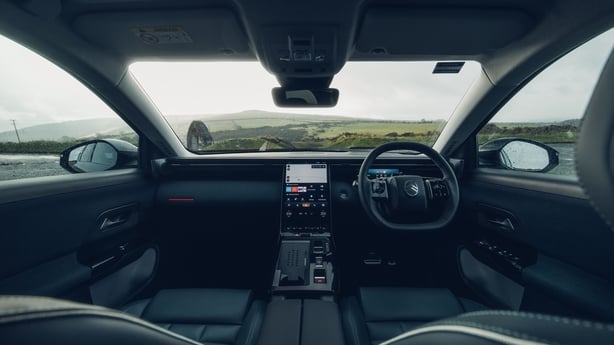
The C3 gets a rear camera, automatic air conditioning, electric side mirrors, a multi-function steering wheel, which is now a good deal smaller, and a set of safety features.
The seats are particularly comfortable, and Citroen says it has used some ten millimetres of upgraded foam for them. The advanced suspension system, which Citroen originally championed, is also impressive.
The bigger C5 is a bit more Peugeot-like in its design and is all the better for it. There are Z-shaped rear light wings, those bigger wheel arches and a sloping roofline.
It’s 1.6 metres high, 4.6 metres long and 1.9 metres wide, combining to give it a very spacious interior and levels of comfort - again, there is the use of high-density foam to bolster support.
One impression, though, is that the front seats are a little short for taller drivers.
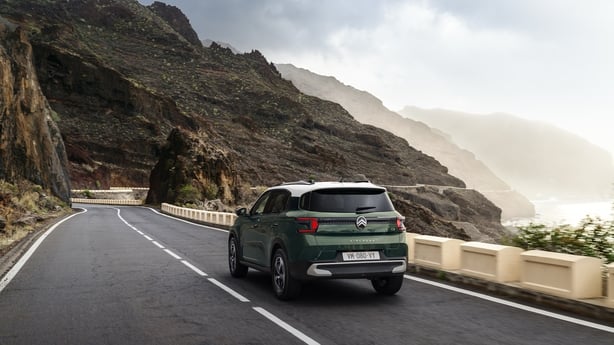
The boot at 651 litres capacity is pretty cavernous. Elsewhere, the 13" screen is well placed and has nice, clear graphics. The driver’s information screen is 10".
There are three versions of the C5 - a hybrid, electric and plug-in hybrid - again with competitive pricing from €39,300. The EV has a 73 kWh battery with a claimed range of 520 kilometres, and Citroen plans to introduce a bigger 97 kWh battery, with a claimed range of up to 680 kilometres, at a later stage.
Standard equipment includes the 13" screen, adaptive cruise control, keyless entry, LED headlights, a wireless phone charger and an automatic tailgate.
