



On a balmy day in September last year, I stomped home from my gym ready to give my boyfriend a piece of my mind.
He hadn't done anything wrong, but he was the only other person I knew who had used a fitness tracker, so he was an educated ear for my rant.
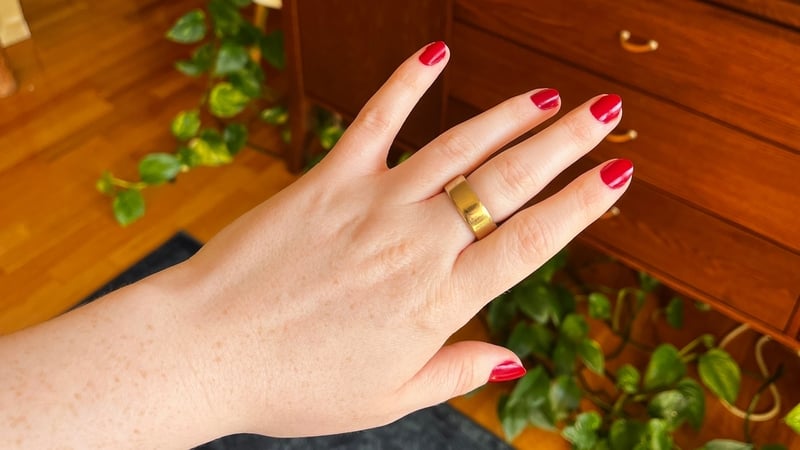
I had been wearing the Oura ring for three weeks and, having been excited about the idea of understanding my body more, I had never been more confused about what it was doing.
How does it work?
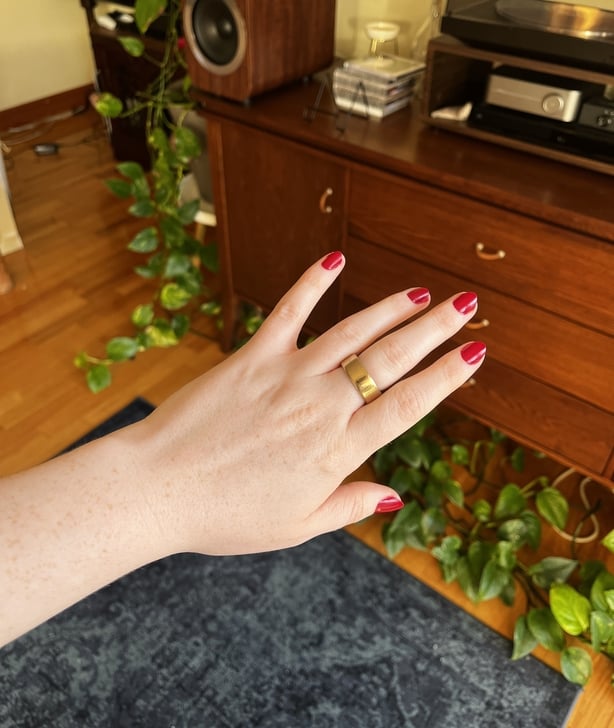
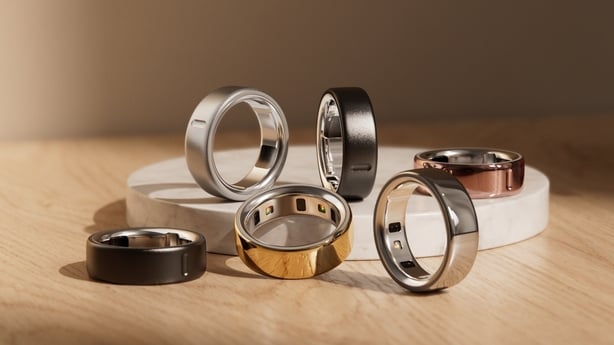
Designed in Finland with Nordic wellbeing practices in its DNA, the Oura ring has become a ubiquitous symbol of wellness enthusiasts everywhere. Now in its fourth iteration, it's a discreet ring (though somewhat on the chunky side for small hands) that seamlessly blends into your wardrobe.
The Oura uses a variety of sensors such as infrared, red, and green LED to track heart rate, body temperature, respiratory rate, sleep duration, heart rate variability and more. It combines these to deliver three 'scores' - Readiness, Sleep and Activity - to the user every morning, scoring them out of 100.
It's water-resistant in up to 100m of water and can be synced with over 40 other apps, like Apple Health, Google Health Connect, Flo, and Strava.
I'd long heard that it was a game changer piece of tech, so when I was offered the chance to review an Oura 4 by the company, I gamely accepted. I've worn the ring almost constantly for five months, save for a week of the flu after Christmas.
The Oura currently costs between €399-€549 depending on the finish (silver, gold and rose gold are among the options) while the app subscription costs €5.99 per month or €69.99 per year. Both my ring and two years of the subscription were provided for the purpose of review by Oura.
A little about me
Firstly, as each body is different and will have different needs of a tracker like this, a little introduction to myself and my lifestyle might be useful.
I'm a 31-year-old with no kids and work at a desk during the day. I'm quite active, hitting the gym roughly four times a week for two cardio sessions and two strength training sessions, and have been consistently strength training for over seven years. I walk a good bit, averaging between 7,000-13,000 steps a day. I was once a chronic under-sleeper but have slowly gotten better, though I still struggle with getting to bed at a reasonable time and not scrolling on my phone.
I've never used a health tracker before, and my only experience with them before this was my boyfriend's brief WHOOP subscription, which can cost hundreds of euro a year and would serve up detailed reports on his health as a very dedicated athlete. But I am not an athlete, so I don't need all that.
So what would I need the Oura for?
I wanted to know what my body was doing when I wasn't paying attention to it. I wanted to get a sense of what my basic activity output was, how my body recovered from intense exercise, and what helped the most. I wanted to track my cycles better and make informed decisions to support recovery.
Set up took five minutes and off I went to investigate. Five months in, I've gotten lots of compliments on the appearance of the ring and start many mornings checking the app right after waking up.
Activity
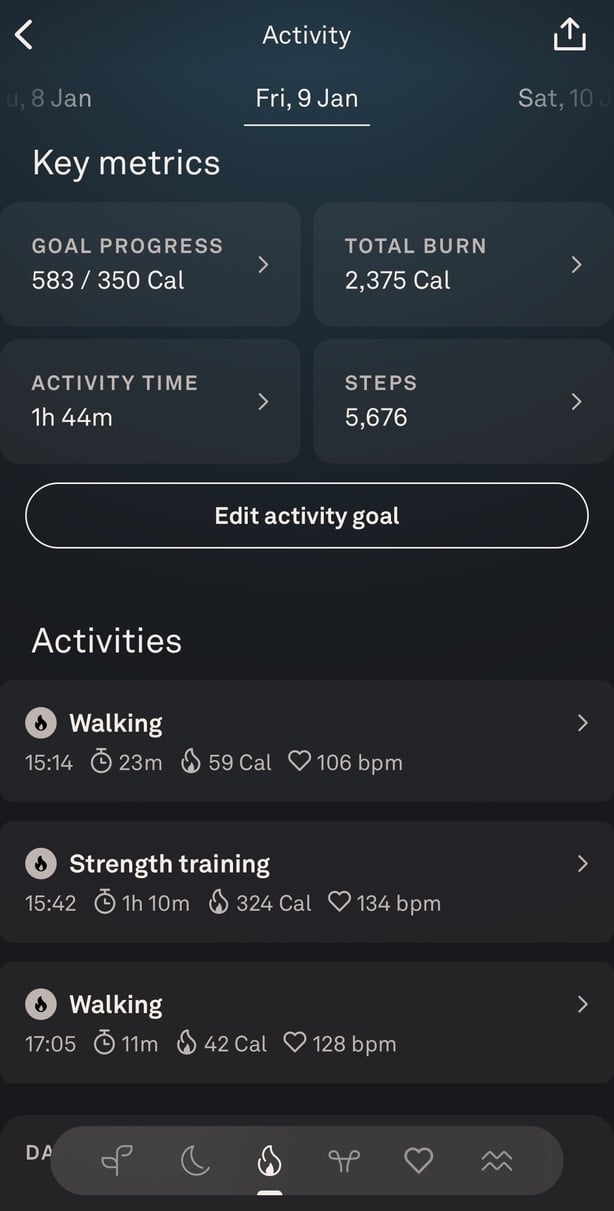
A big focus for me was activity and this is the Score I found myself checking the most. The ring uses an accelerometer to monitor how much you move during the day, and gives you a baseline activity score each day to aim towards, which is based on calories burned. If you're feeling sick or don't want to see an estimate for calories burned, you can turn on the 'rest mode' which is helpful.
While the ring accurately noted when I was walking from minute to minute, it was less impressive at picking up other forms of exercise. For example, it never picked up a sweaty and challenging Pilates workout that raised my heart rate, but guessed that blow drying my hair was actually a 20-minute HIIT session.
The user also has to log each activity and its intensity, which can be subjective as well as time consuming. When logging a strength training exercise, it's difficult to know whether it was 'easy', 'moderate' or 'hard' and the impact on your activity score varies significantly between the three.
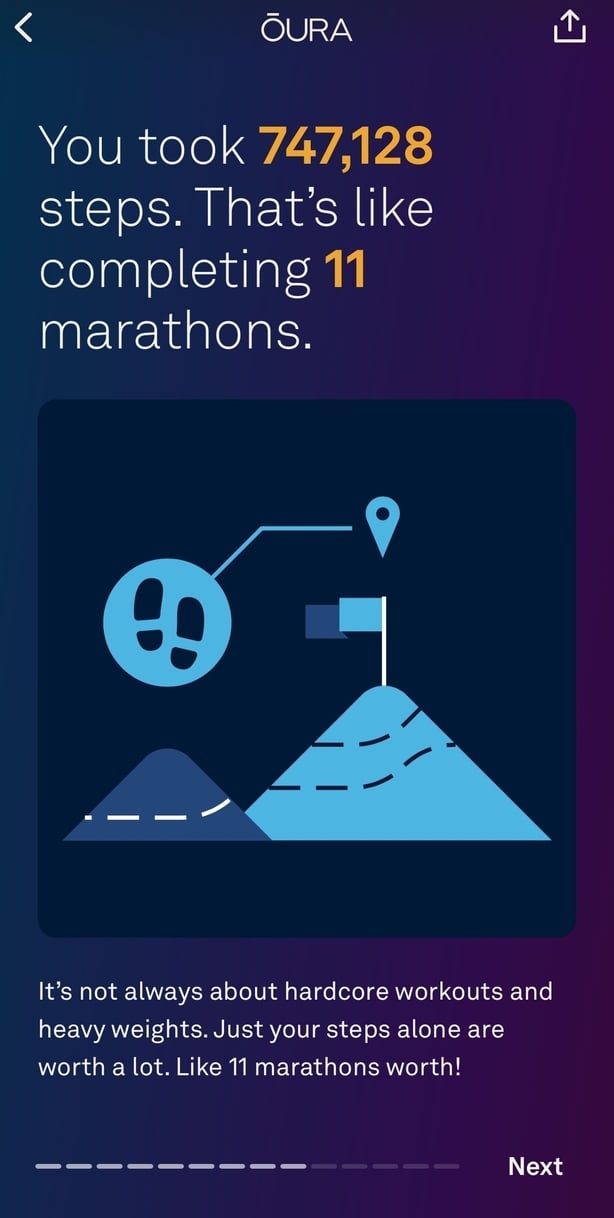
That said, having a little reminder to get as much movement as I could undoubtedly improved my fitness and mental wellbeing as it encouraged me to get out and move more. From August to September I took 350,182 steps, but doubled that between October and December. I also hit my activity goal on more days in the last three months of the year. Tracking this through the in-app Reports section is very user-friendly and motivating, too.
Sleep
Without a doubt the Oura is best marketed as a sleep tracker. There are scores of Reddit users who ferociously debate their Sleep and Readiness scores, trying to perfect them. When the ring detects that you've had a bad night's sleep, it will offer suggestions to improve it the next night, such as unwinding a few hours before bed or avoiding caffeine. You can also use the in-app advisor to dig in more, but I found it slow and not particularly insightful.
I've also found that while the amount of data the Oura collects is impressive - there's plenty to dig into if you want - its ability to tell the difference between sleeping and resting is questionable.
The problem is, I love lying down. The other problem is, I'm actually sometimes quite calm. Combine the two and the Oura picked up many instances of what it thought was napping.
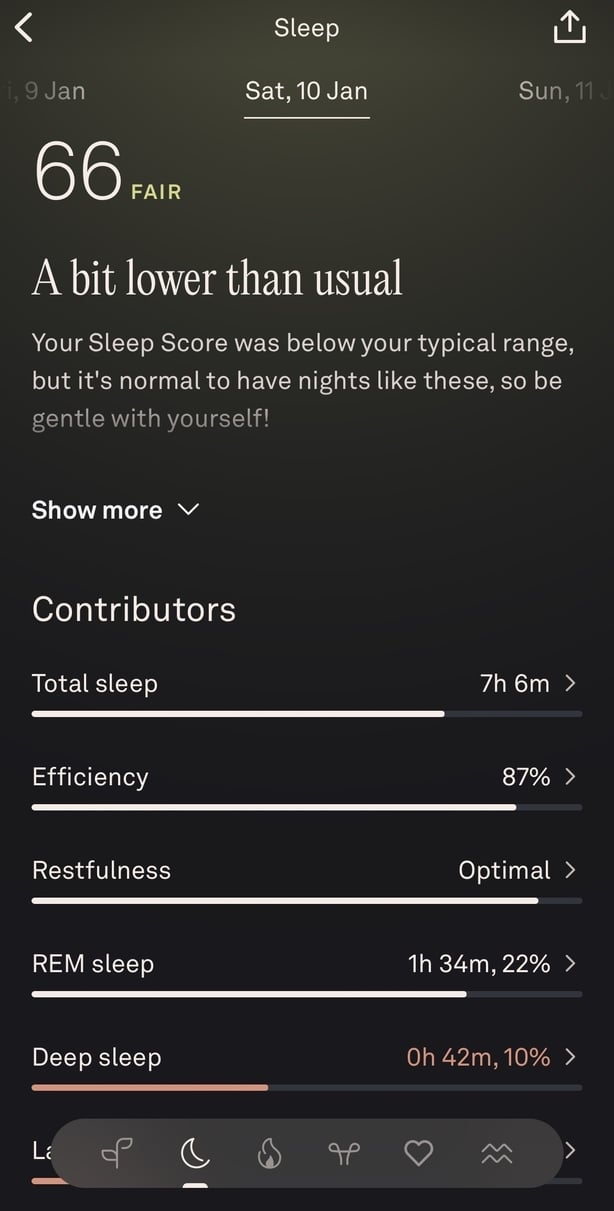
A memorable example of this was when, at a choral concert in Krakow, it thought I'd slipped into a 24-minute nap.
What I have learned is to pay attention to how long I've spent in deep sleep and my 'latency' - the time it takes for me to fall asleep once I'm in bed. I could anecdotally tell when I've had a deep sleep before but I'd have no way of tracking that, so this is useful. This has also encouraged me to swap out the phone for a book, so a good habit is being built.
Crucially, I must add, it's me building that habit - a ring isn't going to come and take the phone out of your hand if you're not someone who already likes to read. This extends to all parts of using the Oura, which is a great motivator on the hand of the right person.
Cycle tracking
As someone who is interested in menstrual health anyway, I was particularly excited to try the Oura's cycle tracking feature. This works by reading biometrics such as your temperature in your sleep, and users log the days of their period, flagging it as light, medium, heavy or a skipped period. It also predicts your most fertile window and ovulation, and highlights what phase of your menstrual cycle you're in.
It correctly predicted the start of my period just once, but given that it needs three months to start monitoring trends that's pretty good going. Using its temperature tracking to anticipate your period is also very helpful, though this would be most beneficial for women looking to get pregnant.
Symtom Radar
The most thrilling and arguably terrifying feature for me, however, was one I didn't expect: the symptom radar.
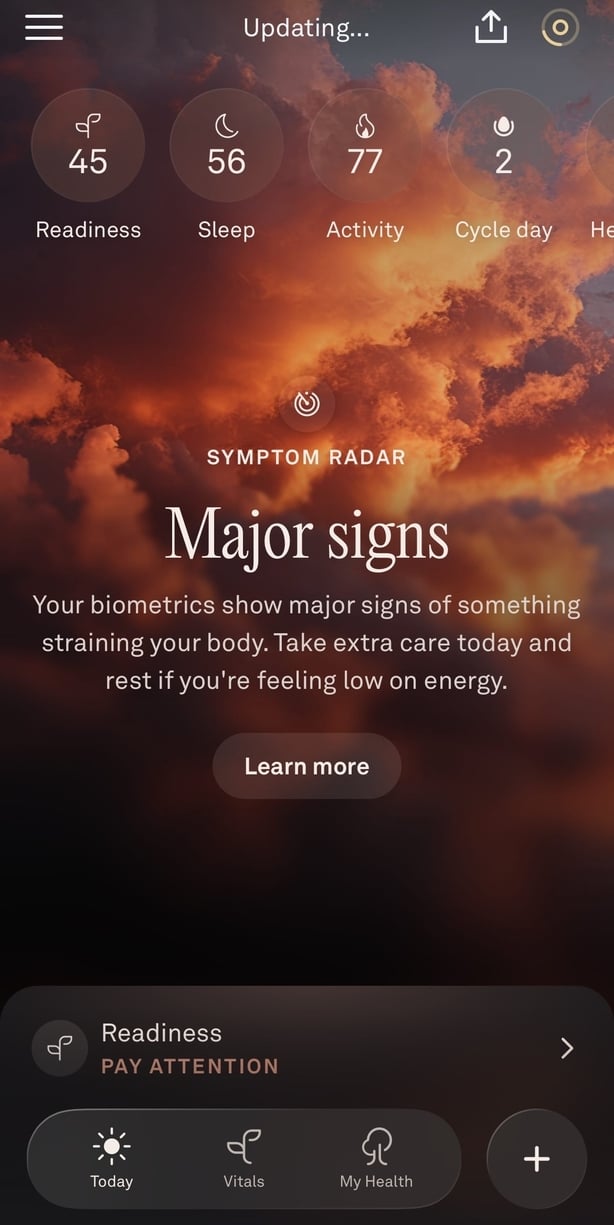
Picture it: you wake up, have a little stretch, roll over and blearily squint at the Oura app. In place of the serene blues of the sleep and heart rate trackers, however, is a far more hellish sight. Dark red clouds, deep shadows and the words 'Major signs', flagging that the Oura has picked up trends in your biometrics that suggest something is severely straining your body.
I encountered the dark red clouds three times in the five months I wore the ring and each time felt like being part of the climax in Apocalypse Now. Exciting? Yes. Unnerving? Extremely. It felt like having a stern nurse or my mam burst into my bedroom in the morning, not only telling me that I'm sick, but brandishing all the evidence of my wellbeing misdemeanours in my face.
This feature does, however, sum up what I like the most about the Oura: it's like having someone watching your back (in a way that feels far less creepy than that sounds in this day and age), the way a concerned but loving parent would.
Trusting yourself
There's an existential problem at the heart of these kinds of trackers, though, one that many users and some journalists have discussed: despite promising to shed evermore light on what your body is doing, they can leave you second guessing your system's natural cues. 'Ontological insecurity', Martin Berg, a Professor of Media Technology and Associate Professor of Sociology at Malmö University, called it in 2017.
An obvious example is waking up feeling rested and ready for the day until you look at your Readiness and Sleep scores and find that they're in the 50s or 60s, with the Oura app suggesting you take it easy. This often happened to me and it would be up to me to make the call on whether I'd hole up on the couch for the night or go meet friends. Sometimes, going out and moving my body was enough to get me out of the slump, but the entire experience felt counter intuitive.
The way I see it, if you have a teething baby, an elderly relative going through a health struggle or a demanding and stressful job, you already know if you get bad sleep and why. When I was going through my most challenging weeks in recent months, one thing that would make a bad day worse was seeing a Readiness Score of 45 and knowing I had no hope of addressing it that day.
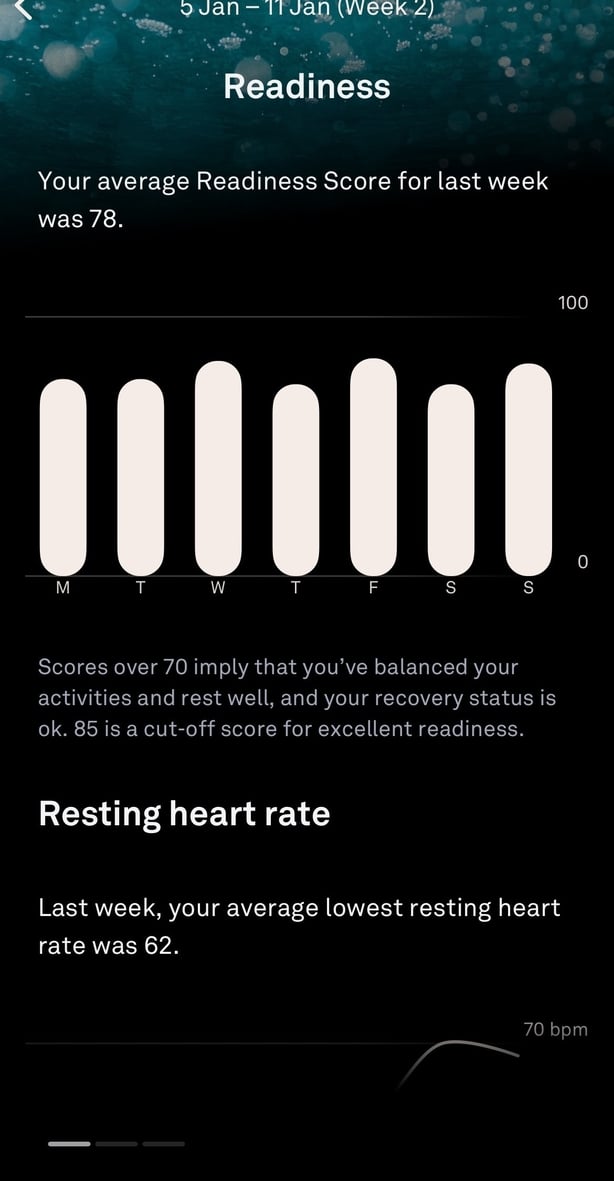
If you're already someone who is somewhat attuned to their body, like I think I am, the best benefit of the Oura is that it gives you accountability and encouragement to improve. In that way, the ring has sincerely improved my habits, but in terms of understanding what my body does when I'm not looking, I'm not really any wiser.
I also don't know how much time I want to spend unravelling the secrets of my sleep or my stress. As with self-help, life advice and fortune cookie messages, the best strategy for me was to take what felt relevant in that moment and leave the rest.
In short, the Oura is an incredibly impressive piece of tech for what it is: compact, elegant, responsive, with a stylish and easy to use app. But as with any gadget on the market, I think you have to really consider how much use you'll get out of it to justify the price.
Like a handsome but irritating boyfriend, aside from a surface level lustre the Oura doesn't add much more to my life when on my finger versus when off of it. It may be fun to look at but frankly talks back too much for my patience to withstand.
The views expressed here are those of the author and do not represent or reflect the views of RTÉ.
