




On This Week: Irish moments from history (May 18th - 24th)
Welcome to On This Week, where we delve into the standout stories from the years gone by, featuring standout news stories, major sporting events, and pop culture highlights that helped shape Irish life. Here's your dose of Irish history from May 18th - 24th.
This week in Irish life and news
1986: The biggest art heist in Irish history
On this week in 1986, £10 million worth of paintings were taken from Russborough house. The collection was considered to be the most important personal collection in the world. Despite sophisticated security in place at the house, 18 paintings were stolen.
It was second major theft from Russborough House despite increased security after the Dugdale robbery 12 years earlier, and was the biggest art heist in Irish history. Gardaí had called at the house during the night in response to a security alarm, but left as all seemed well.
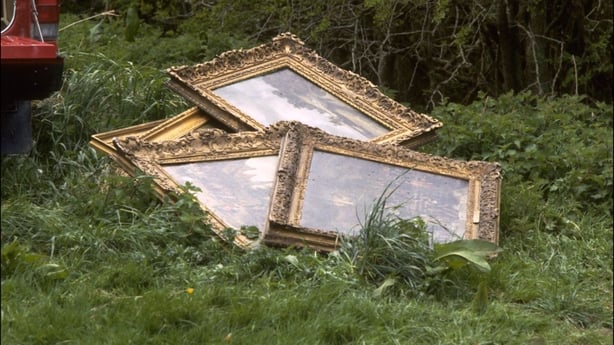
In this RTÉ News report broadcast on 21 May 1986, reporter David Davin Power spoke to Superintendent Frank Hanlon of the Garda Press Office to find out what went wrong. Superintendent Hanlon explained that the house was thoroughly checked when the alarm was raised. However he acknowledged that security did break down somewhere along the way resulting in the loss of the paintings.
It appeared that the thieves got in through a ground floor window at the back of the house. Tracks were found in the field to the rear of the house suggesting that there were two vehicles involved in the robbery. As they tried to piece together what happened Supt Hanlon appealed for assistance from anyone who may have seen anything suspicious in the vicinity of the house.
The crime was later revealed to be the work of Martin Cahill, known as 'The General'. Most of the paintings were subsequently recovered, The Beit collection is now in the National Gallery of Ireland.
1992: The Guardian is withdrawn in Ireland because of an ad
The Guardian newspaper was not distributed for sale in the Republic of Ireland on May 21st 1992, as it contained an advertisement for abortion services in Britain. 2,000 copies of early edition of The Guardian arrived in Dublin and were transported to the Eason's company depot in Dublin city centre. Eason's began shredding the page containing an advertisement placed by the Marie Stopes Clinic. Gardaí were present at Dublin airport when the newspapers arrived and had the authority to seize them if they were sold. However, as none had been distributed for sale no offence was committed. The headline of the advertisment read:
It took an act of parliament to legalise abortion. Does it take an act of courage to talk about it?
The Eason company had first learned of the advertisement the previous night on the television news. After receiving legal advice, Easons decided that it had no other option than to halt the distribution and sale of the newspaper.
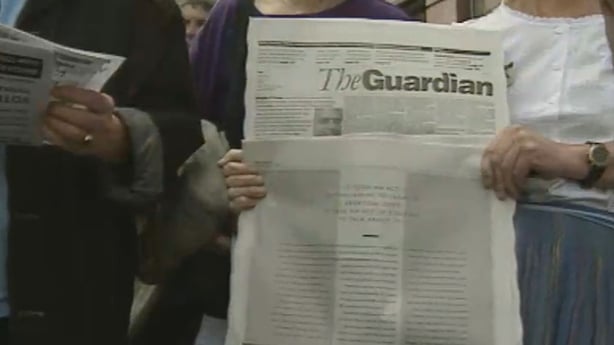
Society for the Protection of the Unborn Child (SPUC) has raised concerns over the way in which the controversy became public. SPUC spokesperson Marie Vernon described the controversy as an effort to influence the outcome of the Maastricht debate.
The advert was placed by the Marie Stopes Clinic who claim it was aimed primarily at a British readership. Director of the Marie Stopes Clinics Helen Axby defended their position saying
This advertisement is part of an overall campaign which promotes all of Marie Stopes services.
There were heated exchanges in the Dáil on the issue with Fine Gael leader John Bruton asking for a time frame on legislation for a right to information on abortion. Leader of Democratic Left, Proinsias De Rossa, said that the events proved that we are living in "an infantile theocracy".
Taoiseach Albert Reynolds rejected any suggestion of Garda intervention and said that the Eason company had acted itself. Speaking to RTÉ News, Mr Reynolds said that a strange set of circumstances surrounded the publicity about the placing of the advertisement.
An RTÉ News report first broadcast on 20 May 1992. The reporter is Mark Little.
2006: Bertie's make-up bill
On this week in 2006, during a Dáil debate, the Taoiseach Bertie Ahern defended the cost of his makeup expenses.
It had been the practice of all Taoisigh to wear makeup since the televising of Dáil proceedings began in 1990. But in 2006 Dublin South East Green Party TD John Gormley questioned Taoiseach Bertie Ahern about his priorities and suggests that €480 a week was too much to spend on cosmetics.
It's extraordinary that ...you spend more money on makeup than any of the ladies in the cabinet. What sort of priorities do you have when you're heading around like the 'Queen of Drumcondra'?
He asks Bertie Ahern should he be known as the L'Oreal Taoiseach 'because he is worth it'?
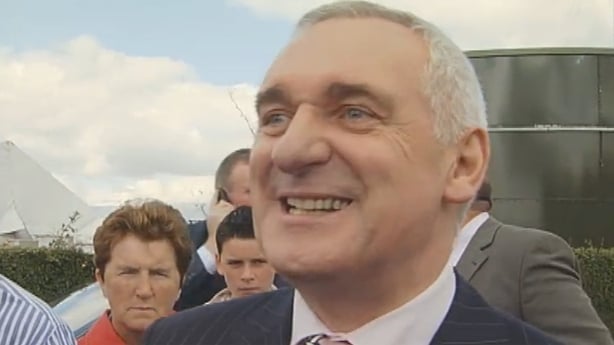
The daily rate for the Taoiseach's professional makeup artist was €187.45 (gross) per day and two makeup artists were employed on a rotational basis for 2/3 days a week.
An RTÉ News report broadcast on 24 May 2006. The reporter is Gareth O'Connor.
On this week in arts and entertainment
1984: The 'Girl from Ipanema' in Cork
The legendary bossa nova and jazz singer Astrud Gilberto performed 'The Girl From Ipanema' at the Cork Opera House in 1984. She was one of the international artists performing at the annual Cork Jazz Festival, sponsored by Guinness, taking place over the October bank holiday.
In this clip, broadcast on May 23 1984, she introduced her band to the Cork Opera House audience; pianist Ted Lo, guitarist Emily Remler, bassist Marcelo Gilberto, drummer Duduka da Fonseca and trombonist David Sacks.
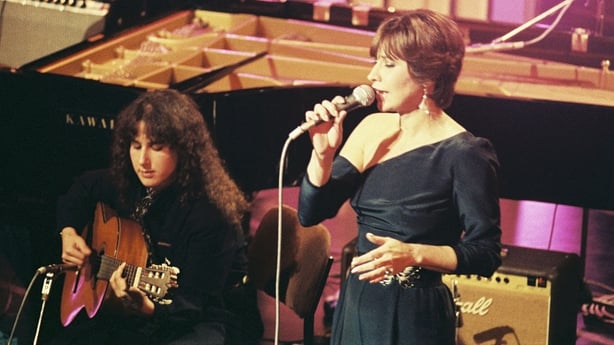
She performed 'The Girl From Ipanema', singing the lyrics firstly in Portuguese and then in English. The music for 'The Girl From Ipanema’ was written in 1962 by Antonio Carlos Jobim with Portuguese lyrics by Vinicius de Moraes. The English lyrics were written by Norman Gimbel. The Stan Getz recording featuring the vocal debut of Astrud Gilberto released in 1963, became an international hit in 1964 and received a Grammy Award for Record of the Year in 1965.
The RTÉ Outside Broadcast Unit recorded several of the concerts staged in the Cork Opera House and in all some 15 hours of jazz was recorded. These recordings were edited into 14 programmes and broadcast weekly from 25 April 1984 for 14 weeks as 'The Guinness Jazz Festival'. This episode of 'The Guinness Jazz Festival' was broadcast on 23 May 1984.
1999: Gay Byrne leaves the Late Late Show - with some help from U2
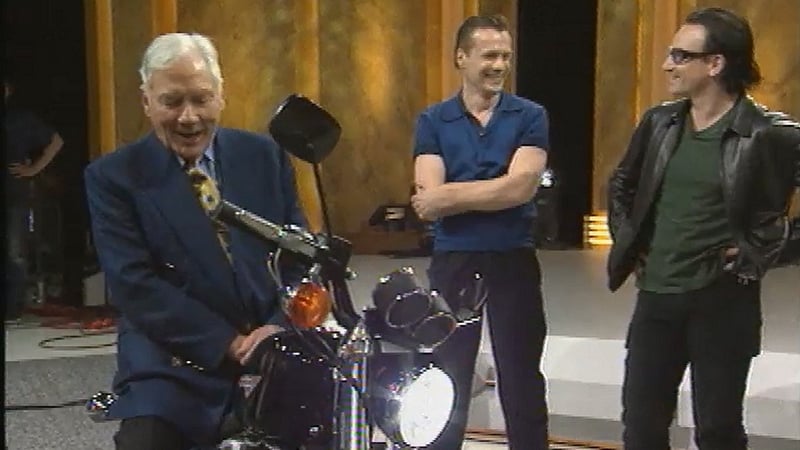
On this week in May 1999, Gay Byrne presented his final 'Late Late Show' after almost 37 years as the show's host.
The world's longest running chat show had, over four decades, brought many topics deemed taboo by elements of Irish society into a public forum for discussion. The first episode of 'The Late Late Show' was broadcast on the 6 July 1962 and was intended as a 'filler' for the summer schedule.
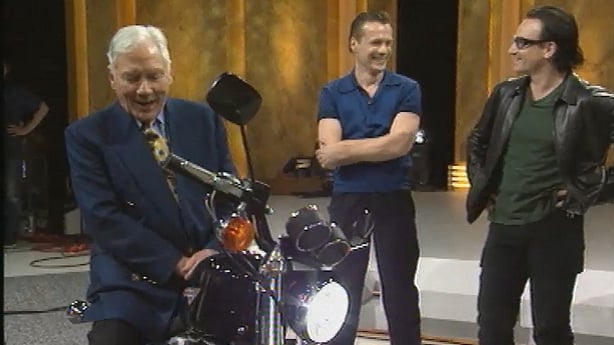
In this clip from Gay Byrne's final Late Late Show on May 21 1999, U2 members, Bono and Larry present Gay with a Harley Davidson and Bono tells a story of calling out to Byrne's house to try and get the young U2 on 'The Late Late Show'.
This is from us to you.
Pat Kenny replaced Gay Byrne as presenter in 1999 and remained in that position for 10 years. Ryan Tubridy was the next host and was in the presenter's chair until 2023. Patrick Kielty is the current host of the Late Late Show.
On this week in sport
1990: The FAI's Italia 90 handbook
On May 21st 1990, the Football Association of Ireland launched the 'Official World Cup Handbook' at a function for the press in the Gresham Hotel in Dublin. Selling at £3.95, this colourful booklet outlined the history of Ireland's progress to the World Cup. The publication included articles by Jack Charlton and well known Irish soccer commentators. It gave information on the combinations and permutations that go into success in the groups involved in the World Cup, as well as pen portraits and photos of the Irish team.
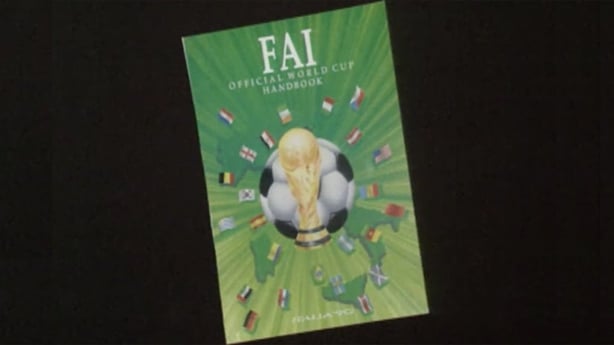
FAI commercial manager and the handbook’s editor Donie Butler said,
It’s the complete and comprehensive publication.
He believed it is useful for the stay at home fan and for the fan travelling to Italy as it provides information on all the 24 finalists, statistics and match day team checks.
It’s actually a veritable programme for ever match in Italy during the World Cup.
The reporter is Colm Murray.
1993: David O'Leary leaves Arsenal
On Kenny Live on 22 May 1993, Republic of Ireland team mates paid tribute to David O'Leary who is to depart Arsenal the club he had played with for the last nineteen years. Manager Jack Charlton and members of the Republic of Ireland Football squad paid homage to David O'Leary ahead of his testimonial game for Arsenal at the end of the season.
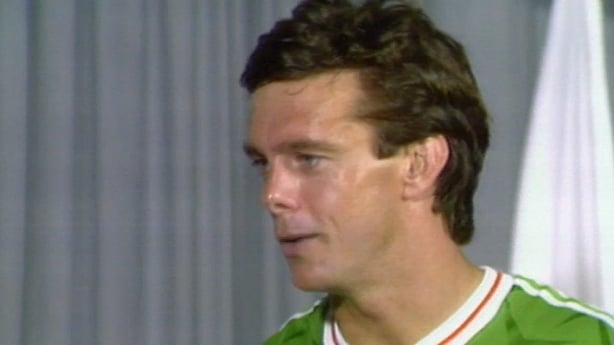
Despite being left out Jack Charlton's Republic of Ireland squad for two years before a recall in 1988 O'Leary and Charlton spoke fondly of each other now, with Leary saying
I've never had an argument with Jack.
O'Leary recalled scoring a goal against Turkey in Lansdowne Road during a Euro 92 qualifier game which Ireland went on to win 5-0 and Andy Townsend, John Aldridge, Tony Cascarino, Roy Keane, and Terry Phelan all paid tribute to their Republic of Ireland team-mate and the contribution he has made to Irish football.
We all admire Dave for the service that he's given the game over the years.
The presenter is Pat Kenny.
What was Number 1 in Ireland this week?
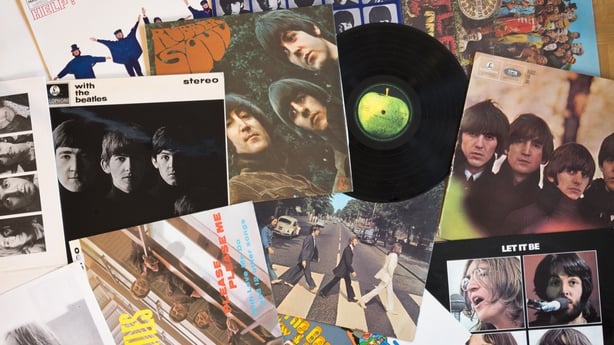
1969: 'Get Back' by the Beatles
One of the Fab Four's last singles was number one for six weeks in 1969
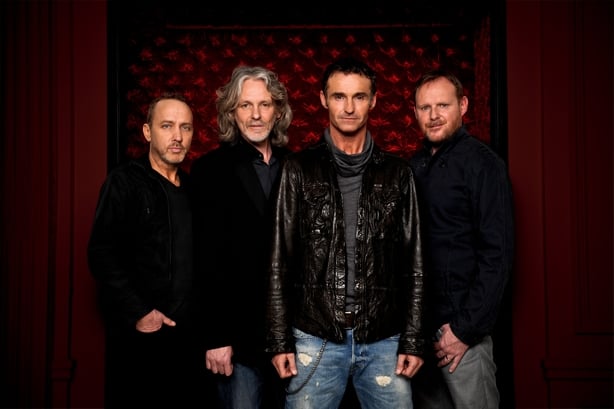
1991: 'With a Little Help from My Friends' by Wet Wet Wet
And a song by the Beatles was number one 22 years later, when Scottish band Wet Wet Wet covered it and stayed at number one for three weeks.
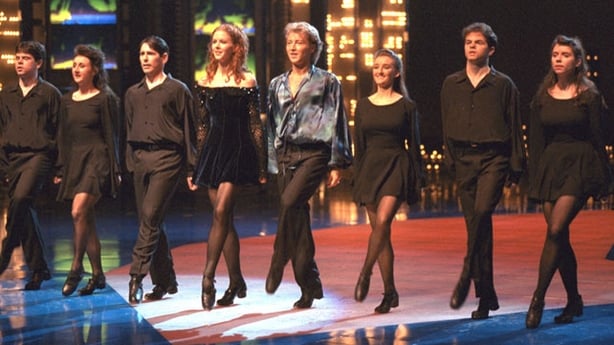
1994: 'Riverdance' by Bill Whelan
The music from the Eurovision sensation was released as a single to phenomenal success in early summer 1994 and, unbelievably, stayed at the top of the charts for 18 weeks. Yes, four and a half months.
Famous Irish names celebrating birthdays this week
Alan Leech
The Downton Abbey star turns 45 on May 18th.
Paul Brady
The legendary musician is 79 on May 19th.
Mary Robinson
The activist and former President of Ireland turns 82 on May 21st.
