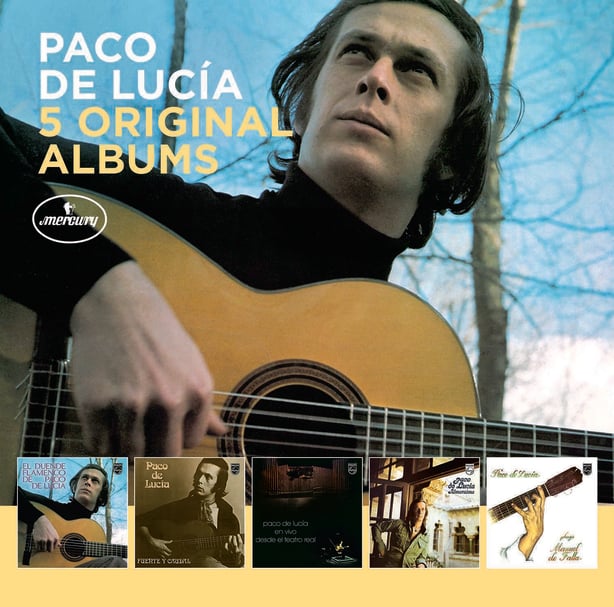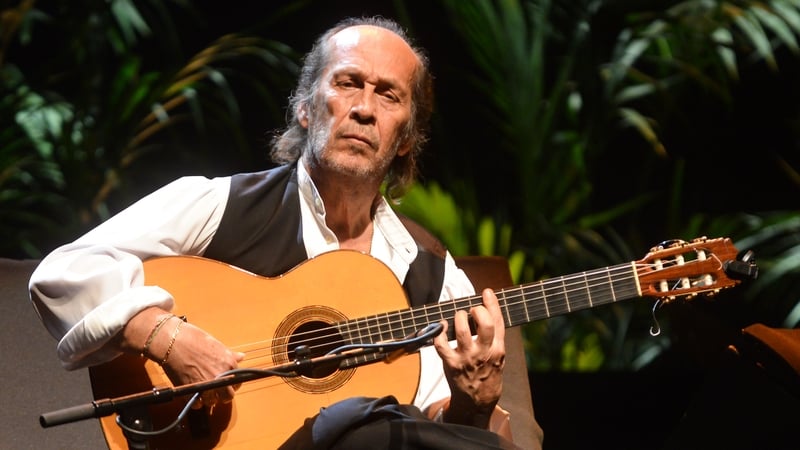

Four studio albums and one live album – that’s the bill of fare here in this interesting retrospective of the work of the late Paco de Lucía, who hailed from Algeciras in Southern Spain. Born Francisco Gustavo Sánchez Gómez, de Lucía was the son of a Spanish guitarist who obliged his son to study at least nine or ten hours day. That just as easily might might turn a young lad off, but de Lucía – who took his Portuguese mother’s surname for his career – ran with the ball, following the example of his elder brother Ramón. In the early seventies however, it was Paco who was being spoken about in reverential tones, although he drew criticism for expanding the interpretation of Flamenco into rock and jazz-influenced territory.
Such arguments have validity of course, but is hard to appreciate the obvious talents of Tomatito - still very much with us - or Moraíto Chico II (1956-2011) without the example of de Lucía to light the way. Listen to what they can do and the purist arguments seem somehow inconsequential, debate from another day.
Not everything is brilliant here, let’s not over-idolise. I don’t find the Manuel de Falla interpretations, the matter of the fifth disc, particularly exciting. Sometimes when he is accompanied by strings, you feel a sense of superfluity, ditto with the additions of flute, chromatic harmonica - they can be like strings that get tangled up with the core tune. That’s just a personal gripe but orchestration applied to someone like Paco compromises the music it seems.
For the true essence of the man’s talent, listen to the craggily Moorish tracks Doblan Campanas or Tientos del Mentediero on the first disc, El Duende Flamenco de Paco de Lucía. There was a numinous profundity about such pieces and they beat hands down a lot of the later and rather over-hyped collaborations with the big-name jazz guitarists John McLaughlin, Al Di Meola and Larry Coryell.
More of that lonesome, wistful air evoked by one man and his guitar can be found on two very fine albums, Fuente Y Caudal (1973) and Almoraima (1976), both of which are included here. If you haven't investigated Paco, now is the time to start.