



Analysis: The jobs people do to earn a living have changed fundamentally in 100 years, reflecting how the workforce evolves to reflect the world around us
By Maria Yasin and Ciara Hayes, CSO
Census 1926 records provide the first comprehensive insight into life in the Irish Free State and paints a picture of a time and place quite different to the country we live in today.
To complement the release of the Census records, the Central Statistics Office has produced Then and Now: Life in Ireland in 1926 and 2022 highlighting statistical trends over almost 100 years on topics such as life expectancy, religion, and population. The chapter on occupations stands out for its ability to show how much our working life has changed in that time.
What was the workforce like 100 years ago?
The Irish workforce has changed significantly as 100 years ago we were a smaller, more rural country. In 1926, Ireland's population was just under three million, compared with over five million in 2022. More than 1.3 million people were at work in 1926 compared with 2.3 million in 2022. Notably in 1926, 74% of those in employment were men whereas today the split is far more even, with men accounting for 53% of those in employment and women 47%.
We need your consent to load this rte-player contentWe use rte-player to manage extra content that can set cookies on your device and collect data about your activity. Please review their details and accept them to load the content.Manage Preferences
From RTÉ's Come To Your Census podcast, Liz Gillis is joined by local historians Maria O’Reilly and Eamonn Delaney to talk about the stories behind some of Dublin's earliest public housing projects
According to the official 1926 tables, a person’s occupation was defined by the "operations he performs in earning his living", while industry referred to a broader sector of the economy.
We know that Ireland was primarily an agrarian society, with more than half (51%) of those in employment working on the land compared with just 4% in 2022. There are fascinating geographical insights with Leitrim having the highest agricultural dependency in 1926 at 81%, followed closely by Mayo (80%), and Roscommon (80%). The family farm was very much in evidence with more than 206,000 sons and daughters assisting farmers working on family land.
When we look to the cities, we see skilled trades were the lifeblood of large urban areas. Limerick City (33%), Dublin City (32%) and Cork City (31%) were the industrial hubs, home to thousands of bakers, tailors, and smiths (blacksmiths).
The Census 1926 records show that almost 91,000 people were employed in domestic service. Around 87,500 of these types of workers were women, and around 3,000 men were employed as domestic servants.
We need your consent to load this rte-player contentWe use rte-player to manage extra content that can set cookies on your device and collect data about your activity. Please review their details and accept them to load the content.Manage Preferences
From RTÉ Radio 1's This Week, genealogist Jennifer McLaughlin Doherty talks about the release of the 1926 Census
Are there unusual or vanishing occupations?
Yes, given how we relied on coal and peat for home heating, there was work for 211 chimney sweepers, of which only one was female, and just over 1,000 coopers (cask and barrel makers).
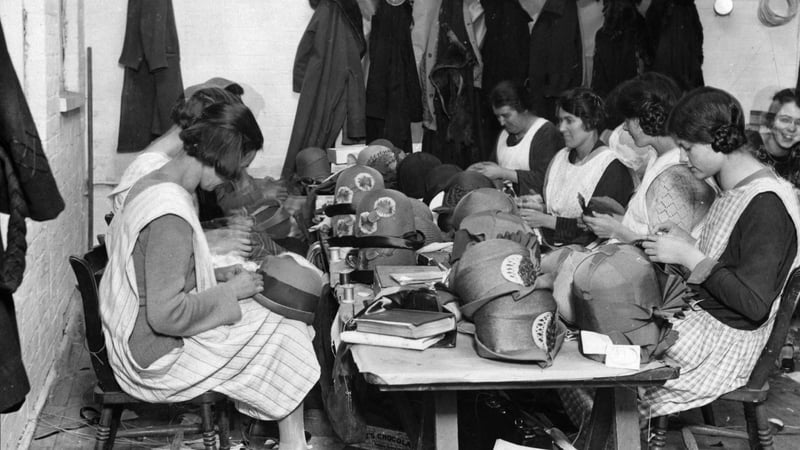
Another reflection of changing trends in employment and fashion was the 1,385 milliners, 826 embroiderers and 336 hand lace workers in 1926 comprising a skilled cottage industry that supported many women across the country.
Was there an emergence of a professional class?
Yes, professional occupations such as teachers, doctors, and clergy, and others in this group represented a growing middle class. They made up just 4% of workers in 1926 but had grown to 10% by 2022, reflecting the longterm growth of education, health, and technical occupations. Co Dublin led the way in professional roles.
Have some jobs stood the test of time?
Looking at health and medical professions, many of the occupations still exist but the roles will have changed significantly. In 1926, when the health sector was far smaller and more limited in scope, there were: 2,051 medical doctors, 491 midwives, 5,341 sick nurses and 536 dentists.
Census 2022 recorded 62,483 nurses and midwives, 17,953 medical practitioners, 2,330 dental practitioners, 5,056 medical and dental technicians, 37,843 nursing auxiliaries and assistants, 1,699 paramedics, 6,033 pharmacists, 2,975 psychologists and 4,069 therapy professionals.
From RTÉ Archives, Tom Linehan from the CSO talks to Charlie Bird from RTÉ News about how to fill out the census form ahead of the 1986 census
This reflects new clinical, diagnostic and therapeutic roles emerging in response to advances in medicine and the growing complexity of healthcare delivery.
In financial services, there were only 382 chartered accountants recorded in 1926, whereas in 2022 there were more than 43,000 chartered and certified accountants, over 15,000 business and financial project management professionals, and a further 13,000 finance and investment analysts and advisers recorded in the census.
What about technical roles?
Technical and engineering roles remained an important part of the workforce in 2022, with 9,112 civil engineers, 7,778 electrical engineers, 6,088 mechanical engineers, and 10,195 'Engineering Professionals n.e.c.’ recorded in the census.
From RTÉ News, director of the National Archives of Ireland Orlaith McBride talks about the release of census 1926
Skilled technical trades were also substantial, including 17,142 vehicle technicians, mechanics, and electricians, 12,053 plumbers and heating and ventilating engineers, 23,187 electricians and electrical fitters, and 3,141 electrical and electronics technicians.
In 1926, the scale of these types of occupations was far smaller. The census recorded 717 workers under ‘Boiler Makers, Plumbers and Mechanics’ Labourers’, 1,899 plumbers, and 2,475 electrical fitters. These figures show a clear expansion from small craft‑based mechanical and electrical roles in 1926 to a large, specialised engineering and technical workforce by 2022.
Transport has changed significantly, how has that changed in terms of employment?
Yes, before the motor car took over, the state relied on 10,852 horse vehicle drivers, 1,441 saddlers, and 1,399 grooms to keep the country moving.
By 2022, these early developments had grown into a broad range of road, air, rail, and marine occupations across the transport and communication sector. Transport-related occupations formed a notable part of the workforce in 2022. Large goods vehicle drivers (23,547), taxi and cab drivers and chauffeurs (13,153), van drivers (12,016) and bus and coach drivers (10,676) accounted for substantial numbers of workers.
We need your consent to load this rte-player contentWe use rte-player to manage extra content that can set cookies on your device and collect data about your activity. Please review their details and accept them to load the content.Manage Preferences
From RTÉ Radio 1's Today with David McCullagh, telling the story of the 1926 census
Managers and directors in transport and distribution (5,025) were also recorded, alongside air transport operatives (1,292), rail transport operatives (1,148), marine and waterways transport operatives (764) and aircraft pilots and flight engineers (1,976).
What about fishing?
In 2022, 2,569 people were recorded as working in fishing-related occupations compared with 5,753 fishermen in 1926. This represented a substantial decline in the number of people directly engaged in fishing over the century.
Taken together, these figures show how peoples’ working lives have changed fundamentally in almost 100 years. Some roles have remained and evolved, with many new ones in 2022 in areas including digital and technology, and they show how the workforce continues to evolve to reflect the world around us.
Follow RTÉ Brainstorm on WhatsApp and Instagram for more stories and updates
Maria Yasin is a data analyst/staticisian for the CSO. Ciara Hayes is a statistician for the CSO. For more insights, visit Then and Now: Life in Ireland in 1926 and 2022 or check out CSO.ie.
The views expressed here are those of the author and do not represent or reflect the views of RTÉ
