
Analysis: While the US and Israel have achieved some objectives, Iran has adapted, regime change has not happened and the state shows no signs of surrender
American sociologist Charles Tilly's famous statement that "war made the state" appears to apply to Iran, particularly after the US–Israeli multi-layer strategy failed to bring about an imminent "regime change" in Iran. On 7 March, the US and Israel carried out an attack aimed at decapitating the Iranian elites, crushing 450 kg of 60%-enricheduranium stockpiles, obliterating missile programme and damaging key infrastructures. While these goals could be seen as immediate operational objectives, the broader strategic goal appears to be a chaotic regime change that could possibly lead to the territorial fragmentation of Iran.
In the first hours of the attack, Iran’s Supreme Leader, Ali Khamenei, was killed. His assassination was a strategic miscalculation: when a leader is killed by a foreign power, it can trigger a "rally-around-the-flag" effect, encouraging supporters—especially within parts of the working class—to recast him as a martyr or national hero. While some particularly wealthy members of the Iranian diaspora have welcomed his death, it expanded religious-nationalist alignment in Iran.
We need your consent to load this rte-player contentWe use rte-player to manage extra content that can set cookies on your device and collect data about your activity. Please review their details and accept them to load the content.Manage Preferences
From RTÉ Radio 1's Morning Ireland, Iran names Mojtaba Khamenei as new supreme leader so who is he?
There is no sign of the 450 kg uranium stockpile, enough for at least 10 nuclear weapons. While Iran’s missile capabilities have been partly degraded, its attacks persist because of the "mosaic defense" doctrine, a decentralised strategy allowing regional commanders to operate independently if central command is disrupted.
Iran’s strategy has expanded the scope of attacks. Within two hours of the US-Israeli offensive, Iran adopted a "madman" approach, sparking a regional conflict to prove it is not the "paper tiger" Israel assumed. Its unpredictability reverberated globally, targeting Israel, Gulf states and US bases, killing at least seven US soldiers.
Following political decapitation and a partly military degradation, US–Israeli strikes have increasingly targeted Iranian infrastructure—a campaign dubbed "infrastructural war" by Iranian officials. Attacks on schools, hospitals, sports complexes, desalination plants, industrial zones and oil facilities have killed over 1,255 people, including schoolgirls and soldiers.
We need your consent to load this rte-player contentWe use rte-player to manage extra content that can set cookies on your device and collect data about your activity. Please review their details and accept them to load the content.Manage Preferences
From RTÉ Radio 1's Morning Ireland, Iranians talk of their of fears and hopes after one week of war
Despite broad sanctions, Iran’s productive capacity remains largely intact. Between 2011-12 and 2021-22, industrial employment rose by 27%, output by 70% and labour productivity by 34%, reflecting state efforts to enhance domestic infrastructural power. Attacks on infrastructure seem aimed at amplifying the psychological impact of sanctions, echoing strategies used in Iraq before the 2003 invasion.
While the US and Israel have achieved some tactical objectives, regime change in Iran has not happened and the state demonstrates no signs of capitulating. A peaceful regime change is unlikely, as surrender is considered a grave sin under the Shia Islamic ideology governing the state. Any violent attempt to force change could trigger civil war and potential territorial fragmentation. Signs of such fragmentation are already visible, with Kurdish militias in western Iran organising militarily with backing from the US and Israel.
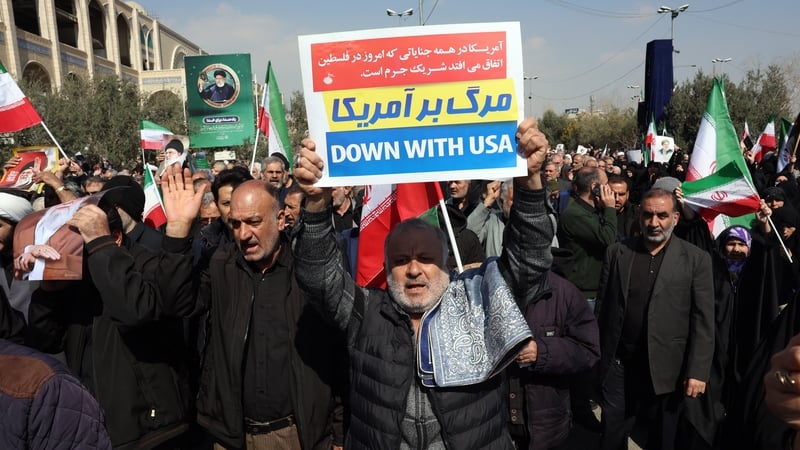
The prospect of a chaotic regime change, coupled with potential territorial fragmentation, is giving rise to a new form of state in Iran, with both international and domestic repercussions. Externally, the appointment of Mojtaba Khamenei as the new supreme leader underscores that there has been no "unconditional surrender" by Tehran. Following the announcement, crowds in Iran were reportedly seen in the streets chanting slogans such as "God’s hand became apparent, Khamenei became young" and "Neither compromise, nor surrender — revenge, revenge", signalling the continuation of "Khameneism".
We need your consent to load this rte-player contentWe use rte-player to manage extra content that can set cookies on your device and collect data about your activity. Please review their details and accept them to load the content.Manage Preferences
From RTÉ 1 Nine News, Us president Donald Trump says Iran war will be a 'short-term excursion'
Since Iranian officials have made it clear they will not accept any ceasefire until there is what they call a "permanent peace", it underlines domestically that the new leadership is attempting to securitise the war. They are seeking to frame it as part of a long‑term security strategy for Iran after enduring multiple illegal attacks over recent months.
Security guarantees could help Iran alleviate the impact of sanctions by attracting foreign investment, particularly from China. Investing in a country under potential military threat is considered high-risk, legally complicated and potentially damaging to reputation and international relations. As a result, capital tends to flow toward stable countries where returns are more predictable.
Although Mojtaba’s appointment will draw sharp criticism both domestically and internationally, his supporters view him as a potential counterpart to the de facto ruler of Saudi Arabia, Mohammed bin Salman: someone viewed as a progressive leader but with a markedly different vision of the global order. Under Mojtaba’s leadership, Iran will be easternised rather than westernised through deepening ties with global south in general and China and Russia in particular. He may also advocate for pursuing nuclear weapons, framing them as essential for national security, a policy explicitly prohibited by his father.
The conflict may thus strengthen, rather than weaken, the state
Domestically, his appointment may further concentrate power, but there is cautious optimism that it could give a voice to the lower classes. Over the past months in general, and especially during the war, these groups have criticised corrupt elites at various levels of government, while still supporting the state as a whole. This could open a pathway for greater civil society involvement in shaping policies.
Rather than collapsing, Iran is adapting: consolidating power under Mojtaba Khamenei, deepening ties with global south, and maintaining its strategic autonomy. The conflict may thus strengthen, rather than weaken, the state, illustrating Tilly’s notion that war can indeed reinforce state structures, even under extreme external pressure.
Follow RTÉ Brainstorm on WhatsApp and Instagram for more stories and updates
The views expressed here are those of the author and do not represent or reflect the views of RTÉ