


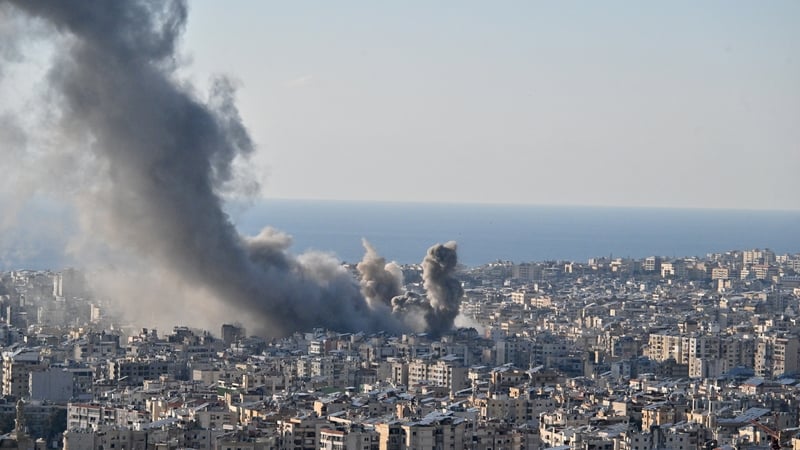
The US Department of State has called on Americans to immediately depart more than a dozen countries in the Middle East amid US-Israeli strikes against Iran.
Americans were urged to depart using commercial means from Bahrain, Egypt, Iran, Iraq, Israel, the West Bank and Gaza, Jordan, Kuwait, Lebanon, Oman, Qatar, Saudi Arabia, Syria, United Arab Emirates and Yemen, according to Mora Namdar, the State Department's assistant secretary for consular affairs.
The advice came against the backdrop of continued Israeli strikes on Tehran tonight while air raid sirens were reported in the UAE and across Israel.
Israel also said it had "struck and dismantled" the headquarters of Iran's state radio and television broadcaster during an attack on Tehran.
Meanwhile, an Iranian Revolutionary Guards senior official has said that the Strait of Hormuz is closed and Iran will fire on any ship trying to pass, Iranian media has reported.
This is Iran's most explicit warning since telling ships it was closing the export route on Saturday, a move that threatens to choke a fifth of global oil flows and send crude prices sharply higher.
"The strait (of Hormuz) is closed. If anyone tries to pass, the heroes of the Revolutionary Guards and the regular navy will set those ships ablaze," Ebrahim Jabari, a senior adviser to the Guards commander-in-chief, said in remarks carried by state media.
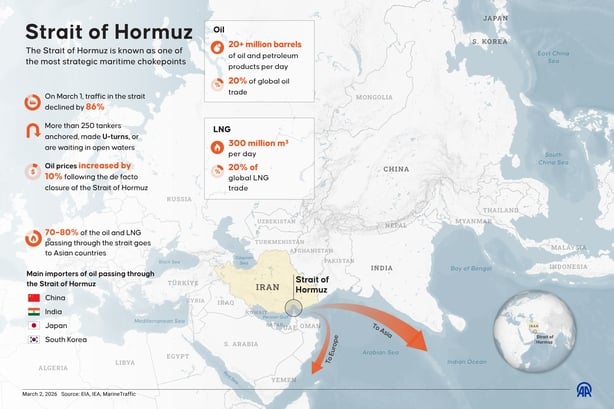
The strait is the world's most vital oil export route, which connects the biggest Gulf oil producers, such as Saudi Arabia, Iran, Iraq and the United Arab Emirates, with the Gulf of Oman and the Arabian Sea.
The closure was triggered by US and Israeli strikes on Iran on February 28 seeking to topple its leaders, with US President Donald Trump offering Iranians help in ousting the ruling clerics.
In response, Iran fired several barrages of missiles at its Gulf neighbours hosting US military bases such as Qatar, Kuwait and Bahrain. Tehran also fired missiles at the United Arab Emirates, Saudi Arabia and Oman.
With this closure, Tehran made good on years of threats to block the narrow waterway in retaliation for any attack on the Islamic Republic.
At least 52 killed in Israeli attacks on Lebanon
The US-Israeli air war against Iran expanded today, with Israel attacking Lebanon in response to strikes by Hezbollah, and Iran firing missiles and drones at Gulf states and a British air base as far away as Cyprus.
The Lebanese government said at least 52 people were killed in Israeli strikes and 154 others injured.
The bombings of southern and eastern Lebanon and Beirut's southern suburbs also displaced more than 28,500 people, according to the government's disaster and management unit.
Israel's military vowed to intensify its attacks on the country and make Hezbollah pay a "heavy price" after launching several strikes on Beirut's southern suburbs and south Lebanon, areas where Hezbollah holds sway.
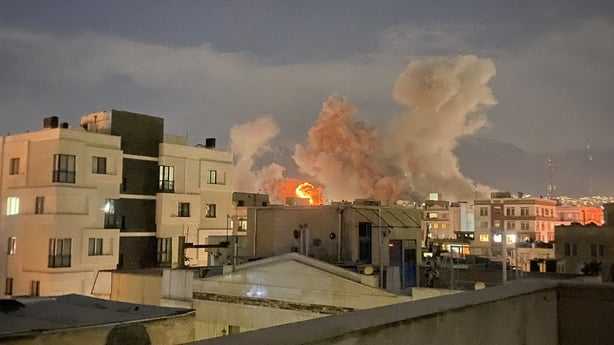
Watch: Footage shows a building on fire in Beirut
Meanwhile, the US military said Kuwait's air defences had mistakenly shot down three American F-16 fighters during an Iranian attack.
All six crew members were safely recovered.
A US base and a power station in Kuwait were also targeted, in what was the most dramatic escalation for the small Gulf country in decades, after the 2003 US invasion of Iraq and Baghdad's attempt to take over Kuwait in 1990.
Blasts also rang out over the Gulf cities of Abu Dhabi, Dubai, Doha and Manama as Iran targets the United States' Gulf allies after the killing of its supreme leader in US-Israeli strikes.
'Last best chance' to strike Iran, says Trump
Speaking this evening, US Secretary of State Marco Rubio said that the United States attacked Iran "pre-emptively" on Saturday after learning that ally Israel was going to strike, which would have meant retaliation against US forces.
"We knew that if we didn't pre-emptively go after them before they launched those attacks, we would suffer higher casualties," Mr Rubio told reporters.
Watch: Trump says war with Iran could last weeks
In the first formal Pentagon briefing since the campaign began, US Defense Secretary Pete Hegseth declined to set out a time frame to end the campaign, saying it was up to President Donald Trump.
The military's aim was to destroy Iran's ability to project force beyond its borders, which it had been using to provide cover to develop a nuclear weapon, Hegseth said.
"We're hitting them surgically, overwhelmingly and unapologetically," he said.
The comments came before US President Donald Trump said the attacks on Iran represented the "last best chance" to strike Iran.
Mr Trump said military operations were ahead of schedule, without providing details.
He said he had projected the US campaign would last four to five weeks but that it could go longer.
Mr Trump said US forces had knocked out ten Iranian ships, saying "they're at the bottom of the sea".
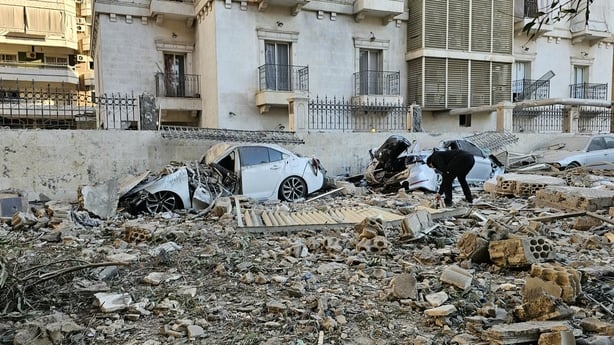
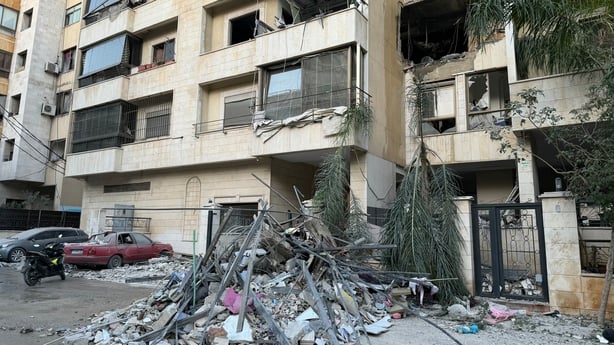
Lebanese Prime Minister Nawaf Salam said Lebanon will ban Hezbollah's military activities after the strikes on Israel.
Minister for Foreign Affairs Helen McEntee has said that she is deeply concerned by reports of the strikes on Lebanon and rocket fire on Israel.
"The widening of this conflict brings greater risk and suffering to the region," she said.
"We all do everything that we possibly can, through our channel, through the European Union, to de-escalate the situation, to prevent wider conflict from happening within the region, and to bring all those involved around the table.
"It is absolutely essential that we bring this conflict under control," Minister McEntee said.
Irish citizens in the Gulf region are advised to shelter in place.
The minister said the longer that this goes on, the implications for energy and energy pricing, more broadly, and the impact on our industry here will be felt significantly.
She added that the Government would engage with industry bodies in Ireland, with EU colleagues, in trying to respond to "what is a very fast moving and a very uncertain environment".
'Heart of Tehran'
The Israeli military said it had begun a new "broad strike" in the "heart of Tehran" after generals vowed to step up attacks on "key elements of the regime".
Loud explosions were heard in several parts of the Iranian capital shaking apartment buildings in the centre.
The Israeli military also said it was simultaneously attacking the Lebanese militant group Hezbollah and claimed to have killed a "senior Hezbollah terrorist" in Beirut, though the army said there was no reason for a ground invasion yet.
Iran's President Masoud Pezeshkian yesterday said a leadership council composed of himself, the judiciary head and a member of the powerful Guardian Council had temporarily assumed the duties of Supreme Leader.
In an X post this morning, Ali Larijani, who was adviser to Iran's Khamenei, said his country would not negotiate with Mr Trump. He said the US president had "delusional ambitions" and was now worried about US casualties.
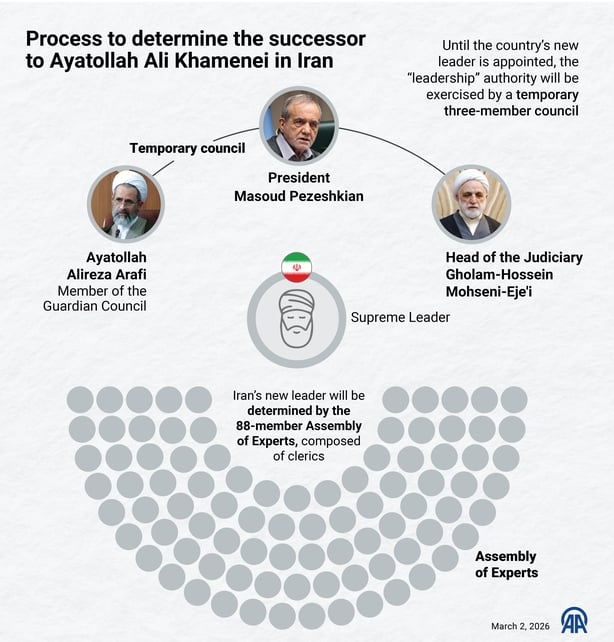
Following the death of Khamenei, Iran faces a power vacuum that could leave it in chaos, but the Trump administration has not outlined longer-term aims for the country.
Iran's Revolutionary Guards said they had hit three US and UK oil tankers in the Gulf and the Strait of Hormuz, and attacked military bases in Kuwait and Bahrain with drones and missiles. Shipping data showed hundreds of vessels including oil and gas tankers dropping anchor in nearby waters with traders expecting sharp jumps in crude oil prices today.
