


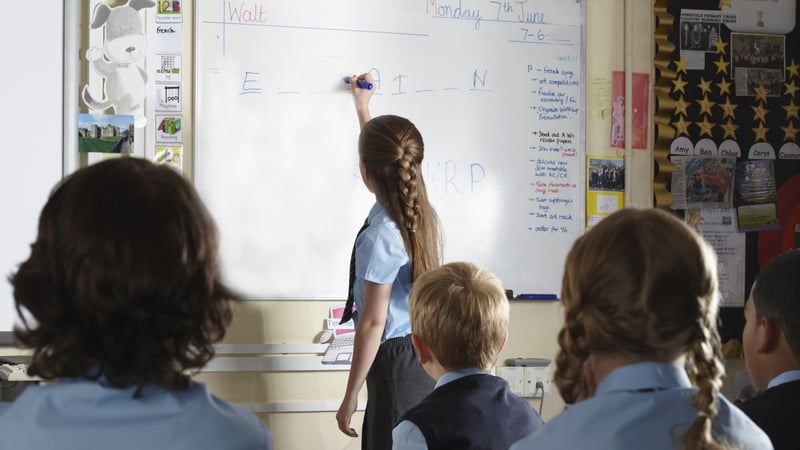

Analysis: Nobody should expect a "big bang" of change come 1st September - schools will proceed slowly and can exercise agency in deciding where to start.
By Laura O'Sullivan and Damien Burke, DCU
Ireland's current primary school curriculum was introduced in 1999: a significant year for Irish education - and the same year Gay Byrne hosted his final Late Late Show. With the long-standing 1999 curriculum now being phased out, there have been a number of in-service days for teachers to prepare them for the changes ahead. So what exactly is changing, and what will it mean for children in primary school?
The Irish primary school curriculum sets out what children need to learn for their first eight years in school, from junior infants to sixth class, and supports high-quality learning, teaching and assessment for all children in primary and special schools.
Changes to the current curriculum are informed by eight years of research, and cyclical drafting and consultation by the National Council for Curriculum and Assessment (NCCA), the statutory body that advises the Minister for Education on curriculum and assessment for early childhood, primary, and post-primary education. This consultative process involved parents, educators, and, importantly, children themselves, ensuring the new curriculum reflects the needs of today’s and tomorrow’s learners.
We need your consent to load this rte-player contentWe use rte-player to manage extra content that can set cookies on your device and collect data about your activity. Please review their details and accept them to load the content.Manage Preferences
From RTÉ Radio 1's Drivetime, a new primary school curriculum will be phased in from next year
These changes, however, have not resulted in a completely "new" curriculum. Instead, the "new" primary curriculum is termed the redeveloped curriculum, building on the successes of the 1971 and 1999 curricula, and in particular, their child-centred approach and broad subject balance. Ironically, and in true Irish fashion, the oldest of the three is still called the "New Curriculum".
Is there a need to change the curriculum?
The 1999 curriculum is considered to have been cutting-edge, providing a strong foundation for teaching and learning. However, it’s fair to say that a lot has changed in Irish society since 1999, and contemporary primary school classrooms are very different spaces.
We don’t have to look too far to see evidence of curriculum change elsewhere. Here at home, post-primary schools began rolling out a revamped senior cycle curriculum in September 2025, aiming to ease the "high-stakes" pressure of the Leaving Certificate examination. Meanwhile, for our closest neighbours in Northern Ireland, changes to their primary education curriculum are also afoot with plans to publish a new curriculum framework in 2026, followed by implementation in 2027.
We need your consent to load this rte-player contentWe use rte-player to manage extra content that can set cookies on your device and collect data about your activity. Please review their details and accept them to load the content.Manage Preferences
From RTÉ Radio 1's Morning Ireland, Minister McEntee: New primary school curriculum to focus on consent
In Ireland, slow and steady is the approach to the introduction of the redeveloped curriculum in primary schools. While curriculum changes have already been introduced in classrooms in the areas of Language and Mathematics, a phased-in approach to the other curricular areas will take place from September 2026.
Unlike the current curriculum which is structured into individual subjects, the redeveloped curriculum will instead have five broader curriculum areas of Language (including Modern Foreign Languages); STEM Education; Social and Environmental Education; Arts Education; and Wellbeing (incorporating Physical Education). Children in stages 1 and 2 (junior infants to 2nd class) will have a more integrated learning experience, while the curriculum becomes more differentiated into discrete subjects in stages 3 and 4 (3rd to 6th class).
Will it mean more time in school?
The good news for children in Ireland is that the time they will spend in school will not be increasing. The redeveloped curriculum is based on a continuation of the current 23.5 hours of direct instruction per week, plus recreation.
We need your consent to load this rte-player contentWe use rte-player to manage extra content that can set cookies on your device and collect data about your activity. Please review their details and accept them to load the content.Manage Preferences
From RTÉ Radio 1's News At One, Maire Ni Bhraonain speaks to children starting school at Scoil Santain in Tallaght.
For infants, the existing instructional week of 18.5 hours remains in force. Reassuringly, sacred cows of the Irish school system which we all fondly recall - such as the traditional assembly time and roll call - have been retained in these new allocations. Interestingly, Ireland's 182 days in the typical primary school year compares favourably or unfavourably (depending on your perspective) with 190 days in Northern Ireland.
The new syllabus prescribes revised time allocations for each of the broad curriculum areas across the four aforementioned stages of primary education. For example, under the new structures, the typical 11 year-old in 5th class in an English-medium school can expect to have close to 4 hours per week of English Literacy instruction; 3 hours of Gaeilge; 1 hour of European language teaching, and 4 hours of Mathematics.
Other allocations include an enhanced 3 hours for Wellbeing and a reduced 2 hours per week for Religious / Ethical / Multi-belief & Values Education, thus reflecting the changing social and cultural landscape of contemporary Ireland. Schools do have certain flexibilities within these time allocations to exploit unanticipated learning opportunities, and to pace teaching interventions to best match learners' needs.
We need your consent to load this rte-player contentWe use rte-player to manage extra content that can set cookies on your device and collect data about your activity. Please review their details and accept them to load the content.Manage Preferences
From RTÉ Radio 1's Morning Ireland, Primary school enrolment falls by 6,500 in past year
What’s next?
Unquestionably, the phased introduction of the redeveloped curriculum is a demanding, long-term process for schools - the 2032/2033 school year is considered the absolute end-point for full implementation.
Neither parents nor children should expect a "big bang" of change on 1st September next - schools will proceed slowly and can exercise agency in deciding where to start.
The in-service programme which supports schools on their implementation journey is therefore a crucial element of this embedding process. With the help of external facilitators, teachers explore the new curriculum documents and then collectively consider the practical steps for effective phased enactment. To facilitate teacher engagement with the redeveloped curriculum, these professional learning days do necessitate school closures.
Therefore, parents should expect more of these in-service days in the coming years as schools begin to roll out more of the redeveloped subject syllabi. While the short-term inconvenience of in-service days is undeniable, sustained professional development is essential if reform is to move beyond aspiration, and into our children’s classrooms.
Follow RTÉ Brainstorm on WhatsApp and Instagram for more stories and updates
Laura O'Sullivan is an assistant professor in the School of Policy and Practice at DCU Institute of Education. Damien Burke is an assistant professor in the School of Policy and Practice at DCU Institute of Education.
The views expressed here are those of the author and do not represent or reflect the views of RTÉ
