


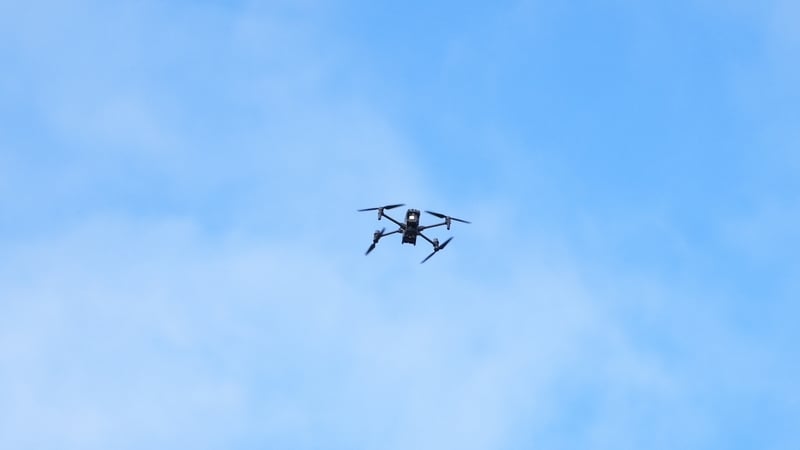

Analysis: Detecting and destroying drones is not about political will or procurement, but physics, law and institutional design
By Alan Kearney, University of Rome Tor Vergata
In recent weeks, political attention has again turned to drones and Irish airspace. As Ireland prepares to assume the EU presidency this July, the Government has stated that counter-drone capability will be in place to protect visiting leaders and major events. The focus is understandable: an unauthorised drone intrusion during the visit of Ukranian president Volodymyr Zelenskyy last year made the issue tangible.
Drones are visible, they are modern and they feel urgent. But discussing drones and actually defending against them are very different things. The real difficulty is not political will. It is physics, law and institutional design.
How to detect the threat
Technically, defence professionals refer to these as Unmanned Aerial Systems (UAS). This term is more accurate because it captures the reality that the aircraft is just one part of a complex chain involving a pilot, a control station and a data link. However, as they move from niche military tools to everyday headlines, "drone" remains the language of public debate, and we will use it here.
We need your consent to load this rte-player contentWe use rte-player to manage extra content that can set cookies on your device and collect data about your activity. Please review their details and accept them to load the content.Manage Preferences
From RTÉ Radio 1's Today with David McCullagh show, unauthorised drones spotted over Dublin during Ukranian president Volodymyr Zelenskyy's visit to the city
Detection comes first: a drone must be detected before it can be stopped. If that sounds straightforward, it isn’t. Traditional radar systems were built to track aircraft, large metal objects moving predictably through open sky. Small drones are different. They are often plastic, battery-powered, and can fly low, slow, fast, or erratically. It is precisely that agility that makes them difficult to identify and track.
In a city, radar does not see a clean sky. Signals bounce off office blocks, cranes, traffic and even flocks of birds. The result is a screen filled with echoes, a chaotic picture in which a small drone can hide easily. No single sensor is enough. Radar helps. Radio frequency sensors that detect control signals help. Cameras help. Microphones that detect the whine of rotors help. But they must work together. Without dependable detection, any counter-drone system is reactive at best.
The 'soft kill' fallacy
If a drone is detected, there are broadly two ways to stop it. The first is electronic disruption, often called 'soft kill'. Many drones rely on radio links or satellite navigation signals so interfering with those links can cause the drone to land or return home. This approach is politically attractive. It avoids explosions and falling debris. It works against many commercially available systems.
We need your consent to load this rte-player contentWe use rte-player to manage extra content that can set cookies on your device and collect data about your activity. Please review their details and accept them to load the content.Manage Preferences
From RTÉ Radio 1's Today with Claire Byrne, how drones have changed modern warfare
But this assumes the drone depends on radio signals which can be a dangerous assumption. The war in Ukraine has ruthlessly exposed this weakness. Some newer drones carry a thin fibre-optic cable behind them like fishing line. Commands from the operator travel down the cable rather than through the air. Because they do not rely on radio transmission, conventional jamming is ineffective against them. Against a hard-wired threat, the expensive electronic shield alone would not be sufficient. If soft kill fails, the only remaining option is physical interception. This is where the problem becomes far more complex.
The 'hard kill' dilemma
This leaves the option of the"hard kill" i.e. physically destroying the drone. But how do you safely shoot down a moving target over Dublin city centre, for example? Projectiles may be effective at close range, but using them over a populated city carries obvious risk. What goes up must come down somewhere.
Even specialist ammunition presents danger in dense urban environments. Fragmentation footprints, especially with larger weapons, make them difficult to justify over a city centre. Interceptor drones, including systems that deploy nets to entangle hostile devices, are being developed, but their use presents practical challenges. Other emerging measures, including directed-energy systems or even birds of prey, have been explored, but each carries practical, legal or environmental limitations.
We need your consent to load this rte-player contentWe use rte-player to manage extra content that can set cookies on your device and collect data about your activity. Please review their details and accept them to load the content.Manage Preferences
From RTÉ Radio 1's Morning Ireland, Denmark orders a ban on civil drone flights after several unmanned aerial vehicles were witnessed at military facilities
Ultimately, If a drone must be physically destroyed, the obvious question follows: what happens to the debris? Stopping a drone over open countryside is one thing, but stopping it safely over a capital city is another entirely.
'Technology alone does not deliver resilience'
Public debate often treats counter-drone capability as a procurement question, but it is not. It requires integrated sensors, legal authorities, rules of engagement, trained personnel on standby and coordination between military, police and aviation agencies. Equipment must be positioned correctly and rehearsed in realistic scenarios. Technology alone does not deliver resilience. Even if the technology were perfect, Ireland faces a deeper structural challenge.
Ireland has previously maintained elements of ground-based air defence capability. However, modern urban counter-drone defence requires sustained staffing, layered sensors, rapid decision-making structures and continuous readiness.
We need your consent to load this rte-player contentWe use rte-player to manage extra content that can set cookies on your device and collect data about your activity. Please review their details and accept them to load the content.Manage Preferences
From RTÉ Brainstorm, from toys to war, where will you encounter drones next?
Ireland’s defence institutions were not built around persistent urban air denial. They evolved primarily around peace support operations, maritime patrol and aid to the civil power. Developing a layered, city-focused, air defence capability from a relatively modest baseline, particularly at a time of well documented staffing challenges, is therefore a complex institutional task.
Drones are just one part of the story
It is tempting to focus heavily on drones because they are dramatic, but drones are only one element in a broader spectrum of pressure below the threshold of declared war. This includes cyber disruption of hospitals or financial systems, maritime interference near subsea infrastructure, disinformation campaigns, sabotage, and risks from chemical, biological, radiological, nuclear, and high-yield explosives (CBRNe). Counter-drone systems may address one slice of that spectrum, but do not resolve the wider challenge of multi-domain resilience and interagency operability. That is the larger conversation Ireland is only beginning to have.
If we stop at the headline "we are buying counter-drone tech," we risk mistaking a purchase order for protection
Ireland’s defence debate often gets bogged down in neutrality or spending percentages. These are political questions; the real questions are technical. What can we actually detect? Can we stop a drone that doesn't use radio? Do we have the legal framework to intercept a device over a city? There is also a legal dimension. Who is authorised to disable or destroy a drone over a city? Under what conditions? What liability exists if debris causes injury? These are not abstract questions. They shape what is realistically possible.
Drones are an accessible entry point into this discussion because they are tangible. But if we stop at the headline "we are buying counter-drone tech," we risk mistaking a purchase order for protection. Modern security challenges are technical, layered and adaptive. Recognising that complexity is the first step towards addressing it responsibly.
Follow RTÉ Brainstorm on WhatsApp and Instagram for more stories and updates
Alan Kearney lectures in chemical, biological, radiological, nuclear and high-yield explosives studies at the University of Rome Tor Vergata. He is a former Irish Army officer.
The views expressed here are those of the author and do not represent or reflect the views of RTÉ
