

Analysis: Horses held immense importance historically in ancient China and are a powerful cultural symbol of loyalty, endurance and dedication
Chinese New Year falls on February 17th 2026 marking the arrival of the Year of the Horse. As one of the twelve traditional zodiac animals in Chinese culture, the Horse corresponds to the Earthly Branch 'Wu' and appears in a twelve-year cyclical pattern within the traditional calendar system. The zodiac system is deeply rooted in Chinese cosmology and reflects a sophisticated understanding of astronomy, philosophy, and the rhythms of nature.
According to the traditional Chinese lunar calendar, years were historically designated through a combination of the Ten Heavenly Stems and the Twelve Earthly Branches. This sixty-year cyclical system (known as the sexagenary cycle) integrates cosmic elements with temporal measurement. The pairing of the twelve Earthly Branches with twelve symbolic animals created the well-known zodiac cycle that continues to influence cultural life today.
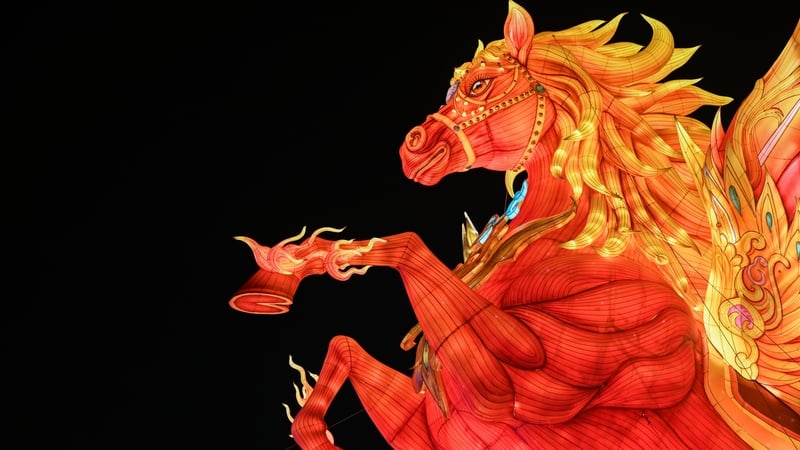
The year 2026 corresponds to 'Bingwu,' a Fire Horse year. 'Bing' represents Yang Fire in the Heavenly Stems, while 'Wu' corresponds to the Horse in the Earthly Branches. Because Fire is traditionally associated with the colour red, 2026 is also referred to as the Year of the Red Horse - a year symbolising vitality, passion, dynamism, and radiant energy.
We need your consent to load this rte-player contentWe use rte-player to manage extra content that can set cookies on your device and collect data about your activity. Please review their details and accept them to load the content.Manage Preferences
From RTÉ Radio 1's Morning Ireland in 2021, everything you need to know about the Chinese New Year
The origins of the Chinese zodiac can be traced to ancient astronomical observation and early forms of animal worship. The twelve zodiac animals - Rat, Ox, Tiger, Rabbit, Dragon, Snake, Horse, Sheep (Goat), Monkey, Rooster, Dog, and Pig - are paired respectively with the twelve Earthly Branches: Zi, Chou, Yin, Mao, Chen, Si, Wu, Wei, Shen, You, Xu, and Hai. The Horse occupies the seventh position in this sequence and corresponds specifically to the Earthly Branch "Wu," hence the designation 'Wu Horse.'
The connection between zodiac animals and Earthly Branches reflects the ancient Chinese understanding of natural order. Early scholars observed patterns in the movement of celestial bodies and the cycles of time, linking them symbolically to characteristics found in animals. A traditional day was divided into twelve two-hour periods, each associated with one Earthly Branch. The branch 'Wu' represents the noon period (11 a.m. to 1 p.m.), the moment when Yang energy reaches its zenith. At noon, sunlight is strongest, vitality is most intense, and nature is at full expression.
The horse, known for its spiritedness, speed, and strength, was therefore chosen as the emblem of this dynamic temporal phase. Its energetic and forward-driving nature mirrors the powerful Yang force associated with midday. Within the framework of the Five Elements theory — Metal, Wood, Water, Fire, and Earth — the branch 'Wu' belongs to Fire.
By symbolic extension, the horse embodies the qualities of Fire: passion, expressiveness, and unrestrained vitality.
The temperament traditionally attributed to the Horse - bold, enthusiastic, energetic - aligns naturally with the attributes of Yang Fire. In this sense, the Year of the Red Horse represents an amplification of creative force, momentum, and emotional intensity.
The philosophical foundation underlying these symbolic systems is the concept of Yin and Yang, regarded in ancient Chinese thought as the fundamental law of the universe. Originally referring to the shaded (Yin) and sunlit (Yang) sides of a mountain, Yin and Yang came to represent complementary dualities such as darkness and brightness, stillness and movement, femininity and masculinity. Rather than opposing forces in conflict, Yin and Yang are understood as interdependent and constantly transforming into one another. This dynamic balance permeates Chinese philosophy, medicine, aesthetics, and daily life.
The Taijitu, the well-known circular symbol commonly referred to as the Yin-Yang symbol - visually represents this philosophy. The black (Yin) and white (Yang) halves flow into one another, each containing a dot of its opposite, symbolizing the principle that within every extreme lies the seed of transformation. The Horse, aligned with peak Yang energy at noon, embodies strength and outward expansion; yet even at this height of energy, balance remains essential.
From ABC News (Australia), The Year of the Horse explained and how people across Asia celebrate the Lunar New Year
Beyond cosmological explanations, rich folk legends also recount the origin of the zodiac animals. One popular narrative tells of the celestial horse, originally the Jade Emperor's imperial steed. According to legend, due to arrogance and misbehaviour, the horse’s wings were cut off and it was banished beneath Mount Kunlun.
Rescued by humans, the horse later repaid their kindness by assisting in agriculture and warfare, earning distinction and ultimately being chosen as one of the twelve zodiac animals. Other folklore suggests that the order of the zodiac animals was determined by a great celestial race. The horse, delayed by helping others along the way, finished seventh - reinforcing cultural values of loyalty and benevolence.
Historically, horses held immense importance in ancient China. They were indispensable in transportation, agriculture, communication, and military campaigns. As a result, the horse became a powerful cultural symbol of loyalty, endurance, and dedication. The well-known proverb "An old horse knows the way" reflects wisdom gained through experience. Similarly, expressions such as "dragon-horse spirit" evoke boundless vitality, while idioms like "sky-horse soaring across the heavens" metaphorically describe bold imagination and unrestrained aspiration.
From TED, the Chinese zodiac explained by technologist and entrepreneur ShaoLan Hseuh
In traditional belief, individuals born in the Year of the Horse are often described as cheerful, energetic, independent, and proactive. They are admired for enthusiasm and courage, though cultural wisdom advises them to guard against impatience or impulsiveness - qualities associated with strong Fire energy.
Festive customs during Horse years frequently include the display of Spring Festival couplets bearing auspicious phrases such as "Success Upon Arrival" (马到成功), and the wearing of horse-themed ornaments to invite good fortune. These practices reflect the enduring symbolic association between the horse and swift achievement.
The influence of the zodiac extends beyond China. Countries shaped by Confucian and East Asian cultural traditions, including South Korea and Vietnam, also observe the lunar New Year cycle.
Although Vietnam replaces the Rabbit with the Cat in its zodiac sequence, the Year of the Horse remains consistent across these cultures, underscoring shared cosmological heritage.
Interestingly, the symbolic meaning of the horse also resonates in Western culture. In Greek mythology, Pegasus represents divine inspiration and freedom, while throughout European history the horse has symbolised power, nobility, and movement. As such, the Year of the Horse often becomes a point of dialogue in cross-cultural exchange, illustrating how shared archetypes transcend geographic boundaries.
Ultimately, the Year of the Red Horse embodies aspirations for speed, freedom, success, and forward momentum. Its symbolism bridges ancient cosmology and contemporary life, offering inspiration for resilience and purposeful striving. Let’s gallop into the Year of the Red Horse with joy and prosperity!
Follow RTÉ Brainstorm on WhatsApp and Instagram for more stories and updates
The views expressed here are those of the author and do not represent or reflect the views of RTÉ