


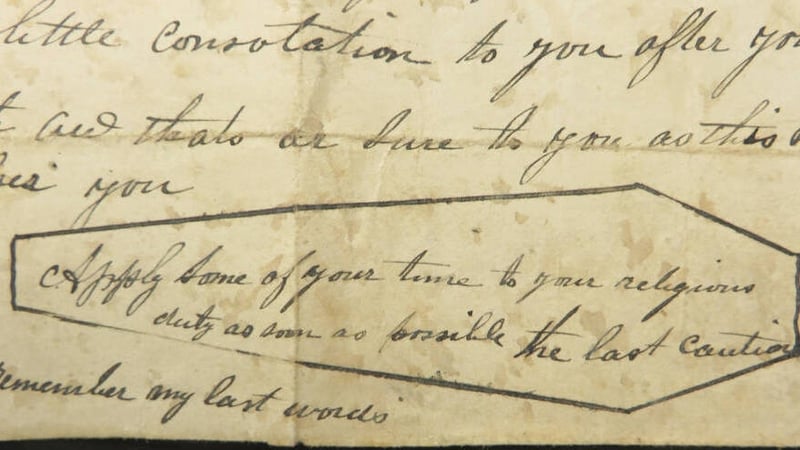
Analysis: Thousands of threatening letters from the likes of Captain Rock, Killman and Slasher were sent directly to victims or posted in public spaces
By Chris Fitzgerald, Mary Immaculate College
Before the Great Famine in Ireland, the threatening letter was a very common form of hostile communication. In the early 19th century, tens of thousands of these letters were either mailed directly to the targets of threats or posted in public spaces for all to see. The relatively small percentage of letters that were preserved offer a rich insight into society and language of this time in Ireland. They concern disputes related to, for example, tythe collections, land disputes and agrarian unrest.
As a linguist, I am mostly concerned with the language used in these letters, especially how creative the authors were in their use of language. These letters provide a window into how Irish people used language in a time that predates recorded speech. I looked at over 500 of these threatening letters, mostly from a collection by Stephen Randolph Gibbons and found that they display a level of creativity with language that is both fascinating and entertaining.
From RTÉ Brainstorm, how Ireland was one of the most violent places on earth in the 1840s
One of the first things that becomes apparent when reading these is the variety of sign-offs used. The most common of these was a variation on 'Captain Rock' to associate with the Rockite movement of violent agrarian rebels. Other blood-curdling pseudonyms include Killman, Slasher and Skinner.
The authors often used pseudonyms which associated themselves with a clandestine group such as the Rockites. While these groups mostly did not exist in any formal way, it was assumed that the association would strengthen the threat by making the recipient think they were not alone, striking more fear in the target of the threat.
As the letters were often posted publicly and intended for an audience beyond their targets, there is an element of performance in them, including the use of humour. Humour can provide a public shaming factor, making the target a laughing stock as well as the recipient of a threat. See an example of this from a letter dated March 1822. An image of the letter is followed by a typed transcript of the letter.
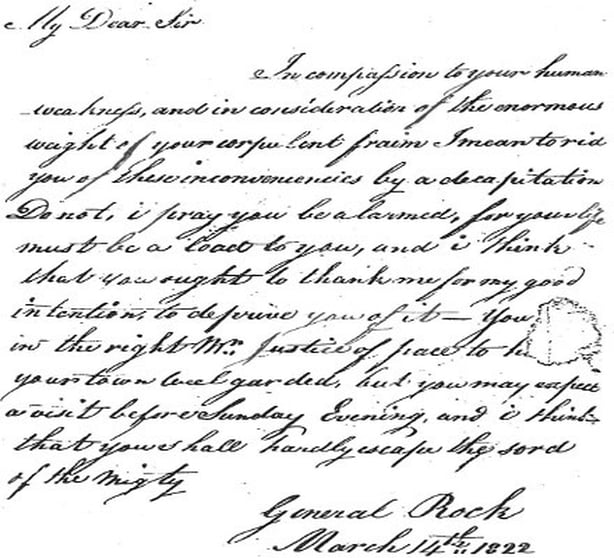
My Dear Sir
In compassion to your human weakness, and in consideration of the enormous weight of your corpulent fraim I mean to rid you of these inconveniences by a decapitation. Do not, i pray you be alarmed, for your life must be a load to you, and i think that you ought to thank me for my good intention, to deprive you of it— you are in the right Mr Justice of pace to have your town well garded, but you may expect a visit before Sunday evening, and I think that you shall hardly escape the sord of the migty
General Rock
March 14th 1822
All writers take inspiration from the texts they are exposed to and the authors of the threatening letters were no different. One of the key texts that was familiar to the authors of these letters was the Bible and this is reflected in some of the language used in the letters. From vague allusions to direct quotations, there are frequent examples of the influence of Biblical passages on the authors' sense of morality. Invoking the Bible adds more weight to the threats as they layer them in Godly morality. One letter contains this quote from Isaiah 13:9: Behold the day of the Lord cometh cruel both with wrath and fierce anger to lay the land desolate.
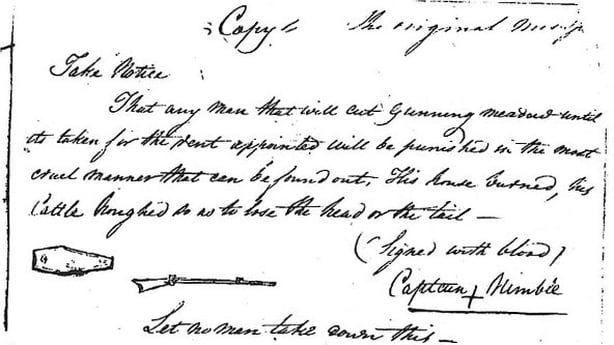
Certain patterns arise when looking at the language of the letters as a collection, including words that occur unusually frequently. A motif that reoccurs throughout the letters is that of the coffin. They were used as symbols of warning at this time, with reports of sods of turf shaped into coffins thrown through windows and carvings of coffin shapes on doors. The authors of the letters use the coffin as a threatening device in phrases such as 'have your coffin at the ready’. A drawing of a coffin alongside a rifle can be seen in the image below from a letter ‘signed in blood’.
The extraordinary rhetorical ability of the authors of these letters is remarkable given that they were penned at a time of such upheaval and impoverishment in Ireland. They show that, despite the circumstances, creativity and culture were expressed in ways beyond the standard artistic modes. These letters were used not only as a means of delivering threats to targets but to present skill and creativity with language.
It is likely that some 'authors' relied on local scribes or scholars to construct their threats for them, but this does not take from the creativity on display in these letters, despite the desperation and deprivation that is also evident in many of them. The final example of playfulness with language I will include here is a letter written to James Morrissey in the form of a poem written in Adare, Co Limerick dated May 3rd 1823:
James Morrissey, I advise you to yield
Your late undertaking, I mean the Priest's field;
If you do not, I'll cause you to rue,
By burning and houghing what belongs to you.
My conscience doth tell me it would be no sin,
As you have circumvented the worthy O' Flynn!!!
The Hanlins too, my laws disobeyed,
To take O'Neil's farm they were not afraid.
Neither Peelers nor soldiers shall ever daunt me,
I'll shew them and you my authority;
Believe me, I intend to give you a shock,
As ye have infringed on the laws of
JOHN ROCK
Follow RTÉ Brainstorm on WhatsApp and Instagram for more stories and updates
Dr Chris Fitzgerald is a postdoctoral Linguistics researcher at Mary Immaculate College.
The views expressed here are those of the author and do not represent or reflect the views of RTÉ
