

Analysis: The Celtic calendar says spring starts on February 1st, but climatologists are adamant it's March so who's right?
It's an evergreen debate over kitchen tables and the airwaves across the country. At school, we are taught the first day of Spring is St. Brigid's Day on the 1 February, but Met Éireann proudly declares 1 March as the day. So who's right?
Ultimately both are right - and both are wrong too! The transition from winter to spring each year is a gradual process, but putting down a line between seasons helps us socially, culturally and scientifically. Each culture defines its own Spring with its own rules. This is no surprise. After all, each part of the world has its own climate, driving different temperature cycles, rainfall patterns, ecology and agriculture.
We need your consent to load this rte-player contentWe use rte-player to manage extra content that can set cookies on your device and collect data about your activity. Please review their details and accept them to load the content.Manage Preferences
From RTÉ Radio 1's Today with Claire Byrne, Dr. Shane Bergin from UCD's School of Education on the signs that spring has sprung
Spring and the natural world
Before fixed calendars, changes in the annual ecological cycle (known as phenology) defined the seasons. The changing seasons might be marked by bud-burst, flowering, ripening of harvests or the arrival and departure of migratory animals.
In some places, non-biological climate markers define seasons. These include the freeze and thaw of snow in the mountains, the arrival and departure of sea-ice in Arctic regions, or the arrival of the monsoons in the tropics.
In Ireland, farmers and keen horticulturalists might use phenological indicators of Spring. The white blossoms on the Blackthorn is one example: a 'Blackthorn winter’ is when spring is arriving but a cold snap or late frost is on the way. The origin of the word Imbolc may derive from either the reproductive timing or lactation of ewes.
We need your consent to load this rte-player contentWe use rte-player to manage extra content that can set cookies on your device and collect data about your activity. Please review their details and accept them to load the content.Manage Preferences
From RTÉ's Wildtrack, a spring soundscape through the archives, reflecting on the season, St Brigid and more
Climate definitions of Spring
The timing of phenological markers varies year to year depending on weather and increasingly climate change. As urban populations expanded, and cultures and nations expanded over larger areas, there became a need to fix the transition between seasons to the same days each year. Written calendars were adopted and this provided consistency and certainty to businesses and festivals.
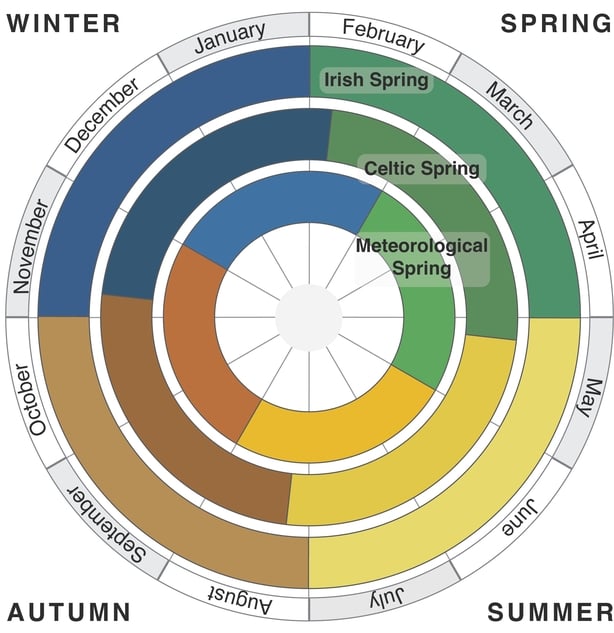
Europe and North America use a temperature based calendar. The warmest three months (June, July, August) are summer, and the coldest three months are winter (December, January, February). Meteorological Spring is therefore March, April and May, with Spring beginning on 1 March.
A standardised definition is very useful for investigating and comparing the weather and climate from year to year and place to place. Meteorological spring has become the agreed upon definition in climate science, and it is the one that Met Éireann will use.
We need your consent to load this rte-player contentWe use rte-player to manage extra content that can set cookies on your device and collect data about your activity. Please review their details and accept them to load the content.Manage Preferences
From RTÉ Radio 1's Mooney Goes Wild, when exactly does spring begin?
Spring and the Celtic Calendar
The Celtic calendar is a light-based calendar. The seasons align with the maximum and minimum sunlight available. Winter is the darkest three months, while summer is the brightest three months.
The divisions between the seasons are Imbolc, Bealtaine, Lúnasa and Samhain. Imbolc marks the end of the darkest quarter of the year, and the return of light. Celtic Spring is between Imbolc and Bealtaine. Imbolc is halfway between the December solstice (21 December-ish) and the March Equinox (21 March-ish) and so falls sometime between the 3 and 6 of February.
As the Celtic calendar became aligned with key events in the church calendar. Imbolc, Bealtaine, Lúnasa and Samhain were fixed to Christian holidays and the first of the month. Irish Spring therefore begins on Candlemas/St. Brigid's Day on 1 February, running through to 30 April, a slight offset to the Celtic calendar.
Light or warmth?
Rising temperatures in Spring come from extra light. Yet there is a month offset between the light based Celtic and Irish calendars, and the warmth based meteorological calendar. Temperature-wise, February is very similar to January in Ireland, but February is more similar to March in terms of light and rainfall.
Why is this? The answer is it takes time for the earth and sea to warm up when receiving the extra light in Spring and Summer. Imagine turning on your oven full blast for three hours and then turning it off without opening the door. The three warmest hours inside the oven would be the second two hours of the oven being on, and the first hour after you turn the oven off. The same idea explains the month delay between the Celtic light based calendar, and the meteorological temperature based calendar.
Whether we choose a light or temperature-based definition of Spring therefore depends on which we think is the most important in our own lives. Should winter be the darkest three months of the year, or the coldest?
It's no wonder the Celtic calendar focused on light as it is the part of the climate that varies the most and influences our lives the most.
Ireland's unique geography
Located between 51 and 56 degrees North, Ireland is towards the top of the planet. This gives us an extreme annual light cycle: 17 hours of daylight in the summer, but a measly seven-and-a-half hours of daylight in the winter.
Yet Ireland’s climate is very mild compared to other places with the same latitude such as Edmonton in Canada. This is thanks to the North Atlantic Drift, bringing warm water up from the Tropics. The warm water prevents frequent deep freezes and heavy snows.
The final piece of the puzzle is Ireland’s place as a small island. Compared to the UK and western Europe which use the meteorological calendar, Ireland has a much smaller temperature range. For example, temperatures of 10 to 12℃ can occur in any month of the year. This is because land warms and cools faster than water, due to a difference in what scientists call specific heat capacity. The Atlantic ocean has a small seasonal temperature cycle and Ireland lacks the landmass to overcome this small temperature range.
Ireland’s geography therefore gives us an extreme annual light cycle, coupled with mild and equitable temperatures. It's no wonder the Celtic calendar focused on light. It is the part of the climate that varies the most, that influences our lives the most. It makes perfect sense for the Celtic and Irish calendars to have Spring beginning in February.
Follow RTÉ Brainstorm on WhatsApp and Instagram for more stories and updates
The views expressed here are those of the author and do not represent or reflect the views of RTÉ